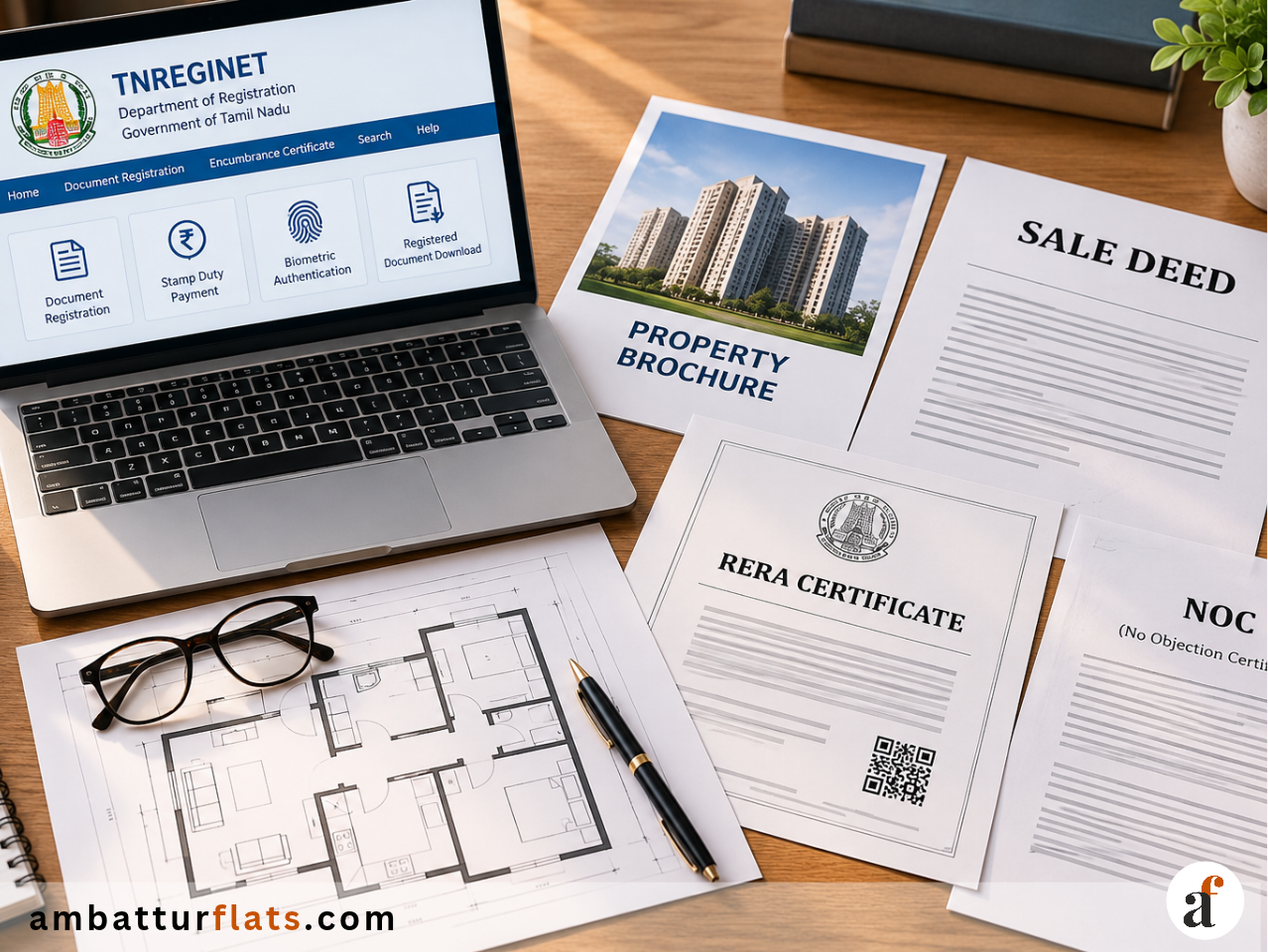

Online flat registration in Tamil Nadu allows eligible property sale documents to be submitted and registered digitally, without the parties visiting a Sub-Registrar Office. The process includes document submission, identity authentication, official scrutiny and access to the digitally signed deed.
Buying a flat feels exciting until the registration stage begins. In Tamil Nadu, much of the first-sale process now happens online. It is quicker than before, but buyers still need to pause, read carefully and verify what they are approving.
A flat number may seem like a minor detail until it appears incorrectly in a sale deed. The same applies to survey numbers, land shares and other property details that buyers may overlook during registration.
Since 17 August 2026, Tamil Nadu has made Presenceless Registration mandatory for specified first-sale transactions involving flats sold by builders and plots sold by promoters.
For buyers planning to purchase a new flat in 2027, understanding this process is important. While digital registration reduces the need for physical visits, it does not eliminate the need to verify property documents.
Does completing registration online mean the property details and ownership are automatically verified?
Not necessarily. Online registration makes the process more convenient, but buyers must still examine the seller's authority, property description and supporting documents before approving the sale deed.
For buyers planning to purchase a new flat in 2027, Tamil Nadu's Presenceless Registration system, introduced for specified first-sale transactions in August 2026, is already in effect.
Preparation now involves understanding whether the transaction qualifies for the online procedure, reviewing the digital draft and knowing how to verify the registered document afterward.
The registering officer can register the document, return it for correction or reject it in accordance with the applicable procedure. The registered deed is then made available electronically with a digital signature. The change reduces the need for physical visits. It does not remove the buyer's responsibility to verify the property being transferred.
No. A digitally registered sale deed is not, by itself, conclusive proof that the seller has clear and undisputed ownership. Registration records the transaction, but the seller's title, legal authority and competing claims may still require independent examination. The online process does not replace property due diligence.
The distinction is supported by the Supreme Court's April 2025 decision in K. Gopi v. The Sub-Registrar. The Supreme Court judgment clarified that determining the seller's ownership rights is not the registering officer's function under the Registration Act.
For someone purchasing a new apartment in Ambattur or elsewhere in Chennai, this has a practical consequence. The sale deed must be examined alongside the documents establishing who owns the property, who has the authority to sell it and what exactly is being transferred.
The most useful approach is to compare the draft deed with the supporting property documents rather than reading it on its own.
These five checks address different aspects of the transaction.
The person selling an apartment may be the landowner, the builder or someone legally authorised to act on their behalf. In some Chennai developments, the landowner and developer operate through a Joint Development Agreement (JDA).
A JDA sets out the rights and responsibilities of the parties involved in developing the property. The buyer needs to establish whether the proposed seller is legally entitled to transfer the particular apartment.
For example, the developer may have authority to sell specific units, while others belong to the landowner under the development arrangement. Our article on Joint Development Agreements in Chennai explains why the agreement's terms and allocation of rights matter.
Before approving registration, have an independent property lawyer examine the ownership documents and the seller's authority. A registered sale deed cannot transfer ownership rights that the seller does not possess.
A buyer may recognise the apartment by its block, floor and flat number. The legal description also depends on the underlying land details. The draft deed should be compared with the relevant agreement, approved plans and title documents. Check the survey number, subdivision, property boundaries, apartment identification and area particulars.
Pay particular attention to the Undivided Share of Land (UDS). UDS represents the apartment owner's proportionate interest in the land on which the building stands.
The land share recorded in the draft must agree with the legally verified allocation and supporting transaction documents. The article on UDS in Chennai apartments explains how this ownership share works.
Parking rights also deserve clarification. An allotted parking space should be supported by the relevant agreement or allocation documents, rather than assumed to be independently owned. The objective is consistency across the documents, not merely completing the fields displayed on the registration screen.
An Encumbrance Certificate (EC) helps buyers examine registered transactions and encumbrances affecting a property during the period searched. It can reveal registered mortgages, previous transfers and other relevant dealings.
For newly constructed apartments, this matters because the underlying land or project may have been used as security for a development loan. Where a mortgage exists, the buyer's lawyer should examine the applicable release documents, lender permissions and arrangements for transferring the unit.
Request an appropriately recent EC and confirm that the search covers the relevant property and ownership period. However, a recent EC is not a guarantee that every claim has been identified.
Some transactions may not yet be reflected in available records. Unregistered interests and certain disputes may also require additional investigation. The EC should therefore be examined with the title documents, not treated as a standalone certificate of clear ownership.
The apartment recorded in the sale deed must correspond to the property the buyer has agreed to purchase. Verify the relevant planning permission, sanctioned building details and any applicable revisions.
Where the project requires TNRERA registration, compare its registration information with the official project disclosures. Check that the flat's identification and relevant specifications are consistent with the approved documents and purchase agreement.
The purpose is not to insist that every approval number appear in a particular section of the deed. It is to establish that the apartment being transferred corresponds to the legally approved development.
A discrepancy in the project description or approved details should be clarified before registration. The broader checks involved in purchasing a property are covered in our homebuyer verification checklist.
The figures recorded in the sale deed should agree with the purchase agreement and relevant payment records. Before final submission, compare the agreed consideration, amounts already paid and the charges calculated for registration.
Tamil Nadu's property-registration charges depend on the applicable transaction category and valuation rules. First-sale apartments can involve different valuation provisions from ordinary property transfers.
For this reason, applying a single stamp-duty percentage to every apartment purchase can produce an incorrect estimate. Ask for an itemised calculation showing the applicable valuation, statutory charges and payment details.
Our guide to stamp duty and registration charges in Tamil Nadu provides further context on these expenses. The final amount should be verified against the rules applicable to the particular transaction. An accurate payment receipt matters, but so does understanding how the amount was calculated.
The August 2026 mandatory Presenceless Registration rollout applies specifically to first-sale flats by builders and first-sale plots by promoters. It does not automatically place every resale apartment transaction under the same mandatory procedure.
A new flat purchased directly from a builder and an existing apartment purchased from an individual owner can involve different documentation and registration requirements.
Other categories of property and banking documents have also been brought into the digital-registration system through subsequent changes.
Buyers should therefore confirm which procedure applies to their transaction rather than relying only on the age of the property.
Our comparison of new-launch and resale homes explains other differences buyers should examine before choosing between the two.
The verification process does not end when the sale deed is registered. Under Tamil Nadu's Presenceless Registration system, the registered document is digitally signed by the Sub-Registrar and made available through the user's registration account.
The document includes QR-code information, such as the registration number, document type and registration date. Buyers should download the authentic digitally signed document and compare it with the approved draft.
The following comparison helps identify what should remain consistent.
| Verification point | Before registration | After registration |
| Buyer and seller | Verify identity and legal authority | Confirm names and party details in the registered deed |
| Property identity | Compare flat number, survey details and boundaries | Confirm the registered property description |
| UDS | Verify the legally agreed land share | Match the land share in the registered deed |
| Transaction value | Check consideration and applicable charges | Compare registered figures with payment records |
| Document authenticity | Review the draft submitted for registration | Check registration details and digital signature |
The government's Presenceless Registration announcement confirms the introduction of the online procedure.
The announced system allows registered documents to be downloaded through the user account for 60 days. Certified copies can be requested through the prescribed procedure afterward.
Retain the original digitally signed file, not merely a screenshot or printed copy. A digital signature helps establish the document's authenticity and detect alterations. It does not independently confirm that the underlying property title is free from legal disputes.
The online process allows the Sub-Registrar to return documents requiring correction. Under the procedure announced in August 2026, returned documents may be corrected and resubmitted within the prescribed 30-day period.
But the availability of a correction process should not replace careful document preparation. A spelling mistake and a dispute over the land share are not equivalent problems.
Some discrepancies may be straightforward to correct. Others may require revised documents, clarification from the developer or independent legal advice. If an important property detail is inconsistent, resolve it before giving final approval rather than assuming it can be corrected easily afterward.
Online registration has changed how eligible apartment transactions are submitted and recorded in Tamil Nadu. The process can remove the need for a visit to the Sub-Registrar Office and make registered documents available electronically.
But three questions remain separate.
Does the seller have the legal right to transfer the property? Does the sale deed correctly describe the apartment? And does the final registered document match what the buyer approved?
These questions cannot be answered merely by the successful completion of an online registration process. For a new flat buyer, the most useful precaution is to review the supporting documents carefully, obtain independent legal verification and settle discrepancies before authorising the transaction.
Digital registration changes how the deed is recorded. It does not change the importance of knowing exactly what is being purchased.
No. The mandatory Presenceless Registration rollout introduced on 17 August 2026 specifically covers the first sale of flats by builders and plots by promoters. Other document categories may follow different procedures.
No. Registration records the transaction but does not conclusively establish that the seller possesses clear and undisputed title. Independent verification of the property's ownership and relevant legal documents remains important.
No. An appropriately recent EC helps identify registered transactions and encumbrances during the period searched. It should be examined with the property's title records, mortgage documents and other relevant legal information.
The system allows documents to be returned for correction. Returned documents may be corrected and resubmitted within the prescribed period. The appropriate solution depends on the nature of the discrepancy.
Compare the registered document with the approved draft, check its registration particulars and verify the registering officer's digital signature. Preserve the original electronically signed document for future reference.