
Tamil Nadu law manages to put a landowner on both sides of the same project. Sign a joint development agreement and RERA can treat you as a promoter, which means a flat buyer who never met you can name you in a claim. Fall out with your builder over a delayed handover and the same law gives you very little, because TNRERA has held that a person in a joint venture arrangement with a developer is not a homebuyer.
That gap is the whole reason the drafting matters. When the regulator will not step in on your side, the paper you signed is your only protection. What follows is a clause by clause read of a standard Chennai JDA, what each clause does once construction starts and the wording that
closes the hole.
Two things changed in 2026 that make this a good moment to reread your draft. Planning permission for high rise projects moved fully inside CMDA and first sale registration in Tamil Nadu is going online. Both shift the balance in ways most templates have not caught up with yet.
Under Section 2(zk) of the Real Estate (Regulation and Development) Act, a promoter includes a person who develops land into a project and also a person acting under a power of attorney from the owner. Where one party constructs and another sells, the Act treats both as promoters and makes them jointly liable. Depending on how the JDA, development rights, sale rights and power of attorney are structured, a landowner may fall within the promoter framework under RERA and may be named on the project registration.
The remedy side does not mirror the liability side. TNRERA's adjudicating officer has taken the view that someone in a joint venture arrangement with a developer is not a homebuyer, so the fast complaint route that flat buyers use is not open to the landowner. A dispute about delayed allocation or sharing terms goes to civil court or to arbitration, which is a different timeline and a different cost.
So the landowner carries a promoter's exposure with an ordinary contracting party's remedies. Every clause below exists because of that imbalance.
Most drafts handle this with a line about charges being borne as per mutual understanding. That sentence looks harmless and settles nothing. In Tamil Nadu a conveyance attracts 7 percent stamp duty and a 4 percent registration fee, so 11 percent of the value moves the moment a deed is executed. A power of attorney given for consideration carries its own 4 percent stamp duty.
In a joint development, the undivided share going to the developer's buyers has to be conveyed. Whoever pays the duty on those conveyances is paying a percentage of the whole project, not of their own flat. Leave it vague and the question surfaces at the sub registrar's counter, which is the worst possible place to start a negotiation.
Fix this: State explicitly in the agreement that the developer shall bear the stamp duty, registration fees and applicable transfer charges for the conveyance of UDS to purchasers of the developer's share and for transfers relating to the developer's own allotment. The landowner shall bear only the charges applicable to the landowner's retained units.
The standard sentence reads that the developer shall endeavour to complete construction within 36 months from the date of approval, with a grace period. Two words are doing damage there. "Endeavour" converts a deadline into an intention. "From the date of approval" hands the developer control of when the clock starts, because the developer is the one filing the application.
The second problem is the forum. A landowner should not assume that the remedies available to an ordinary flat buyer will automatically apply to a JDA dispute. Civil litigation in Chennai over a construction contract is measured in years and the flats you were promised are sitting inside a building the other
side controls.
Fix both. Start the clock from the date of the registered agreement or from a fixed calendar date, not from an event the developer triggers. Replace "endeavour" with "shall". Set a liquidated damages figure per square foot of your allocated area per month of delay that runs automatically once the grace period ends. Then name a sole arbitrator seated in Chennai with a fixed timeline, so the dispute has somewhere to go that is faster than a civil suit.
Force majeure clauses in builder drafts usually open with floods and earthquakes, which nobody argues with. Read to the end of the list and you often find shortage of construction materials, non availability of labour, or delay in obtaining
utility connections.
Those are not acts of god. Material procurement and labour management are the developer's core job and the price of doing that job badly should not land on the landowner as an extended delay with the penalty clock switched off.
Cut the list back to events that are outside anyone’s control and are uninsurable, such as natural disaster, war or a state wide shutdown. Write in an express exclusion for material price increases, labour disputes and routine departmental delay. If the developer resists, that resistance tells you how the
schedule was built.
The most expensive sequencing error in a redevelopment is demolishing the existing structure on the strength of a signed agreement rather than a sanctioned plan. Once the building is down the landowner has no house, no rent and no bargaining position and the developer's incentive to move quickly drops sharply.
For a landowner, demolition is not just a construction decision. It is the moment their negotiating leverage can change. While the old house is still standing, the developer is negotiating for the landowner's consent. Once it is gone, the landowner may be negotiating from a property that is already generating no rent and has no immediate use.
Chennai has enough live examples of projects stalling over land classification, water body buffers and setback objections that this is not a theoretical risk. It is worth reading the CMDA rules that apply to high rise flats before you agree to any demolition date.
There is also a 2026 development that strengthens your hand here. The state government removed the requirement for a separate government order and CMDA can now issue planning permission for high rise projects on its own on the recommendation of the scrutiny panel. One approval stage is gone. A developer asking you to demolish first because sanction takes forever has one fewer reason to ask.
A 60:40 split sounds precise until you ask 60 percent of what. If the sharing ratio is written against super built up area, the number that decides your outcome is the loading factor and the loading factor is set by the developer. It is not fixed by statute. Two projects with identical sharing ratios can hand the landowner meaningfully different amounts of usable floor.
A landowner can negotiate a better percentage and still get a worse deal. If the 60:40 split is applied to a heavily loaded super built-up area, the percentage may look attractive on paper while the actual usable area received is much less than expected. The number that matters is not just the ratio, but what the ratio is applied to.
This is the single easiest clause to fix and the one most often left alone, because the percentage in the term sheet feels like the whole negotiation. It is not. The definition underneath the percentage is. Anyone signing a JDA should be clear on how carpet area differs from super built up area before the ratio is agreed.
Write the sharing ratio against carpet area as defined under RERA. Attach a unit schedule to the agreement naming the exact flats, floors and carpet areas that make up your share, along with the car parks attached to them. A ratio without a unit schedule is a promise about arithmetic. A unit schedule is a promise
about property.
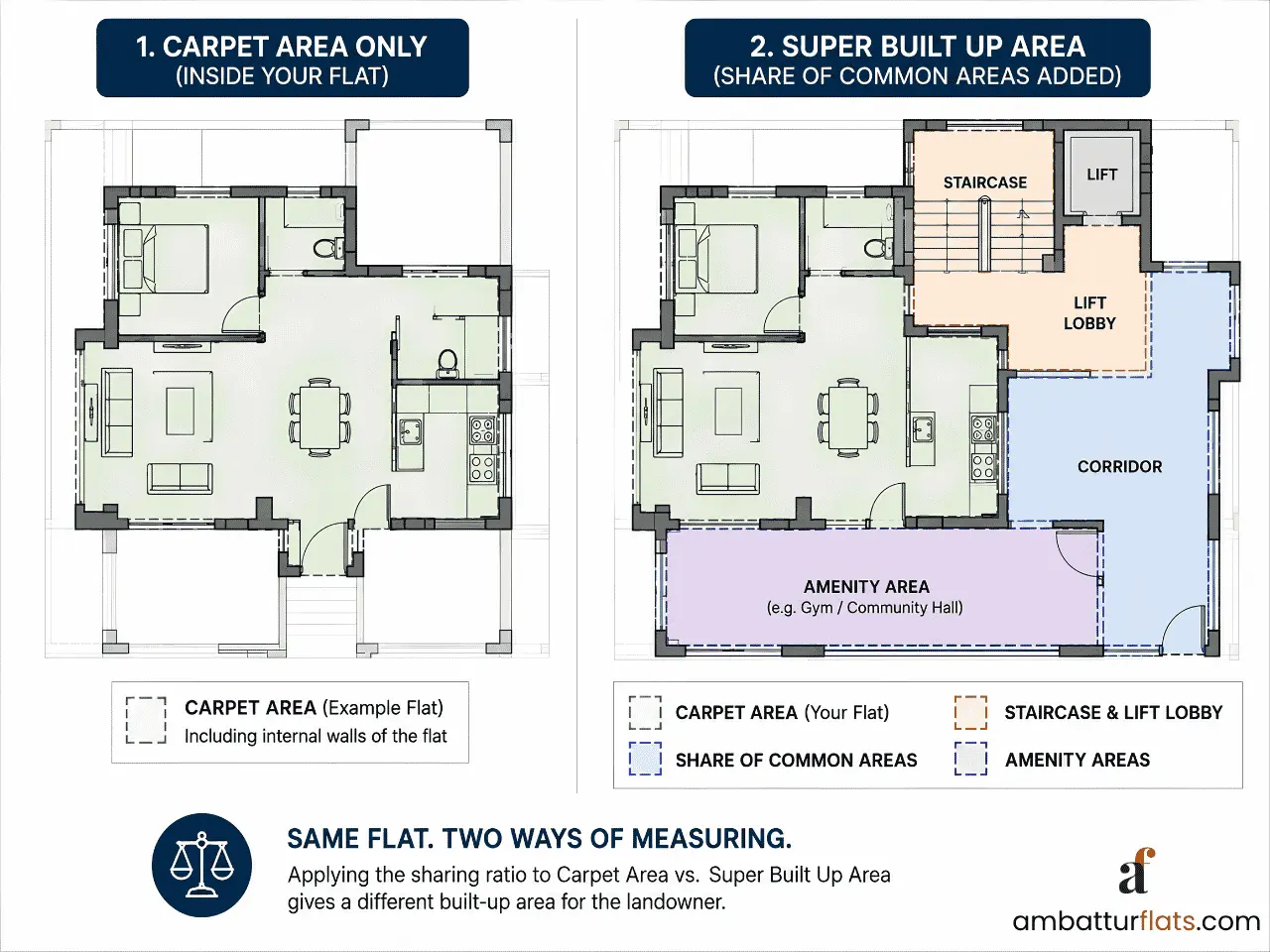
Carpet Area vs Super Built-Up Area in a JDA
A developer needs authority to sign plan applications and deal with departments. That is reasonable. What is not reasonable is a general power of attorney wide enough to let the holder create a charge over the land, combined with a demand that the original title deeds sit in the developer's office
for the duration.
If a developer with those two things raises project finance against the property and then defaults, recovery proceedings attach to land that is still legally yours. The landowner discovers this at the point where it is hardest to fix. It is worth understanding how a power of attorney works in a property transaction before signing one in a development context.
Give a specific power of attorney limited to named acts, being plan submission, approvals, departmental correspondence and execution of sale deeds for the developer's share only. Write in an express bar on mortgaging, pledging or creating any third party charge over the land. Keep originals in a joint safe deposit locker or with a nominated advocate and give certified copies for approvals.
This is the clause that costs the most and gets read the least. For an individual or HUF landowner under a registered joint development agreement, the special JDA capital gains timing rule applies in the year the completion certificate is issued, subject to the applicable conditions. The consideration is the stamp duty value of your allocated share on the date of that certificate, plus any cash you received. Cash consideration paid by the developer is subject to TDS at 10 percent under the applicable JDA TDS provisions of the Income-tax Act, 2025.
Two traps follow from that. The first is that the deferral depends on the agreement being registered. The second is that if you sell any part of your share before the completion certificate is issued, the deferral is lost for that transfer and the tax falls in the year of sale. Landowners who pre sell a flat to fund something else routinely trigger this without being told.
There is a timing risk too. Because the valuation is linked to the stamp duty value on the completion-certificate date, a later certificate date can affect the value used for the
tax calculation.
A specification annexure that lists named brands followed by "or equivalent" is not a specification. It is a budget with a brand name attached for the term sheet stage. Equivalence is judged by the person doing the substituting and substitution happens in the second half of construction when margins are under pressure.
The landowner feels this twice. Once in the finish quality of the flats they keep and again in the rent and resale value those flats command against newer stock in the same street.
Attach an itemised schedule that names product, brand, grade and model for flooring, sanitary ware, fittings, wiring, lifts and elevation materials. Add a line that no substitution takes place without the landowner's written approval and that approved substitutes must be of equal or higher grade. Checking a builder's track record on delivered projects tells you how seriously they
take that annexure.
Running costs start the day the building is handed over, not the day the last flat sells. Lifts, generators, pumps, security, common area power and property tax all begin billing immediately. If the developer's unsold inventory contributes nothing, the shortfall is absorbed by the owners who have moved in and the landowner is usually the largest single owner in that group.
This is also the clause that shapes the first two years of the association's finances, which is when most associations are least equipped to fight a developer
over money.
Write it plainly. The developer is liable for maintenance charges, property tax, water charges and electricity charges on every unsold unit in its share from the date the completion certificate is issued, at the same rate applicable to other owners, payable monthly. Add that handover of the corpus fund and common area documents is not complete until those
dues are cleared.
From 17 August, Tamil Nadu makes online registration compulsory for the first sale of plots and flats. Builders register through a corporate portal on the STAR 3.0 system, buyers and sellers complete Aadhaar based biometric verification remotely and the document comes back digitally. Resale between individuals is not covered and continues at the
sub registrar's office.
For a landowner in a joint development, this changes something practical that no standard template addresses. Until now, every conveyance of undivided share of land to a developer's buyer physically passed through a sub registrar's office and a landowner who wanted to keep count could keep count. From this month, those first sales are registered through a portal the developer operates and the landowner has no natural visibility into how much UDS has been conveyed or against
which flats.
That matters because UDS is finite. Over conveyance against the developer’s share is not a hypothetical problem in Chennai and it surfaces years later when the association tries to reconcile total UDS against total flats.
So add a reporting clause. The developer shall furnish, within seven days of each registration, the document number and a digital copy of every first sale deed executed in respect of the project, together with a running statement of undivided share conveyed against the developer's entitlement. It costs the developer nothing. Refusal is informative.
| Clause | What the draft usually says | What to insist on |
| Duty and fees | Borne as per mutual understanding | Developer bears all duty on UDS transfer and its own allotments |
| Completion timeline | Shall endeavour, from date of approval | Shall complete, from date of registered agreement, with per sq ft monthly damages |
| Dispute forum | Silent or courts at Chennai | Sole arbitrator, Chennai, fixed timeline |
| Force majeure | Includes material and labour shortages | Natural disaster and state wide shutdown only |
| Demolition | On execution of the agreement | Only after final, non appealable sanction |
| Share basis | Percentage of super built up area | Carpet area, with a named unit and parking schedule |
| Power of attorney | General, with originals to developer | Specific, no charge on land, originals in joint custody |
| Completion certificate | Not addressed | Certified copy in 30 days, tax indemnity for developer delay |
| Specifications | Named brands "or equivalent" | Itemised annexure, no substitution without written consent |
| Unsold units | Silent | Developer pays maintenance and tax from CC date |
|
First sale registration |
Not addressed | Document number and copy within 7 days, running UDS statement |
Almost every clause above is decided at the term sheet stage, not at the draft agreement stage. Once a developer has spent money on soil tests, drawings and an application, the cost of walking away is yours as much as theirs and the tone of the conversation changes. Landowners who negotiate hard on paper before any of that spending happens tend to get most of what they ask for. Landowners who wait for the draft tend to get the ratio and nothing else.
Two practical steps. Engage an advocate who acts for landowners rather than the one the developer recommends and pay for that opinion yourself so it belongs to you. Then check that the agreement is registered, because registration is a condition for the special JDA capital gains timing rule and weakens everything else if overlooked. Our note on what registration of a joint development agreement means in Tamil Nadu covers that ground.
If you are at the stage of comparing offers rather than clauses, it helps to see how different joint venture builders in Ambattur structure their terms, because the sharing ratio is only one of eleven numbers that decide what you end up holding.
A joint development agreement that transfers possession or an interest in the land should be registered. Registration also matters for tax, because the special JDA capital gains timing rule applies only to qualifying registered agreements.
Generally no. TNRERA has taken the view that a person in a joint venture arrangement with a developer is not a homebuyer, so the complaint route available to flat buyers is not open to the landowner. Disputes go to arbitration or to civil court, which makes the arbitration
clause important.
It is negotiable, which is exactly why it must be written down. Tamil Nadu charges 7 percent stamp duty and a 4 percent registration fee on a conveyance, so silence in the agreement can leave the landowner funding duty on transfers that
benefit the developer.
For an individual or HUF landowner under a registered agreement, capital gains is taxed in the financial year the completion certificate is issued. The consideration is the stamp duty value of the allocated share on that date plus any cash received. Selling the share earlier moves the tax to the year of sale.
No. A specific power of attorney limited to plan approvals, departmental correspondence and sale of the developer's own share does the same work without allowing the holder to mortgage or create a charge over the land. Original title deeds should stay in joint custody.
Carpet area as defined under RERA, supported by a schedule naming the specific flats, floors and car parks forming the landowner's share. A percentage written against super built up area depends on a loading factor the developer controls.