Stamp Duty and Registration Fees in Tamil Nadu

[DISCLAIMER]: Statutory charges, stamp duty percentages, and property registration rules are governed by the Tamil Nadu Registration Department and are subject to official government notifications. Always verify current rates with a legal consultant or jurisdictional Sub-Registrar Office before completing transactions.
When purchasing real estate across Chennai and Tamil Nadu, statutory charges—specifically stamp duty and property registration fees—represent the single largest out-of-pocket transaction cost beyond the base property purchase price. A critical realization for buyers navigating property acquisitions is that commercial banks and housing finance companies do not include these registration expenses in standard home loan disbursements. Because these statutory fees must be paid directly to the government at the time of document execution, they constitute mandatory upfront cash commitments that buyers must manage independently. Understanding these statutory rates and how they impact your liquid financial readiness is an essential milestone in your home purchase journey. To evaluate how these statutory costs align with your overall borrowing limit, refer to our complete guide to home financing in Chennai.
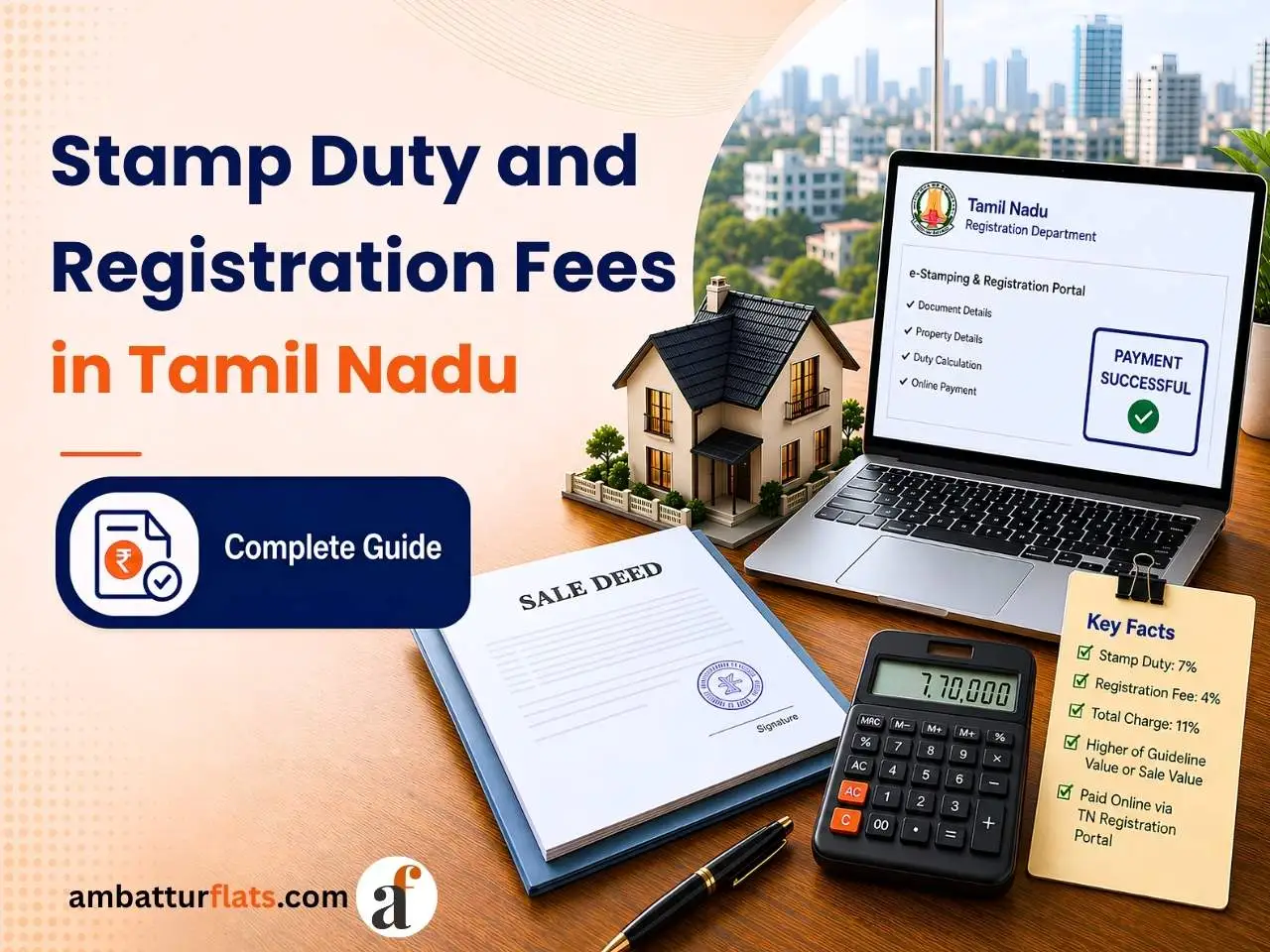
Stamp Duty Rate: Fixed at 7% of the property's market or guideline value for conveyance/sale deeds.
Registration Fee Rate: Fixed at 4% of the property's market or guideline value.
Combined Statutory Cost: Homebuyers pay a total of 11% in combined statutory charges for sale deed execution.
Assessment Base: Charges are calculated on the higher amount between the actual market/sale agreement value and the government's official Guideline Value.
Digital Payment Mandatory: Payments are processed via electronic e-stamping and the official Inspector General of Registration (IGREN) online portal.
Out-of-Pocket Cash Requirement: Mandatory Reserve Bank of India (RBI) guidelines prohibit banks from bundling stamp duty and registration fees into the sanctioned home loan amount.
In Tamil Nadu, the statutory legal structure governing real estate transfers mandates two distinct legal charges under the Indian Stamp Act and the Registration Act:
Stamp Duty (7%): A state-level tax levied on the instrument transferring title of immovable property.
Registration Fee (4%): A regulatory fee charged by the Sub-Registrar Office (SRO) for legally recording the transaction in public registers to guarantee title authenticity.
For standard conveyance sale deeds (including land, independent houses, resale apartments, and completed properties), the buyer pays a combined total of 11%.
When purchasing under-construction apartments, the legal structure often splits the transaction into two distinct registered documents:
Undivided Share (UDS) of Land Sale Deed: Standard 7% stamp duty + 4% registration fee applies to the UDS land value.
Construction Agreement: Subject to a lower statutory rate, typically 1% stamp duty and 1% registration fee (or 2% combined) calculated on the agreed construction value specified in the contract.
Proper documentation structuring is crucial during property evaluation. While verifying property paperwork, buyers should ensure they have compiled all the necessary required documents for property loan processing to avoid delays with their lending institutions.
A common point of confusion for property buyers in Chennai is determining the exact rupee figure on which the 11% charge applies. The Tamil Nadu Registration Department establishes a minimum benchmark price per square foot for every street and survey number across the state, known as the "Guideline Value".
Under Section 47-A of the Indian Stamp Act (Tamil Nadu Amendment), stamp duty and registration charges are calculated on whichever is higher: the actual agreed consideration (Sale Value) or the state's official Guideline Value.
Worked Example Calculation:
Suppose a buyer purchases a residential apartment where:
Agreed Sale Value: ₹70,00,000
State Guideline Value: ₹65,00,000
Because the agreed sale value (₹70 Lakhs) is higher than the guideline value (₹65 Lakhs), statutory charges are calculated on ₹70,00,000:
Stamp Duty (7% of ₹70,00,000): ₹4,90,000
Registration Fee (4% of ₹70,00,000): ₹2,80,000
Total Payable Upfront: ₹7,70,000
If the government guideline value were higher (e.g., Guideline Value of ₹75 Lakhs vs Sale Value of ₹70 Lakhs), the 11% tax would be calculated on ₹75 Lakhs, bringing the upfront charge to ₹8,25,000. Assessing the official guideline rate of a specific neighborhood is vital, as understanding how property location affects bank approval and valuation provides complete clarity on both bank funding limits and statutory tax liabilities.
A major regulatory constraint that catches many homebuyers off-guard is that banks cannot fund stamp duty and registration costs. Reserve Bank of India (RBI) prudential guidelines explicitly mandate that primary housing loans must be restricted to the actual property cost (Loan-to-Value or LTV ratio rules) and cannot bundle ancillary administrative or statutory charges for medium-to-high ticket purchases.
For instance, if you buy a property priced at ₹80 Lakhs, a bank offering an 80% LTV ratio will sanction up to ₹64 Lakhs toward the property purchase. The 20% down payment (₹16 Lakhs) must come from your savings. In addition, the 11% statutory registration charge (₹8.8 Lakhs) must also be funded entirely from your personal liquid reserves. Consequently, your total out-of-pocket cash commitment is ₹24.8 Lakhs (₹16 Lakhs down payment + ₹8.8 Lakhs registration fee), rather than just the ₹16 Lakhs down payment.
This regulatory separation between housing loan disbursements and statutory charges frequently creates intense financial stress for first-time buyers. Many buyers budget exclusively for the lender's required 10% to 20% down payment, only to discover weeks before document execution at the Sub-Registrar Office that they must furnish an additional 11% in pure liquid cash.
This sudden realization often results in emergency borrowing from family, high-interest personal loans, or liquidating long-term investments under sub-optimal conditions. To avoid this last-minute cash flow crunch, buyers must calculate their total acquisition cost—combining down payment, stamp duty, registration fees, legal verification charges, and bank processing costs—at the very beginning of their home search. Before committing to a purchase agreement, buyers should start by calculating maximum home loan eligibility based on salary to establish a realistic overall budget.
The Tamil Nadu government has streamlined the property registration process through the STAR 2.0 (Simplified Web-Based Registration Application) online portal operated by the Registration Department.
Document Generation: Draft the sale deed or construction agreement through certified document writers or legal counsel.
STAR 2.0 Entry: Input property details, survey numbers, boundary details, and party details on the portal.
Automated Calculation: The system automatically evaluates the prevailing Guideline Value against the declared sale consideration and generates the exact stamp duty and registration fee liability.
Payment Gateway & E-Stamping: Pay statutory fees online using net banking, UPI, or challan generation at designated bank branches. E-stamp certificates are issued electronically upon payment verification.
Appointment Scheduling: Book a time slot at the jurisdictional Sub-Registrar Office for physical biometric verification, photo capture, and final document signing.
Homebuyers can claim tax deductions on payments made toward stamp duty and registration fees under Section 80C of the Income Tax Act.
Maximum Limit: Deductions fall within the overall Section 80C cap of ₹1,50,000 per financial year.
Eligibility Window: The deduction can only be claimed in the specific financial year in which the charges were actually paid and property registration was completed.
Joint Owners: If a property is co-owned and registered jointly, both co-owners can claim Section 80C tax benefits in proportion to their financial share in the property, subject to their individual ₹1.5 Lakh ceiling.