

Most Chennai flat buyers spend a lot of time picking the right floor, the right view, and the right builder. Then they sign a sale deed that runs to twenty pages, skim through it, and move on. Buried somewhere in those pages is a figure, expressed in square feet, that has more influence on your property's long-term value than the flat itself. That figure is your UDS (Undivided Share of Land). This post explains what it means, how it is calculated, and what to verify before you commit to any purchase.
When a builder constructs an apartment block on a plot of land, that land cannot be physically carved up and handed to each flat buyer in separate pieces. The law does not permit it. Instead, every flat owner receives a proportionate share of the total land — a share that exists on paper and in the registered sale deed, but has no physical boundary markers on the ground.
That shared ownership is called the Undivided Share of Land, or UDS.
The word "undivided" is precise. Your share of the land is not a specific corner or section of the plot. Every flat owner in the building holds ownership of the entire land collectively, each in proportion to the size of their flat. No individual can fence off their portion, build on it separately, or exclude others from it. The land remains a single undivided asset, held jointly by all owners.
This arrangement is standard across all apartment projects in Chennai and across India. It is legally recognised, and the ownership is registered at the Sub-Registrar office in your name.
When you purchase a flat, you are buying two separate things. The first is the constructed unit which includes the walls, floors, fittings, and the built-up area you will live in. The second is your UDS, which is your proportionate share of the land on which the entire building stands.
Both are recorded in your sale deed. Both are yours legally. The critical difference is what happens to them over time. The building ages, requires maintenance, and will eventually need redevelopment. The land, by contrast, does not depreciate. In a city like Chennai, where land supply is finite and demand from a growing population keeps pushing prices up, the land is the asset that holds and grows your investment's value. Your UDS is your legal claim to that asset.
UDS is calculated using a straightforward formula:
UDS = (Your Flat's Super Built-Up Area / Total Super Built-Up Area of All Flats in the Building) x Total Land Area
The approved building plan will show the total super built-up area. Your builder's agreement will show the UDS registered in your name along with the total land area.
Suppose you are buying a flat in a building constructed on a plot of 6,000 sq. ft. The building has 20 flats, each with a super built-up area of 1,200 sq. ft.
Applying the formula: UDS = (1,200 / 24,000) x 6,000 = 300 sq. ft.
Your UDS is 300 sq. ft. out of the 6,000 sq. ft. plot.
Now consider a different project: the same size flat in a high-rise with 80 units, built on the same 6,000 sq. ft. plot.
Same flat size. Same land area. But your UDS has dropped from 300 sq. ft. to 75 sq. ft. — simply because more units were packed onto the same plot. This is why the number of floors and units in a project matters so much to your long-term investment.
Your UDS should appear in two places. First, in the builder-buyer agreement (also called the construction agreement), which is signed before the flat is handed over. Second, and more importantly, in the registered sale deed. The sale deed is the document that is officially recorded at the Sub-Registrar office and serves as your legal proof of ownership. Always verify that UDS is mentioned in exact square feet in both documents and not just as a percentage. For guidance on how property registration works in Chennai and what documents you should receive at each stage, read our post on how property registration works in Chennai.
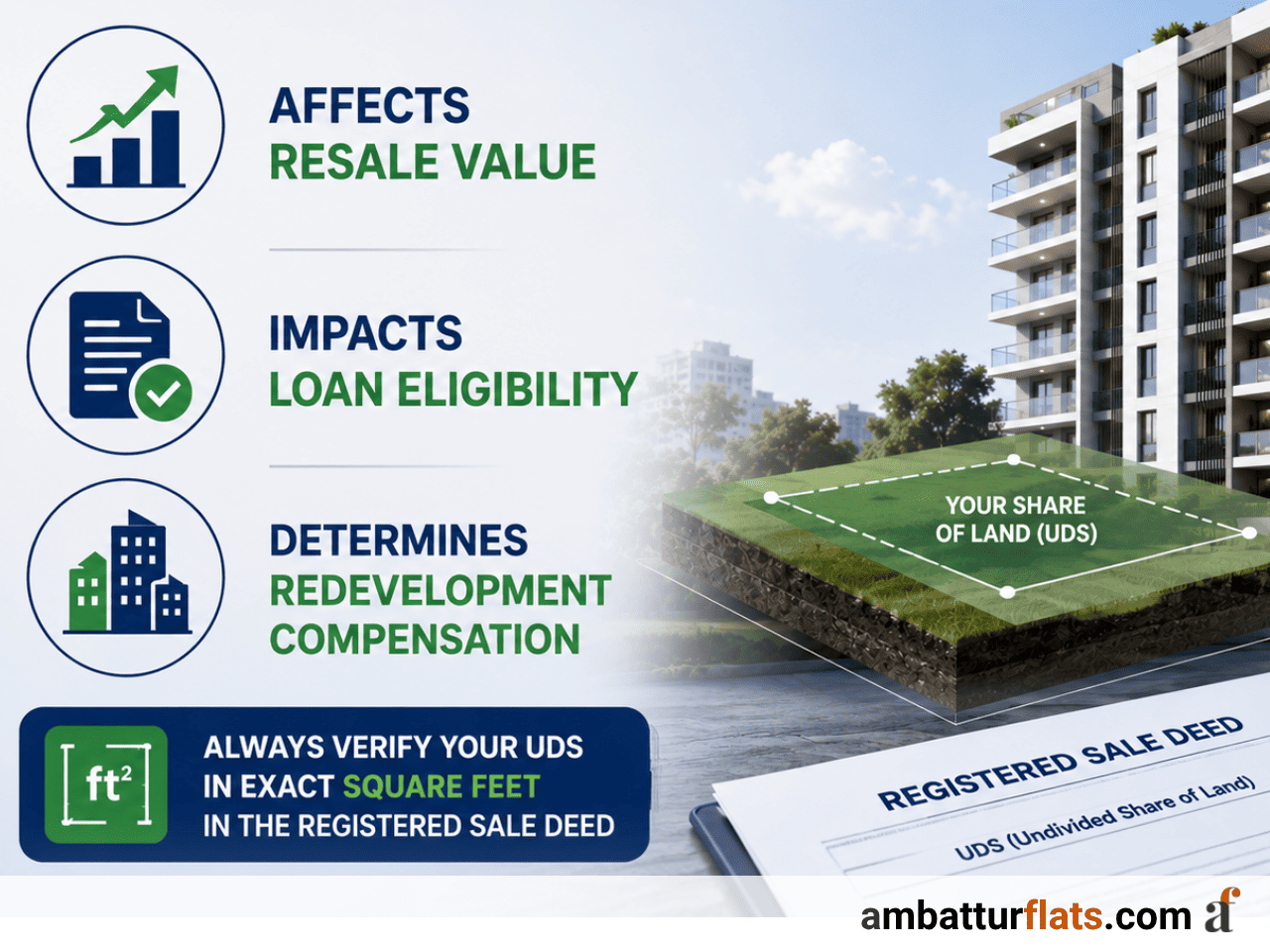
A flat's value has two components: the structure and the land. Structures depreciate. Paint fades, pipes age, common areas wear out, and a building that is 30 years old is worth considerably less structurally than it was when new. Land does the opposite. In Chennai's growing localities, the land prices have climbed consistently over the past two decades, regardless of short-term market cycles.
When you hold a meaningful UDS, you hold a stake in a genuinely appreciating asset. A small UDS means the bulk of your investment is tied to the depreciating structure rather than the appreciating land.
When a buyer evaluates a resale flat in Chennai, they look at the UDS alongside the built-up area. A flat with a higher UDS is a more attractive purchase because it carries a larger land ownership stake. Buyers who understand this will factor UDS into their offer price. A flat with a low or poorly documented UDS will either sell at a discount or take longer to move.
Banks in Chennai examine the UDS before approving a home loan. A clearly registered UDS in your sale deed signals that the property has a clean title and proper documentation. If a bank's legal team finds that UDS is missing from the sale deed, vaguely stated, or inconsistent with the approved building plan, it can result in loan rejection or demand for additional documentation. This is especially relevant for resale properties, where UDS irregularities from the original purchase can surface years later and cause complications.
Chennai has thousands of apartment buildings that are 25 to 40 years old. As these buildings age past their structural lifespan, redevelopment becomes necessary. A builder approaches the owners, proposes to demolish the existing structure, and construct a new building in its place — offering owners either a new flat or financial compensation in return.
Your UDS determines everything about what you receive in that situation.
In a redevelopment negotiation, owners with a higher UDS have stronger legal standing and better bargaining power. If the builder offers compensation proportionate to land ownership, the owner with 300 sq. ft. UDS receives four times more than the owner with 75 sq. ft. UDS, even if both owners had identically sized flats.
This is not a distant or theoretical concern. Redevelopment is already happening across Chennai's older localities, and disputes between flat owners and developers over entitlement are frequently linked to unclear or inadequate UDS records. Owners who did not verify their UDS at the time of purchase find themselves with limited recourse.
Accepting a percentage instead of a square footage figure. A builder might say "you receive 5% UDS." That number means nothing unless you know the total land area. Always convert to square feet and verify it against the approved plan.
Not checking whether the total UDS adds up. The sum of all registered UDS across every flat in a building should equal the total land area of the plot. If it falls short, the builder has retained the difference. That retained UDS belongs to someone — and it may cause disputes later, particularly during redevelopment or government acquisition. Ask for the full UDS allocation list, or have a property lawyer verify it.
Skipping legal review on resale flats. Original UDS irregularities from the first sale often go undetected for years. When a resale buyer discovers missing or incorrect UDS, rectifying it involves legal work, potential disputes with the building association, and in some cases trips to the Sub-Registrar. Engage a property lawyer for any resale purchase. Our homebuyer checklist for buying property covers the other key documents to verify as well.
Assuming parking is included automatically. A designated car parking space adds to your UDS. If the builder has included a parking spot in your sale, confirm that the corresponding land area for the parking is added to your UDS figure in the sale deed — not just mentioned as an amenity.
UDS is not paperwork. It is the part of your property that will still be worth something when the building around it has aged past its useful life. In Chennai's property market, where land is scarce and demand is consistent, the size and clarity of your UDS is one of the most reliable indicators of long-term investment value.
Before you sign a sale deed for any flat in Chennai, verify your UDS in square feet, confirm it appears in the registered document, check the project on the TNRERA portal, and have a property lawyer review the full UDS allocation for the building.
At Ambattur Flats, every property we list comes with transparent documentation. If you have questions about a specific project or want guidance on what to verify before you buy, get in touch with our team. We are happy to walk you through it.