
Stand outside two towers in Pallikaranai, and you would not be able to tell which one got its approval under the old system and which one got it under the new one. Same height, same scaffolding, same site office with a security guard checking IDs. But the file that cleared that project moved through a different process this year than it would have
a year ago.
On June 15, 2026, the Tamil Nadu government handed the Chennai Metropolitan Development Authority direct power to approve or reject high-rise building plans. No more sending files to the state government for a final signature. Combined with a separate push to raise floor space index limits along Metro and MRTS corridors, this is reshaping how fast high-rises get built across the city and where they cluster. If you are flat-hunting in 2026, here is what actually changes for you, and what does not.
Until this year, a high-rise project in the Chennai Metropolitan Area followed a longer route. CMDA would scrutinise the plan, a panel would review it, and the file would then travel to the state government for final clearance. Only after that could construction proceed.
Under the new order, CMDA itself issues or refuses planning permission once its panel completes scrutiny. The government sign-off step is gone. For developers, this trims weeks, sometimes months, off the approval timeline. For you as a buyer, it means projects can move from land acquisition to launch faster than they did two years ago.
Faster approval is not the same as fewer checks. The scrutiny panel that reviews each application still includes representatives from the Directorate of Fire and Rescue Services, the Chennai Metropolitan Water Supply and Sewerage Board, Greater Chennai Corporation, Tangedco, the Water Resources Department, the Public Works Department, Chennai Traffic Police, and an independent architect.
Every high-rise application still goes through field inspection and multi-tier scrutiny before CMDA signs off. What moved is the final approving authority, not the list of people checking your future building for fire safety, water supply, and structural soundness.
Floor space index decides how much built-up area a plot can legally carry. A higher FSI means more floors on the same land. CMDA has been working through a proposal to raise FSI in transit-oriented development zones along Metro Rail and MRTS corridors to as high as 6.5, a sharp jump from the earlier ceiling of 4.87 for such areas. Outside these designated zones, the standard high-rise FSI limit
stays at 3.25.
This is not a blanket increase across the city. It targets plots near transit lines, the logic being that people living closer to a Metro or MRTS station should not need a car for daily commuting. If you are evaluating a flat near a transit corridor, this is exactly why you may be seeing more high-rise launches in that stretch compared to a similar locality without rail access.
Chennai's third master plan, running from 2021 to 2046 under the World Bank-assisted Tamil Nadu Housing and Urban Habitat Development Project, leans deliberately toward vertical development over horizontal sprawl. The reasoning is direct: building outward has eaten into water bodies and farmland on the city's edges for two decades. Building upward, in areas where infrastructure already exists, is the corrective.
Several West Chennai localities are already seeing this play out. If you want a sense of how this is reshaping pricing and project density across the western suburbs, our coverage of West Chennai's real estate shift walks through what's changed over the past year.
More high-rise approvals near Metro and MRTS lines means more inventory in those pockets over the next two to three years. That is good news if you want choice. It is less straightforward on pricing. Land near a confirmed transit corridor tends to hold or gain value precisely because of the access it offers, so a higher FSI does not automatically translate to cheaper flats. Builders factor the premium FSI charges they pay into the unit price.
If your priority is affordability over proximity to a station, it is worth comparing a flat five minutes from a Metro stop against one fifteen minutes away by auto. The price gap can be wide enough to fund a better floor or a larger carpet area.
Established neighbourhoods built up decades ago, places like Anna Nagar or T Nagar, were largely developed under lower FSI norms. You will not see them suddenly filling with 20-storey towers under this change. The FSI bump is concentrated in transit-oriented zones, many of which sit in newer or redeveloping corridors rather than the city's traditional cores.
If you are choosing between an established locality and a newer high-rise cluster, floor selection matters more than usual in a taller building. Check our guide to picking the right floor in a Chennai apartment for a breakdown of the tradeoffs between lower floors,
mid-rise levels, and the top of a tower.
Ask for the CMDA planning permission number and cross-check it on CMDA's online portal. A genuine high-rise approval, old process or new, will show up there with the project name, plot details, and approval status. Builders who hesitate to share this number, or whose project does not match the portal record, are a red flag regardless of how the approval was processed.
Clearance for a high-rise in the Chennai Metropolitan Area involves sign-off from multiple departments, including Tamil Nadu Fire and Rescue Services, the Airports Authority of India for taller buildings, Chennai Metro Rail Limited where the project sits near a metro alignment, and the Water Resources Department where it is near a water body. None of these checks disappeared with the approval change. They run in parallel, then feed into the same CMDA decision.
A Fire No Objection Certificate remains mandatory before a high-rise can get its Occupancy Certificate. This NOC confirms the building has working fire exits, alarm systems, and sprinkler coverage that meet National Building Code standards. Do not take a builder's word for this. Ask to see the actual Fire NOC and Occupancy Certificate before you sign anything, particularly if the project markets itself as recently approved.
A flat without an Occupancy Certificate is not legally fit for habitation, no matter how finished the interiors look during your site visit.
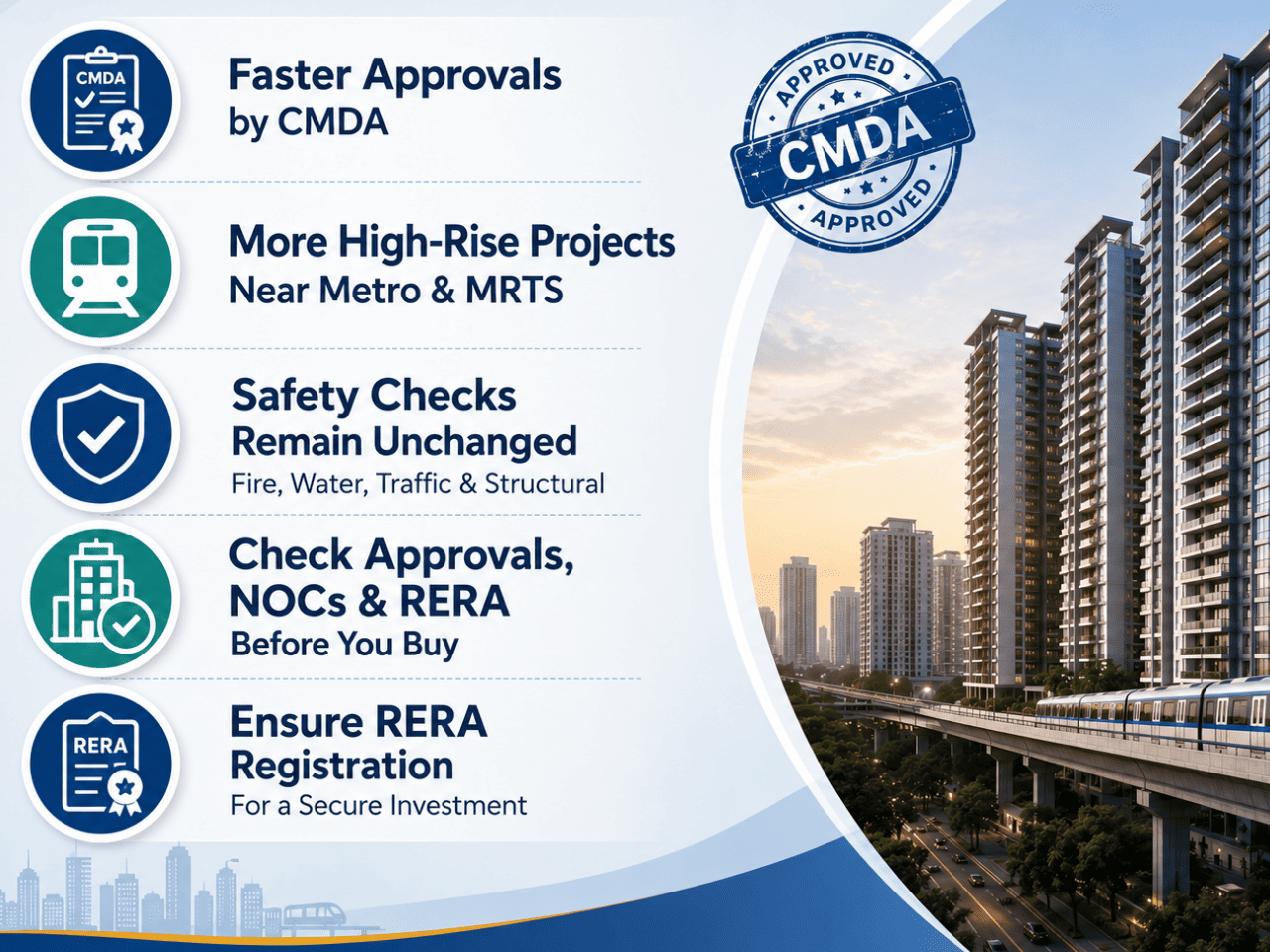
Before you commit, confirm four things independently rather than trusting the brochure: the CMDA planning permission number,
Tamil Nadu RERA registration, the Fire NOC status, and the builder's history of delivering past projects on time.
A full breakdown of what to check, document by document, is covered in our homebuyer checklist for buying property in Chennai.
Ask the builder directly whether the project is built on standard FSI or premium FSI, and whether it falls inside a transit-oriented development zone. A project built on premium FSI near a Metro corridor has paid extra charges to the government for that additional floor space, and that cost is built into your purchase price. It is a fair question, and a credible builder will answer it without hesitation.
It also helps to verify the builder's track record independently before you rely on anything stated in a
sales brochure.
Resale value in transit-oriented zones is likely to hold up well over the next decade, simply because connectivity is the single factor buyers consistently pay a premium for. A flat in a high-rise within walking distance of a Metro station is competing for buyers on a different basis than a flat in a low-rise complex fifteen minutes away by road.
The bigger resale risk is not the high-rise format itself. It is buying into a project where the builder cut corners on approvals to launch faster. A flat with a clean CMDA approval, a valid Fire NOC, and a proper Occupancy Certificate will always resell more easily than one with paperwork gaps, regardless of how the original planning permission was processed.
CMDA's new approval power makes the process faster, not looser. Every high-rise application still clears fire, water, traffic, and structural checks before approval. FSI increases along Metro and MRTS corridors are pushing high-rise supply toward transit-connected localities rather than the whole city evenly. And as a buyer, your due diligence on CMDA approval numbers, Fire NOCs, and RERA registration matters just as much under the new system as it did under the old one, if not more, given how quickly projects can now move from approval to launch.
If property tax compliance is on your checklist once you do buy, you can check and pay your Chennai property tax online through the Greater Chennai Corporation portal. Browse our latest listings to see which high-rise projects near you carry clean approvals from
day one.