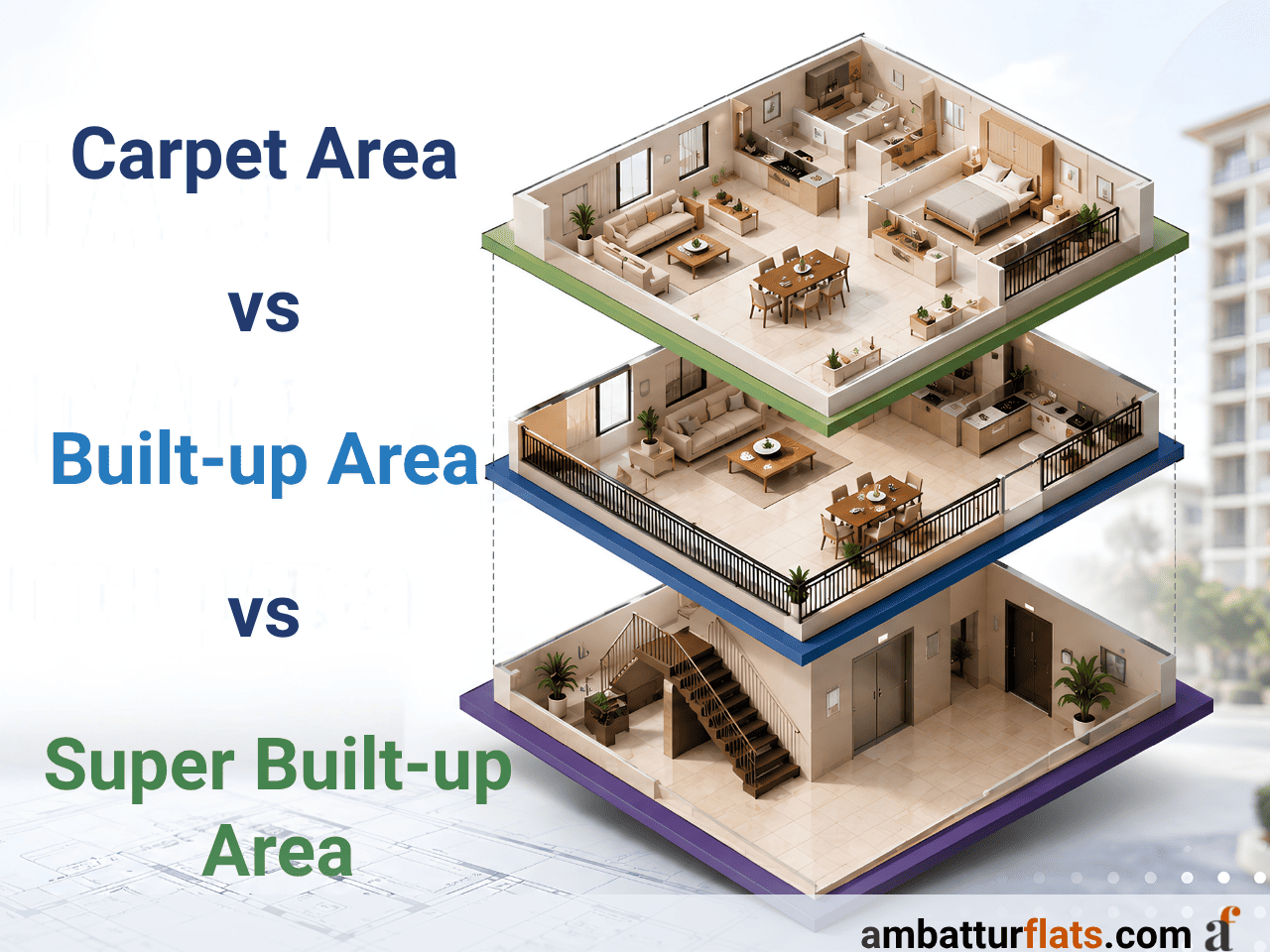

You've been quoted 1,400 square feet for a flat in Porur. You walk in, and it feels closer to 950. Chennai builders routinely advertise three different area figures for the same flat: carpet area, built-up area, and super built-up area, and only one of them is what the law actually requires them to
price against.
Get that one wrong and you could end up paying full price for hallway space you'll never own. This explains how to tell the three apart, and how to check the real number before you
sign anything.
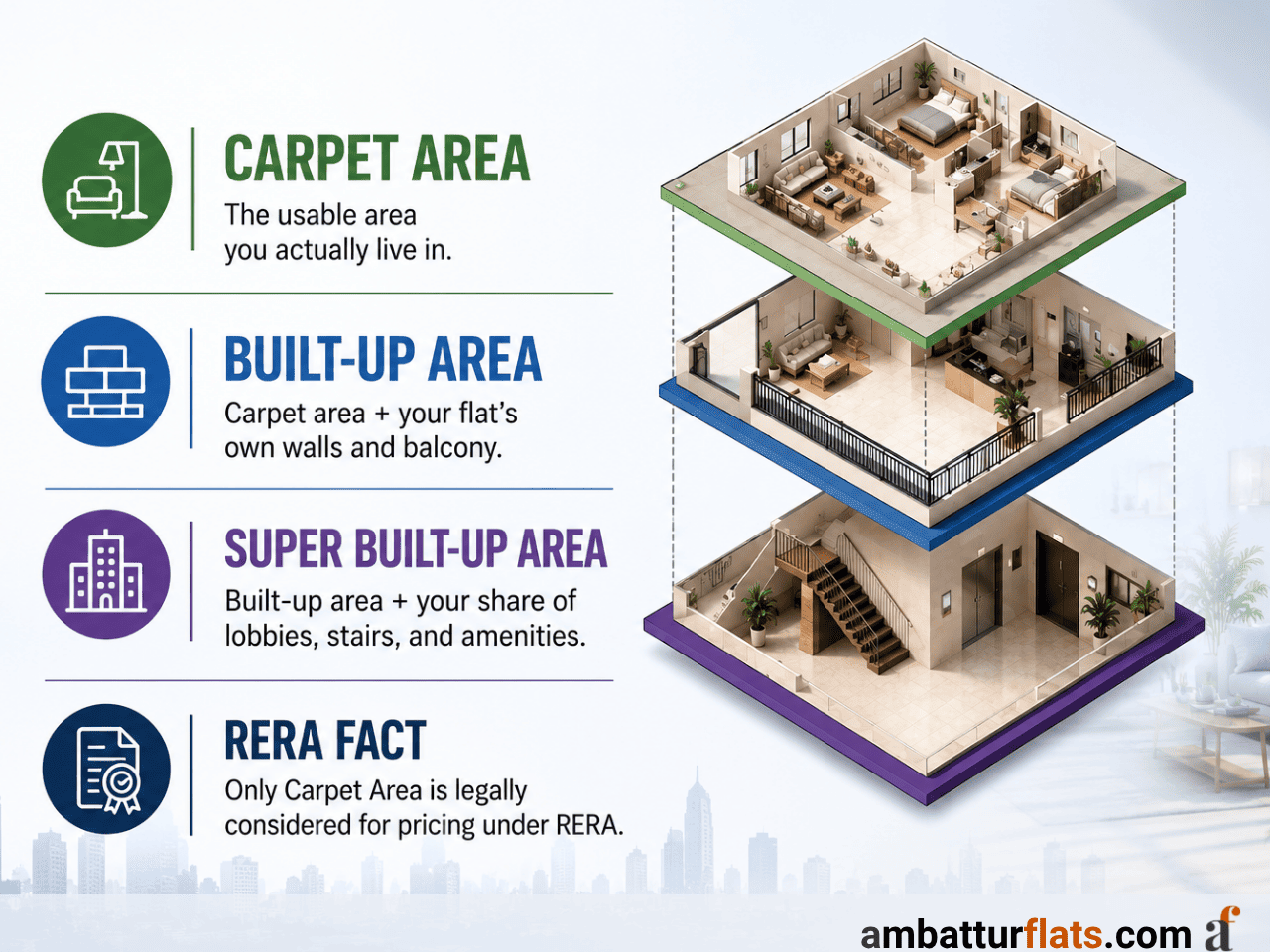
Before 2016, builders sold flats using whatever area figure worked best for them, usually the largest one. The Real Estate (Regulation and Development) Act, 2016, changed that. It defines carpet area as the net usable floor space inside a flat, measured wall to wall, including internal partition walls but excluding external walls, service shafts, balconies, and open terraces. That definition matters because sale agreements are now legally required to state the carpet area, not the
built-up or super built-up figure.
MBefore RERA, two buyers could pay for flats both marketed as 1,200 square feet and walk away with very different amounts of usable space. One builder's 1,200 included a share of the clubhouse. Another's didn't. There was no common measuring stick, and no easy way for a buyer to catch the difference before signing. RERA fixed that by making carpet area the only figure a builder can legally use to calculate your price per square foot in the agreement for sale.
TNRERA, the state authority that enforces RERA in Tamil Nadu, requires every registered project to disclose carpet area on its own portal at rera.tn.gov.in, alongside the project's approvals, promoter details, and delivery timeline. Before you sign anything, search the project by name or registration number and check the carpet area TNRERA has on record against what your builder is quoting. If the two numbers don't match, that's a conversation to have before you pay anything further.
Carpet area is the number that matters legally. Built-up area and super built-up area still show up constantly, in ads, in brochures, in casual conversation with brokers. Knowing what each one adds is what lets you convert between them instead of getting confused every time a number changes.
Built-up area is your carpet area plus the space taken up by your flat's own walls, plus any balcony or terrace attached to it. It's usually 10 to 20 percent larger than the carpet area, depending on wall thickness and how much balcony space the flat has. A flat with a generous balcony will show a bigger gap between carpet and built-up than one without.
Super built-up area takes the built-up area and adds a share of the building's common spaces: staircases, lift lobbies, corridors, sometimes the clubhouse and gym. This share isn't fixed. It's typically calculated by dividing the total common area across all flats in the project, so a bigger project with more amenities can carry a bigger loading, often 25 to 30 percent above the built-up figure. Two projects with identical flats can show very different super built-up numbers if one has a larger clubhouse to spread across its units.
Take a flat with a carpet area of 800 square feet. Add a built-up loading of 15 percent, a reasonable middle figure for a flat with a modest balcony, and the built-up area comes to about 920 square feet. Add a super built-up loading of 28 percent on top of that, and the super built-up area comes to roughly 1,180 square feet. That's the number a builder is likely to put in an ad.
The number you actually live in, cook in, and sleep in is still 800 square feet. If the flat is priced per square foot on the super built-up figure, you're paying for 380 square feet of walls, corridors, and lobby space you don't get to furnish.
RERA requires carpet area pricing in the sale agreement, but project brochures and online listings still lead with the bigger super built-up number, because advertising rules and pricing rules aren't quite the same thing. TNRERA has recently tightened its stance on misleading property ads, including how amenities and sizes get presented to buyers, but a super built-up figure prominently displayed in a brochure isn't automatically a violation the way a fabricated amenity claim or a fake government-scheme name would be. It's a marketing choice, and a legal one, as long as the sale agreement itself quotes
carpet area correctly.
That's exactly why verifying a builder's claims independently matters more than trusting the brochure. This is especially worth doing when you're comparing new launch brochures against each other, since two projects can look similar on paper until you check what each one's quoted square footage actually includes.
Start with the TNRERA portal Search for the project by name, promoter, or registration number, and open its disclosure page. The carpet area for each unit type should be listed there, filed by the promoter as
part of registration.
Next, compare that figure against your draft sale agreement. The agreement should state carpet area explicitly, not just a total price. If it only mentions super built-up area or a lump sum, ask for the carpet area breakdown before you sign.
Finally, if you can, measure it yourself. A rough wall-to-wall measurement of each room, added up, should land close to the carpet area on paper. It won't be exact, but a mismatch of more than a few percentage points is worth raising with the builder immediately, and worth checking against your full homebuyer checklist before you go further.
RERA doesn't just standardize the definition, it also protects you if the finished flat doesn't match what you signed up for. Under Section 14 of the Act, once construction is complete and the occupancy certificate is granted, the promoter has to confirm the final carpet area and compare it against the figure stated in your
sale agreement.
If the final carpet area comes in smaller, the builder has to refund the excess amount you paid, with interest, within 45 days. If it comes in larger, you're only liable to pay the difference if the increase falls within a 3 percent cap. Anything beyond that cap isn't something the builder can simply bill you for after the fact.
If a builder disputes this or delays the refund past 45 days, you can raise it directly with TNRERA rather than negotiating it informally over the phone. A formal complaint to the regulatory authority carries more weight than a call to the sales office, and it exists specifically to enforce this kind of
post-possession adjustment.
No, and this is one of the more common mix-ups among first-time buyers. Carpet area is about the floor space inside your flat. UDS, or Undivided Share of Land, is about your proportional ownership of the land the entire building sits on. Two flats with identical carpet areas in different projects can carry very different UDS shares, depending on how many units share the plot and how the land is divided.
Carpet area tells you how much living space you're getting. UDS in Chennai apartments works differently, and it affects your legal share of the land itself, which matters for things like redevelopment rights and resale value down the line. Don't let a builder or broker use one number to explain away confusion about the other.
Only one of these three numbers is what the law requires a builder to price against, and it's the smallest one. Before you shortlist anything further, check the RERA carpet area against what's advertised, get it confirmed in writing, and don't let a bigger square-foot figure on a brochure talk you into paying for space you'll never use. If you're comparing options right now, our current listings of apartments in Chennai for sale are a reasonable place to start with the real numbers
in hand.