
When you buy a home, you're not just investing in a building. You're investing in the legal strength behind it. A recent policy change in Tamil Nadu is making that legal foundation much stronger for homebuyers.
For more than a decade, many residential developments in Tamil Nadu operated through unregistered Joint Development Agreements (JDAs). If you're planning to buy apartments for sale in Chennai, understanding this change can help you make a more
informed investment.
A Joint Development Agreement is a partnership between a landowner and a developer where the landowner contributes the land while the developer manages approvals, finances the construction and delivers the completed project. Once the development is complete, both parties share the apartments or revenue based on the agreed terms.
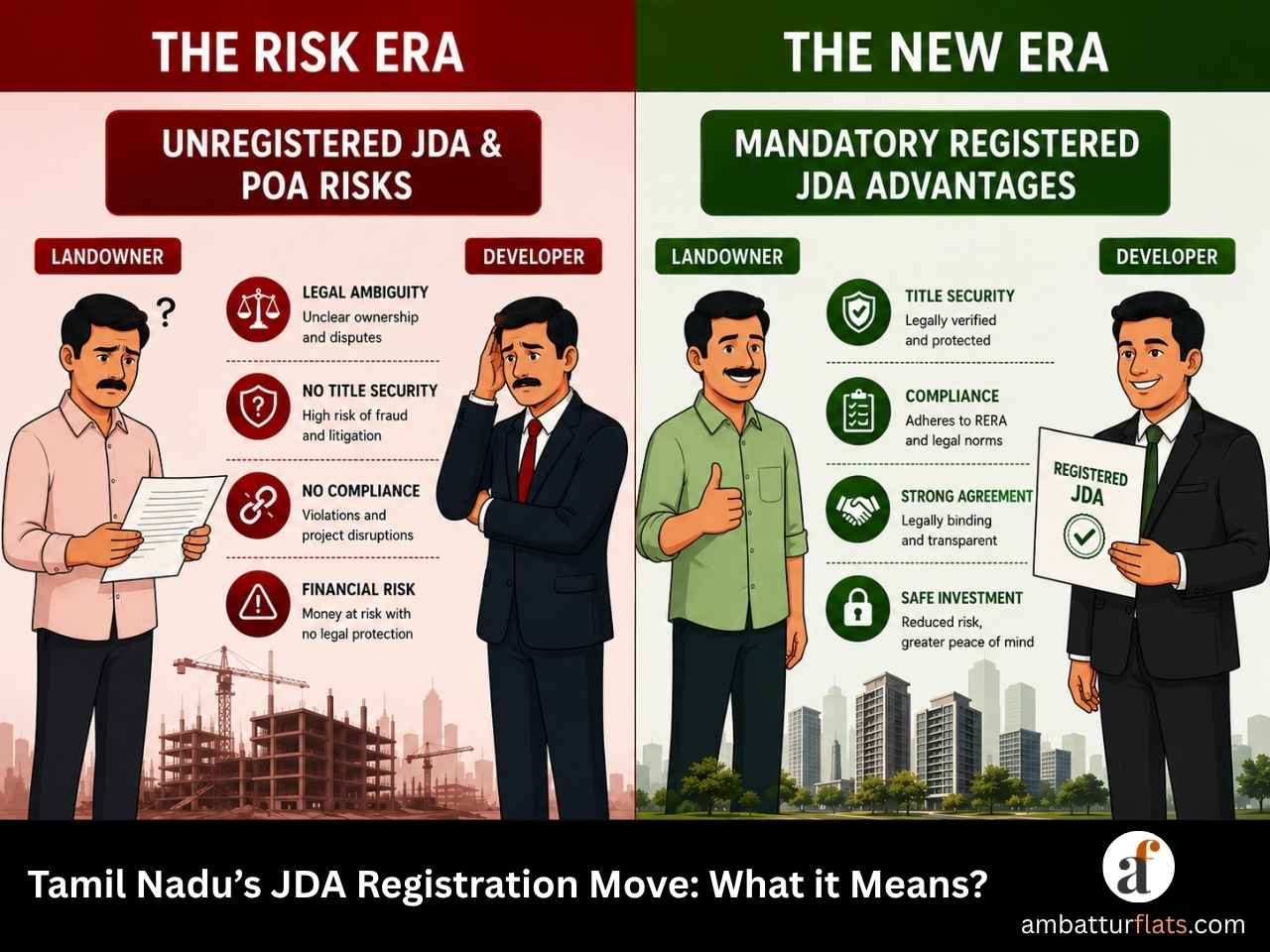
For years, many of these arrangements relied mainly on a Power of Attorney (PoA) instead of a registered JDA. While this allowed projects to move forward, it also created legal uncertainty for developers, lenders and homebuyers.
To improve transparency and accountability, the Tamil Nadu Registration Department has made JDA registration mandatory and linked it directly with the Power of Attorney. This is more than a procedural update. It creates a stronger legal foundation for residential developments while giving landowners, developers and homebuyers greater confidence.
Before the new regulation came into effect, developers often did not hold a registered legal authority over the land. Instead, they worked under a Power of Attorney granted by
the landowner.
A PoA gives someone the authority to act on another person's behalf, but it does not transfer ownership of the property. As a result, many projects depended on an arrangement that could become vulnerable if disagreements arose between the landowner and the developer.
For anyone exploring properties in Chennai for sale, this distinction is worth understanding because it directly affects the legal stability of a residential project.
A Power of Attorney authorises a developer to carry out specific actions for the landowner, but it does not establish ownership rights over the property.
If a dispute arose during construction and the PoA was cancelled, the entire development could face delays, legal challenges or even come to a standstill. Buyers who had already booked apartments often found themselves caught in disputes that had nothing to do with them.
A registered JDA significantly reduces this uncertainty by recording the rights, responsibilities and obligations of both parties through an officially recognised agreement.
Legal uncertainty did not affect only developers. It also influenced how financial institutions assessed residential projects.
Many nationalised banks and institutional lenders became cautious about financing developments that relied solely on an unregistered JDA or a standalone Power of Attorney. Without a properly documented agreement, verifying ownership rights and financial accountability became more challenging.
This often delayed project funding, slowed construction and increased financial pressure on developers.
A registered JDA provides lenders with a clear legal record, making it easier to evaluate the project and process approvals. Better access to institutional funding also improves financial stability throughout the construction phase.
The Tamil Nadu Registration Department's decision to make JDA registration mandatory is designed to improve transparency across the residential real estate sector. It follows the state's broader efforts to strengthen property registration and improve accountability, much like its recent initiatives to curb inflated guideline values.
Under the previous system, both landowners and developers were exposed to legal uncertainty. Buyers also had limited visibility into the agreements that governed the project.
The revised framework creates a stronger legal foundation by ensuring that the rights and responsibilities of every party are formally documented. It also makes funding easier, improves compliance and gives homebuyers greater confidence when evaluating real estate investment in Chennai.
| Feature | Unregistered JDA | Registered JDA |
|---|---|---|
| Title Security | A cancelled Power of Attorney could interrupt the development and create uncertainty. | The registered agreement clearly records the rights of both parties, reducing the risk of disputes. |
| Bank Loan Approval | Many lenders hesitate because of limited legal documentation and an incomplete paper trail. | Banks can assess the project with greater confidence through a properly documented agreement. |
| Fund Tracking | Limited oversight of project funds | Project funds are monitored through the mandatory TNRERA three bank account system, improving financial transparency. |
| Accountability | Responsibilities between the landowner and developer are often unclear, leading to delays and disputes. | Roles, timelines and obligations are clearly documented, making accountability easier to establish. |
One of the biggest advantages of a registered JDA is the clarity it brings to every stage of a
residential development.
Under the earlier system, delays often led to disputes between the landowner and the developer. The developer could point to unresolved land-related issues while the landowner could blame the developer for slow construction. Since the agreement was not publicly recorded, establishing responsibility was
often difficult.
A registered JDA changes that. It clearly defines the obligations of both parties, including construction milestones, timelines, revenue sharing, penalty clauses and dispute resolution. With every responsibility formally documented, accountability becomes easier to establish and buyers gain greater confidence in the project's progress.
A well-documented project is more likely to attract funding from banks and financial institutions.
When developers can present a registered JDA along with the required approvals, lenders have greater confidence in the project's legal standing. This helps streamline the loan approval process and ensures funds are released with fewer legal concerns.
Better access to institutional finance helps developers maintain construction schedules and reduces the risk of delays caused by funding shortages. For homebuyers, this translates into greater confidence when considering West Chennai real estate or exploring villas in Chennai for sale backed by proper
legal documentation.
The impact of this reform extends well beyond individual housing projects. It reflects a broader effort to make Tamil Nadu's real estate market more transparent and
investment friendly.
Industry bodies such as CREDAI challenged the increase in registration charges for Power of Attorney and construction agreements, arguing that higher transaction costs could affect the pace of real estate development. At the same time, legal ambiguities, lengthy approval processes and inconsistent documentation continue to create challenges for the housing sector. When approvals take longer or legal disputes delay construction, project expenses continue to rise. Those additional costs are eventually reflected in the final price
paid by homebuyers.
By introducing a clearer legal framework, the state is reducing one of the long-standing sources of uncertainty in the property market. Greater transparency encourages institutional investment, improves buyer confidence and supports healthier growth across the
housing sector.
Buying a property today requires more than comparing prices or visiting model apartments. Understanding the legal strength of a project is
equally important.
Before investing, keep these three checks in mind.
A Power of Attorney alone should never be treated as proof of a developer's authority to build or sell.
Request a copy of the registered Joint Development Agreement or confirm that it has been officially registered. This simple step helps you verify that the development complies with the latest legal requirements.
Every registered JDA outlines the responsibilities of the landowner and the developer.
Take time to understand who is responsible for construction quality, structural defects, project delays and regulatory compliance. Knowing these details in advance helps you make a more informed decision when comparing verified builders in Chennai.
Nationalised banks conduct extensive legal and technical due diligence before approving a residential project.
If leading nationalised banks have sanctioned loans for a development, it is generally a positive indicator that the project's documentation meets current regulatory standards. While this should not replace your own due diligence, it provides an additional layer of confidence during the
buying process.
Large infrastructure projects often dominate headlines because their impact is easy to see. Regulatory reforms, however, can have an even greater influence on the long-term security of your investment.
Mandatory JDA registration is one such reform. It improves transparency, strengthens accountability and creates a more reliable legal framework for residential developments across Tamil Nadu.
Reviewing legal documents, verifying approvals and assessing compliance can be challenging for individual buyers. That is why choosing a trusted property platform becomes equally important.
At Ambattur Flats, we simplify your home buying journey by connecting you with projects that meet current regulatory standards and documentation requirements. If you're planning your next purchase, start by exploring our guide on how to verify a builder before buying and make every decision with confidence.