

A buyer in Chennai reaches the final stage of a property deal, ready to sign, when the seller's representative walks in instead of the seller. He is holding a Power of Attorney. The buyer has never dealt with one before and does not know what it actually allows, or what happens if something about it turns out to be wrong. This scene plays out often in Chennai's property market, especially in deals involving NRIs who own homes here but live abroad. A Power of Attorney is legal and common, but it comes with real limits that catch buyers and NRIs off guard alike. This guide covers what the document can and cannot do, how NRIs execute one correctly from abroad, and how to check whether a Power of Attorney you are relying on is actually valid.
A Power of Attorney is a legal document where one person, the principal, authorises another person, the attorney-holder, to act on their behalf. In real estate, this usually means signing documents, appearing at the Sub-Registrar's office, or negotiating terms when the owner cannot be
physically present.
A General Power of Attorney grants broad authority across many types of transactions, not just one property. A Special Power of Attorney is limited to a single, named transaction, such as the sale or purchase of one specific flat, with its survey number and address written into the
document itself.
For property deals, a Special Power of Attorney is the safer choice. It gives the attorney-holder exactly the authority needed for that one transaction and nothing more, which limits how much damage a dishonest agent can do.
An attorney-holder acting under a valid Power of Attorney can sign a sale agreement, appear before the Sub-Registrar, pay stamp duty, and complete registration formalities on the owner's behalf. What the document cannot do, regardless of how it is worded, is make the attorney-holder the owner of the property. Ownership stays with the principal until a registered sale deed transfers it to someone else.
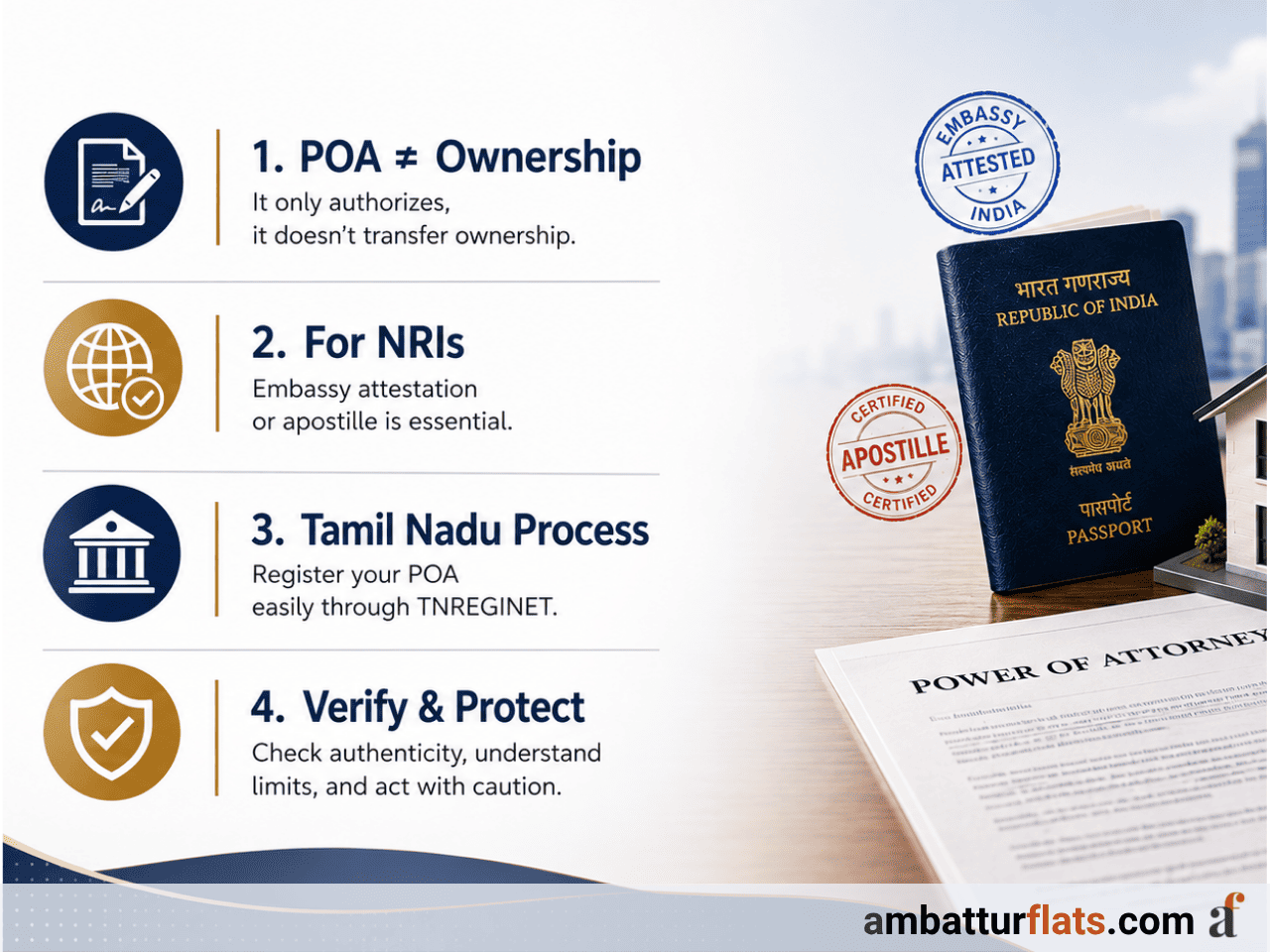
A Power of Attorney does not transfer ownership by itself, regardless of how the document is worded. Indian courts have made this point repeatedly, in cases stretching back over a decade.
The Supreme Court settled this question in Suraj Lamp & Industries v. State of Haryana, ruling that General Power of Attorney sales, and Sale Agreement, Power of Attorney, and Will arrangements together, do not convey title and cannot be treated as completed transfers of immovable property. The court has reaffirmed this position more than once since.
In M.S. Ananthamurthy v. J. Manjula, decided in 2025, the court held that a General Power of Attorney does not transfer title and is automatically revoked when the person who granted it dies, even if the document describes itself as irrevocable. Later that year, in Ramesh Chand v. Suresh Chand, the court went further, holding that even a registered will cannot establish ownership on its own if there are suspicious circumstances around how
it was made.
For a buyer, this means a property sold only through a Power of Attorney, an agreement to sell, and a will, without a registered sale deed, does not actually belong to you in the eyes of the law. For an NRI managing a sale through an attorney-holder, this means the attorney can sign and appear at registration, but only a properly executed and registered sale deed completes the transfer. Skipping that final step, however convenient it seems at the time, leaves ownership legally unresolved.
Most NRIs cannot travel to India for every stage of a property transaction, which is why a Power of Attorney matters so much to them. Getting the document right at the source, before it ever leaves the country of residence, determines whether it holds up in India months later.
An NRI executing a Power of Attorney abroad must sign it in the presence of the Indian Embassy or Consulate in their country of residence, or have it apostilled if that country is part of the Hague Convention. This step confirms the signature is genuine and gives the document legal standing for use in India. Skipping it, or relying on a locally notarised document without embassy or apostille backing, is one of the more common reasons a Power of Attorney gets rejected at the Sub-Registrar's office.
Once the attested Power of Attorney arrives in India, typically by courier, it needs to be registered with the local Sub-Registrar within a defined window from the date it reaches the country. Registering late risks the document being treated as invalid for property transactions, which can stall a sale or purchase indefinitely.
In Tamil Nadu, a Power of Attorney intended for property transactions must be registered before it can be used at the Sub-Registrar's office, the same office that handles sale deeds and
other property documents.
The Tamil Nadu Registration Department's TNREGINET portal lets the attorney-holder or their representative complete much of the groundwork online, including checking the applicable guideline value and calculating stamp duty, before visiting the Sub-Registrar's office in person for the actual registration itself. Physical appearance is still required at that stage, regardless of how much preparation happens online.
Buyers who have not gone through this before may find our earlier piece on the Registration Department's recent guideline value clarification useful for understanding how the portal's valuation checks work, since the same system applies whether you are registering a Power of Attorney or a sale deed. For the full registration walkthrough, see our guide to the registration process itself.
Stamp duty and registration fees for a Power of Attorney depend on the relationship between the principal and the attorney-holder, with lower fees typically applying when the attorney is a close family member. These figures change periodically and vary by transaction type, so the reliable move is to check the current rate on the TNREGINET stamp duty calculator before paying anything, rather than relying on a
number quoted secondhand.
Not entirely, no. An attorney-holder can negotiate terms, verify documents, sign the sale agreement, and handle most of the paperwork on the buyer's or seller's behalf. Registration of the actual sale deed at the Sub-Registrar's office, however, still needs someone physically present, whether that is the owner or their properly registered attorney-holder.
For NRIs, this is precisely why the Power of Attorney exists in the first place. It lets a trusted representative stand in for the parts of the transaction that legally require someone's physical signature in India, while the NRI handles negotiation, banking, and paperwork remotely. What it does not do is remove the need for that in-person step altogether. Someone still has to appear at the Sub-Registrar's office on registration day, and that someone is either the owner or a validly registered attorney-holder acting on their behalf.
Start by checking whether the Power of Attorney is actually registered, and when. An unregistered or expired document carries far less legal weight, and courts have repeatedly refused to treat unregistered Power of Attorney documents as sufficient authority to transfer property.
Next, check the scope of authority written into the document itself. A Power of Attorney that does not name the specific property, survey number, and transaction it covers should raise concerns, since a vague or overly broad document gives the attorney-holder room to act beyond what the principal actually intended. Before you sign anything based on someone else's authority, verifying who you are dealing with matters as much here as it does with a builder.
Confirm the Power of Attorney has not been revoked, since a revocation does not always get publicised, and a buyer relying on a cancelled document has no real protection. Cross-check ownership against the property's current Encumbrance Certificate, and where the situation calls for it, work through a complete homebuyer checklist before finalising anything tied to a
Power of Attorney.
If an attorney-holder acts outside the authority they were given, or sells a property without the owner's knowledge, the principal can revoke the Power of Attorney immediately through a formal deed of revocation, with witnesses, and by giving notice to relevant parties, including the Sub-Registrar.
Revocation stops the misuse going forward, but it does not automatically undo a transaction that already happened. Recovering a property sold through a misused Power of Attorney typically means filing a civil suit, and in cases of forgery, a police complaint as well. That risk is why NRIs are increasingly cautious about who they name as attorney-holder, and why buyers should never assume a Power of Attorney is valid just because it looks official.
If any document tied to a property dispute has gone missing or needs replacing, our guide on lost property documents walks through the process.
A Power of Attorney makes property transactions possible across distance, which is exactly why so many NRIs and busy buyers rely on one. It is not a substitute for a registered sale deed, and courts have made that distinction increasingly clear in recent years. Before you sign anything, rely on anything, or hand authority to anyone, verify the document itself: its registration, its scope, and its current validity. That single check protects a transaction more than any other precaution you can take, so treat it as the first step,
not the last.