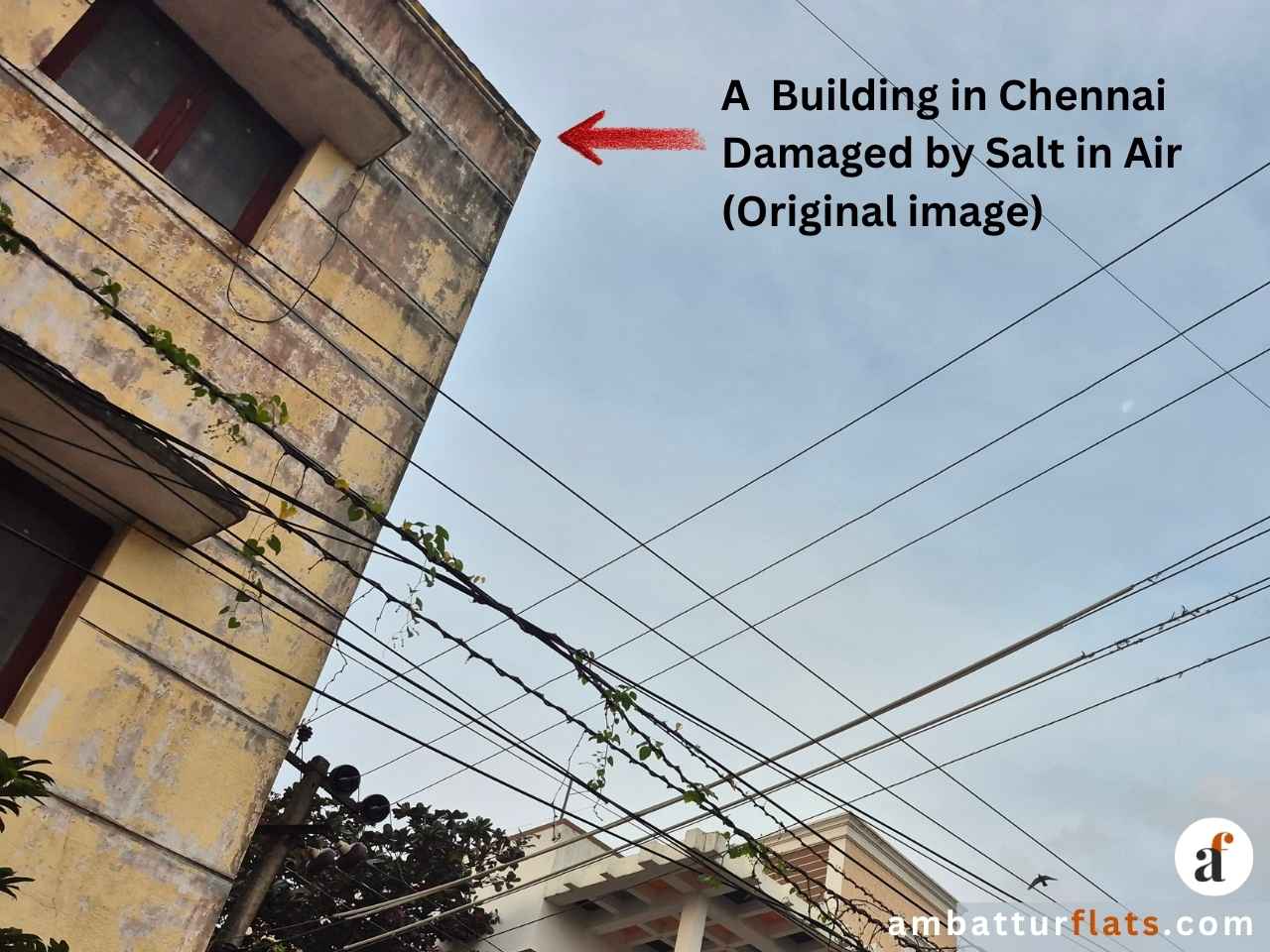

Walk a street two blocks from the Chennai shoreline and the buildings there will not be ageing at the same rate. One has rust stains below the balcony edges and a patch of plaster missing under a slab. Its neighbour, built around the same time, looks close to intact. Owners tend to put that gap down to maintenance. Maintenance is only part of it. What went into the concrete before either building was handed over is the other part, and this article is about how salt air works on a coastal building in Chennai across twenty years, and which parts of that an owner
can still change.
That gap eventually becomes somebody's buying decision. Two flats of the same age, on the same road, at the same price, can carry different repair bills for the rest of their lives. The engineering below is what separates them.
Coastal building maintenance in Chennai is usually discussed as a painting and washing schedule. That part matters. It is also the smaller half of the problem. What follows is not a year by year damage schedule, because the timing depends on how the building was built. It is an account of the mechanism, the stages it moves through and the decisions that still change the outcome.
Salt air damages a coastal building in Chennai by carrying chloride onto the concrete surface, where humidity and rain dissolve it and draw it inward through the pore structure. When enough chloride reaches the steel reinforcement, the steel begins to corrode, and the rust that forms cracks the concrete cover
from inside.
Chloride is the corrosive part of common salt. Concrete is normally a good place for steel to sit, because fresh concrete is strongly alkaline and that alkalinity holds a thin oxide film on the surface of every bar. Engineers call that film passivity, and it is the reason a steel bar cast into concrete does not rust the way a bar left in the open does. Chloride ions attack that film. Once enough of them collect at the depth where the steel sits, the film breaks down in patches and corrosion starts
at those patches.
The concrete cover is the layer of concrete between the outer face of a wall, beam or slab and the first steel bar inside it. Cover is the barrier the steel has, and it works in two ways at once: it is a physical distance the chloride has to travel, and it is a chemical buffer while it travels. Rust occupies more space than the steel it formed from, so once corrosion is running, it pushes outward against that cover until the concrete cracks along the line of the bar and eventually breaks away. That last stage is called spalling, and it is the point at which the damage becomes visible from the ground.
By then the process has been running for years. The visible stage comes late in the sequence.
Indian Standard IS 456:2000, the national code for plain and reinforced concrete, caps the chloride the mix itself may contain at the time of placing at 0.6 kg per cubic metre for reinforced concrete, counting what the cement, aggregates, water and admixtures bring in. That limit does not govern the chloride that arrives later
from the air.
The code does not treat all coastal sites as one condition. IS 456:2000 classifies a building's environment by exposure, and it separates a structure in a coastal environment from one taking direct sea water spray and from one standing in the tidal zone. Each class carries its own minimum concrete grade, minimum cement content, maximum water to cement ratio and minimum cover, and together those are the durability requirements for that exposure.
| Exposure condition under IS 456:2000 | Minimum grade | Minimum cement content | Maximum free water to cement ratio | Nominal cover |
| Moderate | M25 | 300 kg per cubic metre | 0.50 | 30 mm |
| Severe, which includes concrete exposed to a coastal environment | M30 | 320 kg per cubic metre | 0.45 | 45 mm |
| Very severe, which includes surfaces exposed to sea water spray | M35 | 340 kg per cubic metre | 0.45 | 50 mm |
| Extreme, which includes members in the tidal zone | M40 | 360 kg per cubic metre | 0.40 | 75 mm |
Read those four rows against each other and the mechanism shows up in the numbers. Across those rows the grade, the cement content and the cover all rise at every step towards the sea, and the water to cement ratio tightens at two of the three steps. Denser concrete has a finer pore structure, so chloride moves through it more slowly. More cover means further to travel. Both buy time, and time is the whole game.
A residential block in a coastal environment sits in the second row. It should have been built to at least M30 with 45 mm of cover, and that is a question the builder or the association can be
asked directly.
The floor a national code sets is still a floor. Research modelling chloride movement through concrete in the marine tidal zone, which the table above treats as extreme exposure, found that the cover depth needed for a safe service life varied by 20 to 25 mm between Indian coastal stations, and that current practice does not distinguish between the severities of different tidal zones. That result compares tidal structures at different coastal cities, so it does not settle what the right cover is for an apartment block
in Chennai.
A plainer reason sits on the site itself. Specified is not the
same as built.
Cover is held by small plastic or concrete spacers tied to the reinforcement cage before the pour. A cage that shifts, a spacer that is missing or a pour that is over watered on a hot afternoon will each produce a wall that meets the drawing on paper and not in the concrete.
None of that is visible once the plaster and paint go on. It is why the builder's record on finished projects carries more weight than the specification sheet, and why knowing how to verify a builder before buying is worth more on the coast than almost anywhere else in the city.
The damage moves through a reliable sequence, but the clock attached to it varies from building to building, so treat what follows as stages rather than dates.
The things that decide the pace are fixed here: the grade of concrete, how much water went into the mix, how well it was compacted and how much cover ended up over the steel. Nothing later in the building's life changes any of it.
Salt settles on external surfaces and dissolves in humidity and rain, and chloride begins moving inward through the pore structure. The building looks new. Paint, sealants around windows and any mild steel railings start ageing faster than they would inland, and that is usually the only
outward sign.
Chloride reaches the steel on the most exposed faces first, and corrosion starts before anything shows. What eventually appears is rust coloured staining, fine cracking that runs in a line rather than a random pattern, sealant failure at windows and pitting on railings and fittings. This is the stage where a diagnosis is cheap and useful, and where many buildings get repainted instead.
Rust has expanded enough to crack the cover, and pieces begin to come away and expose the bar. Repairs move from cosmetic to structural, and from
occasional to recurring.
How fast a building travels through those stages depends on four things. The first is cover depth, which sets the distance. The second is the permeability of the concrete, which is largely decided by the water to cement ratio and the compaction on site, and which sets the speed. Neither is visible from the outside, which is why a building's paperwork and its repair history end up standing in for them. The third is the exposure the building actually faces, meaning direct spray and prevailing wind rather than distance to the beach on a map. The fourth is wetting and drying.
Chloride moves fastest where a surface is repeatedly soaked and then allowed to dry, because each cycle draws salt water in and then leaves the salt behind as the water evaporates. The Chennai coastal climate supplies both halves of that cycle, with humid air through much of the year and concentrated rain during the northeast monsoon. That is why sea water spray and tidal zones are treated as the harshest classes in the code, and why a balcony parapet that catches rain on one face and bakes on the other is often the first place a building shows trouble.
So two buildings can sit on the same road and be in noticeably different condition without either owner having done anything unusual. The age of a coastal building says very little on its own, and its condition has to be looked at directly. That changes how the usual comparison between a new launch and a resale flat reads on the coast, where the age of the concrete carries weight it does not carry inland.
Regular maintenance on a coastal building can slow the rate of deterioration and hold off the more expensive repairs, and it helps to be precise about what it buys. Washing salt deposits off external surfaces, repainting with coatings suited to marine exposure, replacing hardened sealants around windows and servicing or replacing mild steel railings all slow the rate at which chloride gets to the concrete in the first place. So does keeping rainwater moving off surfaces instead of standing on them. Applied early and repeated, that work extends the quiet period.
What none of it does is reverse what is already inside. Once chloride has reached the depth of the reinforcement, a fresh coat of exterior paint on the outside face does not remove it, and no coating adds cover to a slab that was cast thin. Surface work manages the supply of chloride. The stock already sitting in the concrete stays where it is.
That distinction matters most for older buildings, where condition starts to affect resale and lending. Buyers looking at older coastal stock run into the same questions that come with financing older Chennai flats, and structural condition is part of what sits behind them.
When a patch of concrete comes away and exposes a rusting bar, many associations treat it as a repair item: cut out the loose concrete, clean the bar, apply a mortar patch, repaint. That is patch repair, and on a chloride contaminated structure it addresses the damage rather than the cause, because the chloride in the surrounding concrete is still there and still active. The same elevation tends to come back.
There are methods that go after the corrosion instead of the damage it leaves behind. Cathodic protection is the main one, and in its galvanic form it means fixing a more reactive metal to the reinforcement so that metal corrodes in place of the steel. A study at the Department of Civil Engineering, IIT Madras, completed in 2021, tracked a coastal jetty in the city where galvanic anodes held chloride induced corrosion in check across fourteen years, alongside a salt processing facility monitored over four years. The anodes added about 4 per cent to the repair cost of the jetty. The same work modelled life cycle costs against repeated patch repair and put the saving at about 90 per cent over about 30 years from the first repair, which is a projection rather than an observed result.
Those figures come from marine and industrial structures rather than from residential apartment blocks. A jetty is a harsher and more accessible structure than an apartment block, so the finding does not transfer directly, and none of it is a recommendation to install anodes in a flat.
What it means for an owner is narrower than the engineering. The first visible sign, usually rust staining rather than a spall, is the point to call a structural consultant rather than a painting contractor, and to pay for an assessment that measures the cover and checks whether the steel is already corroding. A consultant will know those as cover measurement and half cell potential testing. What that assessment buys is the ability to choose the repair, because the cheap looking option at that moment is not reliably the cheap option over the life of the building.
None of this is visible in a listing photograph, so the checks have to be deliberate. Look at the underside of slabs and balconies, at parapet edges and at the sea facing elevation, because those surfaces take the most exposure and fail first. Rust coloured staining running down from a crack line tells you more than a crack on its own, since the stain usually indicates the crack has already reached steel. Chloride is the dominant cause of that on the coast but not the only one, which is a reason to have the diagnosis made rather than assumed.
Then ask the association a few questions. Has the building had structural repairs, and what was actually done. A history of repeated patch repairs on the same elevation can say more about a building's condition than its brochure suggests. Ask as well what the maintenance fund holds against future structural work, because coastal repair is a recurring cost rather than a one off, and a building with thin reserves and visible spalling is a building whose owners
will be billed.
On an older sea facing block, it is reasonable to commission a structural consultant to measure cover and test for chloride at depth before committing. It costs a fraction of the price difference between two flats and it answers the one question the listing cannot. That step belongs in the same category as the legal and title work already on a homebuyer's checklist.
For coastal construction in Chennai that is still on site, the useful control sits in the specification and in what actually gets poured. The exposure class should be set by the building's actual position rather than by habit. Cover should be checked with a cover meter after casting instead of assumed from the drawing, and the finishing schedule should account for marine exposure rather than treating the coast as
one more site.
The handover stage in a Chennai apartment is the last easy point to ask for records of the concrete grades used, while defects are still the builder's responsibility and the paperwork is open. Ask for the mix design and the cover checks, not only the snag list.
A building that arrives with polished interiors and unremarkable concrete is one version of the gap between finish quality and build quality. On the coast that gap shows up faster, because the sea tests the part of a building nobody sees.
Salt will get into a coastal building. The question a Chennai owner can act on is how long the concrete makes that take, and that answer was mostly written into the structure before anyone moved in.
What stays open is the response. Surface maintenance slows the supply of chloride and should be kept up on schedule. The first visible damage is where the decision is made, and treating it as a paint job rather than a diagnosis is how a building ends up on a repair cycle it never leaves. The signal to act on is the first rust stain under a slab, and what matters is what gets decided once it appears.
On this coast, how well a home holds its value has as much to do with how it was built to stand here as with where it stands.
There is no single figure. Service life on the coast depends on the concrete cover over the reinforcement, the permeability of the concrete, the severity of the exposure at that specific site and how often surfaces are wetted and dried. IS 456:2000 addresses this by setting stricter mix and cover requirements as exposure worsens rather than by
stating a lifespan.
Repainting with a coating suited to marine exposure slows the rate at which chloride reaches the concrete, so keeping to the repainting schedule helps. It cannot remove chloride that has already penetrated to the depth of the reinforcement, and it cannot compensate for cover that was cast too thin.
Under IS 456:2000, concrete exposed to a coastal environment falls under severe exposure with a nominal cover of 45 mm, surfaces exposed to sea water spray fall under very severe exposure at 50 mm and members in the tidal zone fall under extreme exposure at 75 mm. Research modelling the marine tidal zone at Indian coastal stations has found that the cover needed for a safe service life varies between those locations, though that result is about tidal structures rather than apartment blocks. The code figure is a minimum rather than a site specific answer.
Exposure generally reduces with distance from the shoreline, but IS 456:2000 classifies exposure by condition rather than by distance, which means the factors that decide it are direct spray, prevailing wind and how often a surface gets wet and dries. A sheltered elevation two streets back and an exposed sea facing elevation on the same building are not in the same condition.
Staining that runs from a crack line usually indicates that corrosion has already started on the reinforcement behind it, because the stain is a corrosion product carried out by water. It is a sign to commission a condition assessment rather than to patch the surface, since the visible damage appears
late in the process.