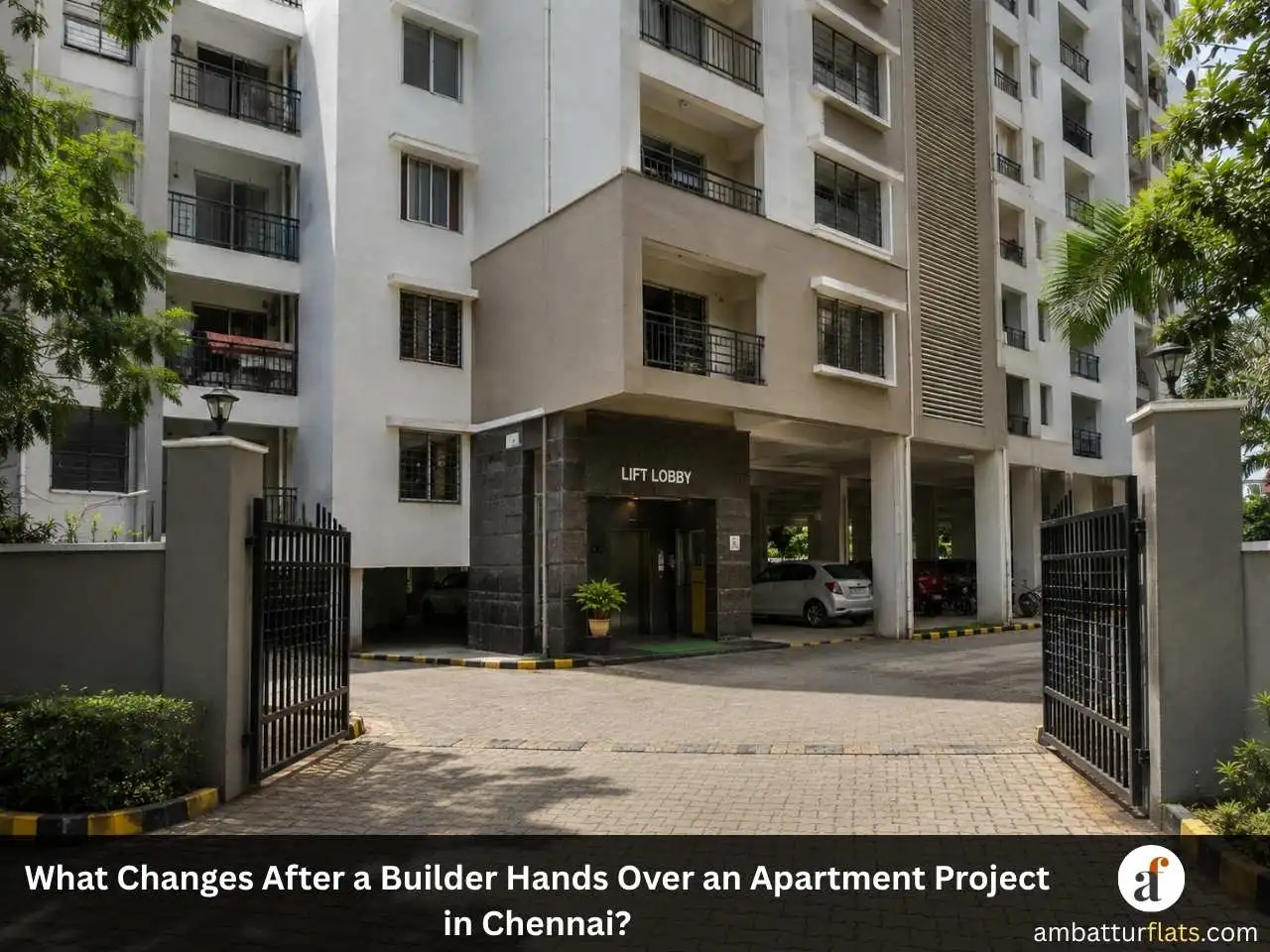

The site office is usually the first thing to go. Banners come down, the sales team moves to the next project, and the guard who used to wear the developer's uniform starts reporting to someone else. Buyers in Chennai will spend six months studying a builder's past projects and about six minutes thinking about who runs the building after that builder walks away.
Apartment handover in Chennai is the moment a building stops being a product and becomes an organisation. This covers what legally changes hands, who pays for what afterwards and the checks that separate a complex which ages well from one that quietly falls apart.
Handover runs on two separate tracks. The first is individual possession, where a buyer receives keys, a registered sale deed and an undivided share of the land. The second is common area handover, where the developer transfers lifts, pumps, generators, terraces, statutory approvals, records and money to a registered owners association.
Most buyers only experience the first track. The second one decides what living there costs for the next twenty years. A flat can be handed over cleanly while the common areas stay in limbo for years, and the two events are often separated by a long gap that nobody warns buyers about.
The distinction matters because the association cannot function without the second track being completed. Without that transfer it is on weak ground when it applies for statutory consents such as a pollution board renewal, takes on capital works or tries to enforce anything against the developer on infrastructure it has never formally received.
Under the Real Estate (Regulation and Development) Act, 2016, or RERA, there are two clocks, and they get confused constantly.
Section 17(1) requires the promoter to execute the conveyance and hand over physical possession of common areas to the association of allottees within three months of the occupancy certificate, unless a local law says otherwise. Section 17(2) is the shorter one: documents and plans, including those relating to common areas, go to the association within thirty days of the occupancy certificate.
So the thirty day figure people quote in owner group chats is about paperwork, not about pumps and terraces. Arguing the wrong deadline weakens an otherwise strong case.
Two more provisions matter here. Section 11(4)(e) requires the promoter to enable formation of an association within three months of the majority of allottees booking their units. Section 11(4)(g) requires the promoter to pay the outgoings he has collected from the allottees until possession has been transferred. That second clause is the one associations run when a developer holds unsold inventory and skips maintenance on it, though it does not squarely settle liability for the builder's own unsold flats.
Unsold inventory is usually discussed as money the builder owes. It is also the only leverage owners get. A builder who is still selling in the same complex needs the lobby to look presentable, needs the water running and needs existing residents to say pleasant things to visiting buyers, which is the period when common area work and fund transfers actually get done. Once the last flat is sold, that pressure disappears, and the same request that would have taken a phone call now takes a tribunal and two years.
Tamil Nadu replaced its old apartment law in 2024 and has amended the rules since, and many buyers have not caught up.
The Tamil Nadu Apartment Ownership Act, 2022 was brought into force on 6 March 2024, repealing the 1994 Act. The Tamil Nadu Apartment Ownership Rules, 2024 followed on 24 September 2024, and were amended on 9 September 2025 to reset the standard bye-laws are measured against, put a floor of three apartment owners on the board of managers and add a procedure for an association to change its name, with removal of difficulties orders issued in the same year. The framework applies of its own force to buildings with four or more apartments, where the 1994 Act depended on the owner opting in by executing a deed of declaration, which pulls in a large share of Chennai's small and mid sized blocks that previously ran on informal arrangements. An apartment association in Chennai now has a defined legal form instead of a committee that exists because a few residents
agreed to it.
Buildings that already existed when the Act commenced were given 180 days from that date to file their declaration, and new buildings file within ninety days of the completion certificate. Whether a given building has filed is worth checking at the district registrar before buying into a resale flat, because an association that has not filed its declaration is operating outside the framework the Act now sets, even where an older single association is deemed to
continue under it.
The sale deed transfers two assets that behave very differently. One is the interior of the flat. The other is an undivided share of the land under the building, which is why what your undivided share of land actually covers decides so much about your position in any future dispute or redevelopment.
Everything past your door is shared. Structural columns, the foundation, staircases, lift shafts, the terrace, transformers, sumps, driveways and the sewage plant belong to all owners collectively and are managed
by the association.
This creates a boundary that generates most apartment disputes. A leak from a fourth floor bathroom into a third floor ceiling is a private matter between two owners. A failure in the main drainage stack inside the shaft is a common expense. Open terraces, driveways and visitor bays are common property, which is why parking disputes in Chennai apartments escalate so quickly once a builder is no longer there to arbitrate.
A Chennai apartment is a small utility company. Water arrives from three unreliable directions, metro supply, borewells and tankers. Power fails often enough that backup is not optional, and wastewater has to be treated on site in most large projects.
The sewage treatment plant, or STP, is where associations get caught. Multistoried residential buildings with built up area above 20,000 square metres need pollution board consent to operate and must reuse treated water for gardening and landscaping, with monitoring systems attached. Once the developer leaves, applying for and renewing that consent becomes the association's job. Enforcement action can go as far as disconnection of power or sealing of the premises.
| System | What it needs after handover |
| Lifts | Monthly servicing, statutory inspection, emergency rescue device checks, controller and rope replacement in the second decade |
| Water treatment and borewells | Pump overhauls, filter media replacement, periodic testing of dissolved solids and bacteria |
| Sewage treatment plant | Blower and dosing upkeep, sludge clearance, discharge testing, pollution board consent renewal |
| Diesel generators | Load testing, fuel and battery checks, panel maintenance |
| Fire safety | Pump pressure tests, alarm and detector testing, hydrant upkeep, periodic no objection certificate renewal |
Lift maintenance is the one owners underestimate most. A monthly service contract is manageable. The major overhaul that follows it is not, and it arrives whether the association planned for it or not.
None of this is visible on a site visit. All of it is on the bill from the month the developer stops
paying it.
Buyers treat a low monthly maintenance figure as good management. It is
often the opposite.
Two pools of money keep a building alive, and they do different jobs. Monthly maintenance pays for salaries, common area power, housekeeping, chemicals and small repairs. A corpus fund, collected once at sale and transferred at handover, and a sinking fund, built from monthly contributions afterwards, pay for the things that arrive on a longer cycle: exterior painting every five to seven years in coastal conditions, then waterproofing, lift controller replacement, generator overhaul and sump repair.
Chennai is hard on the second list. Salt in the air, a long wet season and hard borewell water shorten the life of paint, pumps and metal fittings compared with drier cities. A building that collects nothing for capital repairs is not cheap. It is deferring a bill and adding interest to it in the form of damage.
When a lift finally fails in year eleven and there is no reserve, the association has to raise a large one time levy from every owner at once. Some pay. Some argue. Some are non-resident owners who never respond. The repair stalls, and the building starts sliding. This is the mechanism behind most neglected complexes in the city, and it traces back to a decision made at handover about how much money to collect.
Developers collect corpus funds from buyers during sale. Disputes start when that money does not move to the association's account after handover.
The position has been tested in Tamil Nadu. In an appeal reported in April 2024, a tower owners association in Egattur won an order after the state appellate tribunal dismissed the promoter's appeal and directed the promoter to release seventy per cent of the corpus fund, roughly Rs 1.23 crore, for the association to withdraw. The tribunal's reasoning was that the association was already maintaining the tower's common areas and was entitled to the proportionate share. The remaining thirty per cent goes to the apex body covering the rest of the township after
project completion.
Corpus money follows the body that maintains the property. How a project is registered with the state real estate authority does not settle the question on its own: in that appeal the tribunal held that a tower registered as a standalone project could not be treated as one where the facts said otherwise. Buyers in phased townships should still check how their tower is registered, because it shapes what they will have to argue, but the record of who actually maintains the common areas carries more weight.
Section 14(3) of RERA gives buyers a five year window from the date of possession to report structural defects or defects in workmanship, quality or services to the promoter, who must rectify them without charge. The provision sets thirty days for that rectification, and where the promoter fails within that time the allottee is entitled to compensation under the Act.
The clause is narrower in practice than owners expect. The dispute is usually about where defect ends and normal wear begins. A lift that ages normally, a pump that reaches end of life or paint that fades on schedule are not defects. Cracks that appear repeatedly along the same beam, water entering through a wall junction each monsoon or a sump that leaks into the soil are.
The five year clock does not start on the same day for everyone in the building. It runs from the date each owner took possession, so in a project that sold slowly or was built in phases, the first buyers reach the end of their window while later buyers still have two or three years left. By the time an association is organised enough to take a structural complaint to the builder, the owners pushing hardest are often the ones with nothing left to claim, and the ones who still have a valid window have not yet felt the problem. The builder does not have to refuse anything. The calendar does the work.
The practical failure is timing. Associations often notice a pattern in year four, argue internally for a year, then approach the developer after the window closes. Structural complaints should be documented in writing the first time they appear, with photographs and dates, even if the association intends to
settle it informally.
Five years after handover, disputes are usually won or lost on documents. An association that took over without them pays for the gap repeatedly.
Collect and verify at handover:
Missing manuals and warranty papers are not a small administrative gap. Equipment vendors decline warranty claims without them, and a controller board or blower that fails early becomes a full price purchase.
The quality of an association does not stay an internal matter. It eventually reaches the loan file of the next person trying to
buy your flat.
Buildings without registered associations, without occupancy certificates or with unresolved corpus and common area disputes create exactly the conditions where lenders turn cautious on older Chennai flats. If a buyer cannot get a loan sanctioned easily on your flat, your pool of buyers narrows to people paying cash, and price follows. A governance failure in year three quietly becomes a valuation discount in year twelve.
That is also why some projects that sold on specification stop looking the part after a few years. The finish was never the durable asset. Why some premium flats stop feeling premium usually comes down to whether the community funded upkeep of the systems behind the finish.
It cuts both ways when weighing a new launch against a resale flat. A new launch gives you a defect liability window and a warranty on equipment, but no evidence of how the community will behave. A resale flat in a well run eight year old building gives you audited accounts, a visible sinking fund and a maintenance track record you can inspect. The second is easier to verify, and verification beats optimism.
Before signing anything, in a new project or a resale,
get answers to these:
Ask for the last two years of audited accounts and the last four sets of general body minutes. Associations that hesitate to share those are telling you something. So does the STP: if the treated water smells or the plant is running on bypass, the building's maintenance discipline is already gone, whatever the lobby looks like.
Checking a builder's record before you commit covers the construction. These questions cover the decades after it.
A builder decides how well the building is made. The owners decide how well it is kept. The second decision runs for far longer and costs far more, and it starts on the day the site office is dismantled.
Buying an apartment means buying into a small self governed utility with shared assets, statutory obligations and a slow moving repair bill. Read that part of the purchase as carefully as the floor plan.
No. RERA requires the promoter to enable formation of an association within three months of the majority of allottees booking their units, and Tamil Nadu law now requires registration for buildings with four or more apartments. Continuing to run maintenance indefinitely without accounting for collections is not permitted.
Membership and the obligation to pay common charges follow ownership of the apartment. An owner cannot opt out of the association or refuse maintenance on the grounds that they do not use the lift, the generator or the garden, because those assets are held in common.
It belongs to the owners collectively. On handover the developer is expected to transfer the balance with accrued interest to the association's account. Tamil Nadu's appellate tribunal has ordered a promoter to release a tower association's proportionate share where that association was maintaining the common areas itself.
The promoter. Section 14(3) of RERA keeps the promoter liable for structural defects and defects in workmanship, quality or services reported within five years of possession, at no cost to the owner. Report it in writing when it first appears rather than after the window closes.
Yes. Once control passes, the general body decides the rate, the basis of calculation and the sinking fund contribution. Many associations find at that point that the builder's rate was set to look attractive during sales and does not cover actual running costs.
The statutory position is three months from the occupancy certificate for common areas and thirty days for documents. In practice it takes longer, particularly in phased projects where the developer is still building later towers and continues to control shared infrastructure.