

Two flats on the same Chennai street can carry the same asking price and get two different answers from the same bank. One sanction clears without a query. The other stalls after the site visit and quietly dies, with nobody at the branch willing to say exactly why. The buyers are often
equally creditworthy
The difference usually sits in one field on a form the buyer never sees. It is the estimated residual life written on the lender's technical valuation report.
A home loan for an old apartment in Chennai is rarely refused simply because the building is old. It is refused because a specific check failed, and most of the six checks that matter are about the property's legal, financial or documentary position rather than its age alone. Knowing which one is about to fail, before you pay an advance, is what separates a smooth purchase from a lost token amount.
Most buyers assume a rule exists somewhere that bars banks from funding old flats. No such
rule exists.
The Reserve Bank of India's housing finance norms set loan to value ceilings based on the size of the loan. Loans up to ₹30 lakh can go as high as 90 percent of value, loans between ₹30 lakh and ₹75 lakh up to 80 percent and loans above ₹75 lakh up to 75 percent. These ceilings are keyed to the loan amount, not to the age of the building. The RBI framework does not prescribe a general thirty year or forty year age cutoff for residential buildings.
The age problem comes from each lender's own credit policy. That is an internal document, unpublished and different at every bank. Which means you are not up against a regulation you cannot argue with. You are up against a risk view that varies by institution, sometimes by branch, and that responds to evidence.
The six Factors below are the places where that risk view turns into a rejection. Each one has a paper trail behind it, and each one can be checked before you commit money.
Banks do not lend against buildings. They lend against the years a building has left.
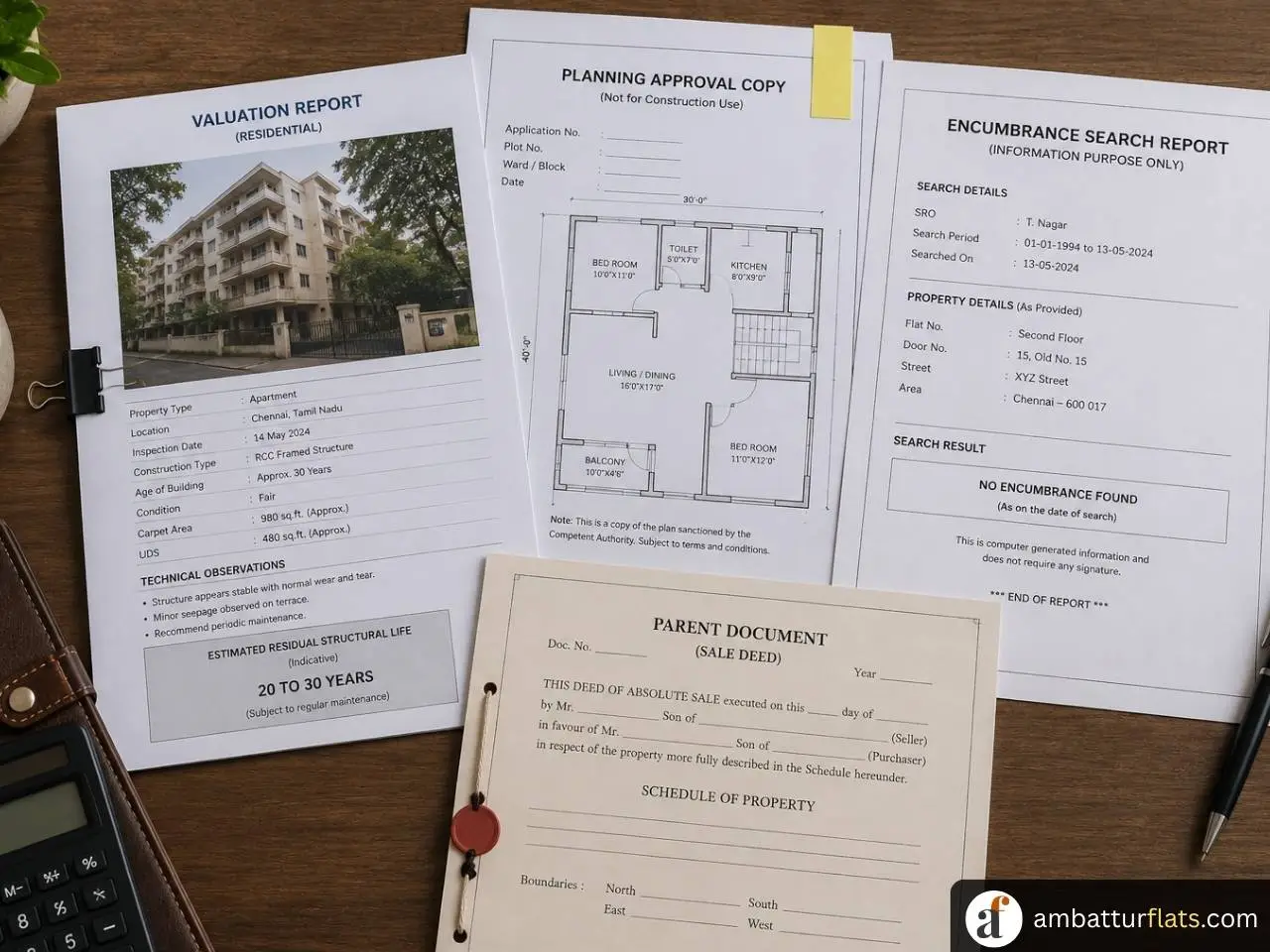
An engineer empanelled by the lender inspects the flat and writes an estimated residual life in years on the valuation report. That figure can influence the maximum tenure a lender is willing to offer, because a lender may not want the final EMI to fall due after the property's estimated remaining life. A shorter tenure means a larger EMI, and a larger EMI means your income has to stretch further to qualify. The rejection often arrives dressed as an eligibility shortfall when the real trigger was the residual life box.
The starting number valuers commonly work from is fifty years, and it traces back to Indian concrete design practice, where durability requirements are framed around a reference design life of about fifty years for ordinary reinforced concrete. Fifty is the target the original designer was asked to build towards. It is not a prediction about your building and it is not a measurement of it.
Two 1994 buildings in Kilpauk can be in completely different condition today. One has had its terrace membrane redone twice and its downpipes replaced. The other has had neither. The design assumption does not know the difference. The valuer can, if the association puts the maintenance record in front of him. Most associations never think to.
A residual life estimate is written for the building, not for the flat. An association that defers terrace waterproofing for five years is not thinking about anybody's home loan, but that maintenance decision can still affect the condition a valuer sees across the building. The cost of that decision does not surface as a maintenance complaint alone. It can surface years later as a buyer who can arrange a smaller loan, and a price that has to
adjust to meet it.
When a lender is uneasy about a property, it rarely says no outright. It says yes to a smaller number.
The mechanism is a reduced loan to value ratio. Instead of the ceiling RBI permits for your loan size, the credit team applies a lower internal cap for aging stock. The buyer then has to bridge the gap in cash at closing, often at three or four weeks' notice. This is where deals collapse. Not at rejection, but at a sanction letter that arrives for less than the buyer planned around.
Two things need stating precisely here, because a lot of confident but unsourced arithmetic circulates on this topic. First, no bank publishes its age based loan to value grid, so any specific percentage you read for a thirty year old flat is an estimate rather than a documented figure. Second, the cut is not uniform. Different lenders can take different views of the same property because their credit policies, valuation approaches and risk appetite differ.
A reduced sanction does not just create a funding gap; it can change the balance of the negotiation. When a bank cuts the loan amount late in the process, the buyer may spend the remaining time arranging additional cash instead of negotiating the price or terms. What looks like a small credit adjustment on paper can therefore leave the buyer with less room to negotiate just when the transaction is closest to closing.
Establish the sanctioned amount before you commit, not the in principle approval. An in principle approval is based on your income. The sanctioned amount is based on the property.
Chennai's building approval regime has been rewritten more than once, and buildings do not get retrospectively upgraded when the rules change.
Development in the city is regulated through planning permission issued before construction begins, followed by a completion certificate confirming the finished building matches what was sanctioned. The current framework, the Tamil Nadu Combined Development and Building Rules 2019, was notified under the Tamil Nadu Town and Country Planning Act of 1971. It ties basic service connections to that completion certificate. The Chennai Metropolitan Development Authority issues planning permission within the Chennai Metropolitan Area.
Older buildings can have approval records that are incomplete, difficult to retrieve or different from the documents available for newer projects. Some may also have additions or alterations that do not appear on the
sanctioned drawing.
None of that troubles anyone until a bank's legal panel lays the physical building against the original approved plan. A deviation that the family has lived with for thirty years can still become a documented issue in a lender's file. Depending on the nature and extent of the deviation, the lender's legal or technical team may require additional documentation, regularisation or may decline the property
as security.
If you are comparing older stock against newer projects, the approval trail is one of the sharper differences between a new launch and a resale home, and the CMDA rules for high rise flats in Chennai tell you what the authority was asking for when your building came up.
In older Chennai low rises, the land is usually worth more than the structure. A three storey building from 1988 on a 4,800 square foot plot gives each of its six owners a substantial share of the ground beneath. A modern tower on the same plot would give each buyer a fraction of that.
So the bank depreciates the part of the asset that is losing value and lends against that, while the part which has been appreciating for thirty years sits in the same sale deed and earns no credit. The undivided share of land in a Chennai apartment is the reason an old flat can be a sound purchase and a poor loan proposal at the same time.
The problems that stall files are arithmetic and registration. In small 1980s developments, builders sometimes allotted shares that do not sum to the total plot area, so the deeds collectively promise more land than exists. Elsewhere, a partition or family settlement moved the built up portion without a registered conveyance of the underlying land share. Both are fixable through rectification deeds executed by all co owners, and both take months, which is time a buyer under an agreement to sell usually does not have. Confirm the share arithmetic before you sign, alongside the carpet area, built up area and super built up area numbers you are
being quoted.
Bank legal teams commonly examine a long chain of previous ownership and title documents, often covering several decades. The exact period and documents required can vary depending on the lender, the property's history and the nature of the transaction.
Older files break in predictable places. A 1992 settlement deed was mislaid during a house move and nobody noticed because the family never sold. An inheritance passed through an unregistered will, with revenue records standing in for a registered partition. An encumbrance certificate shows a mortgage taken from a local finance company in 1988 with no recorded discharge, because the lender wound up and nobody bothered to close the entry.
None of these mean the seller lacks ownership. They mean the seller cannot prove it in the format a bank's legal opinion requires, which is a different problem and a solvable one. A lost original can often be addressed through a non traceable certificate for a lost document, and an undischarged historical charge can be cleared with a supporting affidavit and evidence of repayment. Start these before you apply, not after the legal opinion comes back, because the sequence matters to how the property registration process in Chennai plays out.
This is the one check driven by the local environment rather than by paperwork.
Chennai's coastal belt carries high airborne chloride. Moisture works through the pores in concrete, reaches the reinforcement bars and starts corrosion. Rust occupies more volume than the steel it replaces, so it pushes outward and cracks the concrete cover off. Engineers call the result spalling. You have seen it without naming it: the patches on an older facade where the plaster has fallen away and brown streaked steel is visible underneath.
Indian design codes treat coastal and marine conditions as more severe exposure categories precisely because of this, requiring denser concrete and thicker cover than an inland site. Older buildings in locations exposed to higher levels of marine moisture and airborne chlorides can face greater corrosion risk if they were not designed or maintained appropriately for those conditions.
A valuer who sees significant spalling on columns or in stilt parking may assess the building's remaining life more conservatively. Serious structural deterioration can then affect the lender's technical assessment, valuation, loan tenure or willingness to accept the property as security.
| Chec | Who runs it | What sinks it | What you can put in front of them |
| Technical valuation | Empanelled valuer or engineer | Visible spalling, seepage, distressed columns | Association maintenance records, dated repair invoices, structural audit report |
| Loan to value | Credit team | Internal age based cap | Sanctioned amount confirmed in writing before advance payment |
| Approval trail | Legal panel | Deviation from sanctioned plan, no completion certificate | Original planning permission, approved drawing, any regularisation order |
| Undivided share | Legal panel | Shares that do not sum to plot area, unregistered transfer | Parent deed, plot measurement, rectification deed if needed |
| Title chain | Legal panel | Missing link deed, unregistered will, open encumbrance | Thirty year encumbrance certificate, probate or registered partition, discharge proof |
| Structural condition | Valuer | Chloride corrosion in coastal micro locations | Independent structural assessment before the bank's visit |
Look down the right hand column. Most of what sits in that right hand column is held by the seller or the owners association, not by the buyer. Which is why the loan conversation should start with the seller, weeks before it starts with the bank.
The same building age that makes a flat hard to finance is what makes it a candidate for redevelopment. Financing and redevelopment get written about separately in Chennai, and that separation hides the more useful point. Tamil Nadu notified apartment ownership rules in 2024 that set out a process for owners of an existing building to redevelop it collectively, with written consent from at least two thirds of the apartment owners before a scheme goes to the planning authority. For buildings in the Chennai Metropolitan Area, that route runs through CMDA.
An old flat on a large land share is therefore two assets wearing one price tag. There is a depreciating structure that a lender may assess cautiously, alongside a land share that can carry redevelopment potential for the buyer. Buyers who understand this stop treating a reduced sanction as a verdict on the property and start treating it as a statement about the structure alone.
That distinction tells you which older buildings deserve the extra cash outlay, namely the ones with a large undivided share, a clean title and enough owner cohesion to act together. And which do not, namely a small land share attached to a structure with a short remaining life, where the extra cash buys you nothing but the flat.
Pull a thirty year encumbrance certificate from the Tamil Nadu registration department's portal and read every entry, including the ones that look closed.
Ask the seller for the planning permission, the approved drawing and the completion certificate, and physically compare the drawing against the building. Count the floors.
Get the parent deed and check that the undivided shares across all flats add up to the plot area
on record.
Commission your own structural assessment before the bank's valuer visits. If it is favourable, you have useful supporting information before the lender's assessment. If it is not, you may have saved yourself from paying an advance on a
problematic property.
Apply to two lenders of different types, one bank and one housing finance company, and compare the sanctioned amounts rather than the in principle approvals.
Fix the sanctioned amount in writing before the advance changes hands, and write the loan approval condition into the agreement to sell.
Run in this order, the process turns a home loan for an old apartment in Chennai from a gamble into a checklist. It costs a few weeks and some professional fees. Skipping it costs a token amount that no seller in Chennai has ever cheerfully returned. If the property is being sold by an intermediary, the same discipline you would apply to verifying a builder before buying applies to verifying a
resale seller's paperwork.
There is no regulatory age limit. RBI's housing finance norms set loan to value ceilings by loan amount, not by building age. Individual lenders apply their own internal caps, which is why the same flat can be financeable at one institution and
refused at another.
Residual life is the number of years a lender's empanelled valuer estimates the building can reasonably continue to perform. It can influence the loan tenure because a lender may not want the final EMI to fall due after the property's estimated remaining life. It is a professional judgement made on site, not a fixed calculation.
A lender may apply a lower loan to value ratio or valuation to a property it considers higher risk. The size of any reduction can vary between lenders because their credit policies and property assessments differ.
It frequently does, because the legal panel cannot confirm the built structure matches the sanctioned plan. Some lenders will proceed if a regularisation order exists or if the deviation is minor and documented. Others will not consider the file at all.
Yes, through a rectification deed executed and registered by all affected co owners. The obstacle is coordination rather than law, since every owner in the building has to participate. Expect the process to take months.
Buildings in locations exposed to higher marine moisture and airborne chlorides can face greater reinforcement-corrosion risk. Where significant corrosion or spalling is visible, a valuer may assess the building's remaining life more conservatively, which can affect the lender's technical assessment, tenure or sanctioned amount.
They may. Housing finance companies and other lenders can have different eligibility, valuation and risk criteria, so a property declined by one lender may still be considered by another. The terms offered can also differ