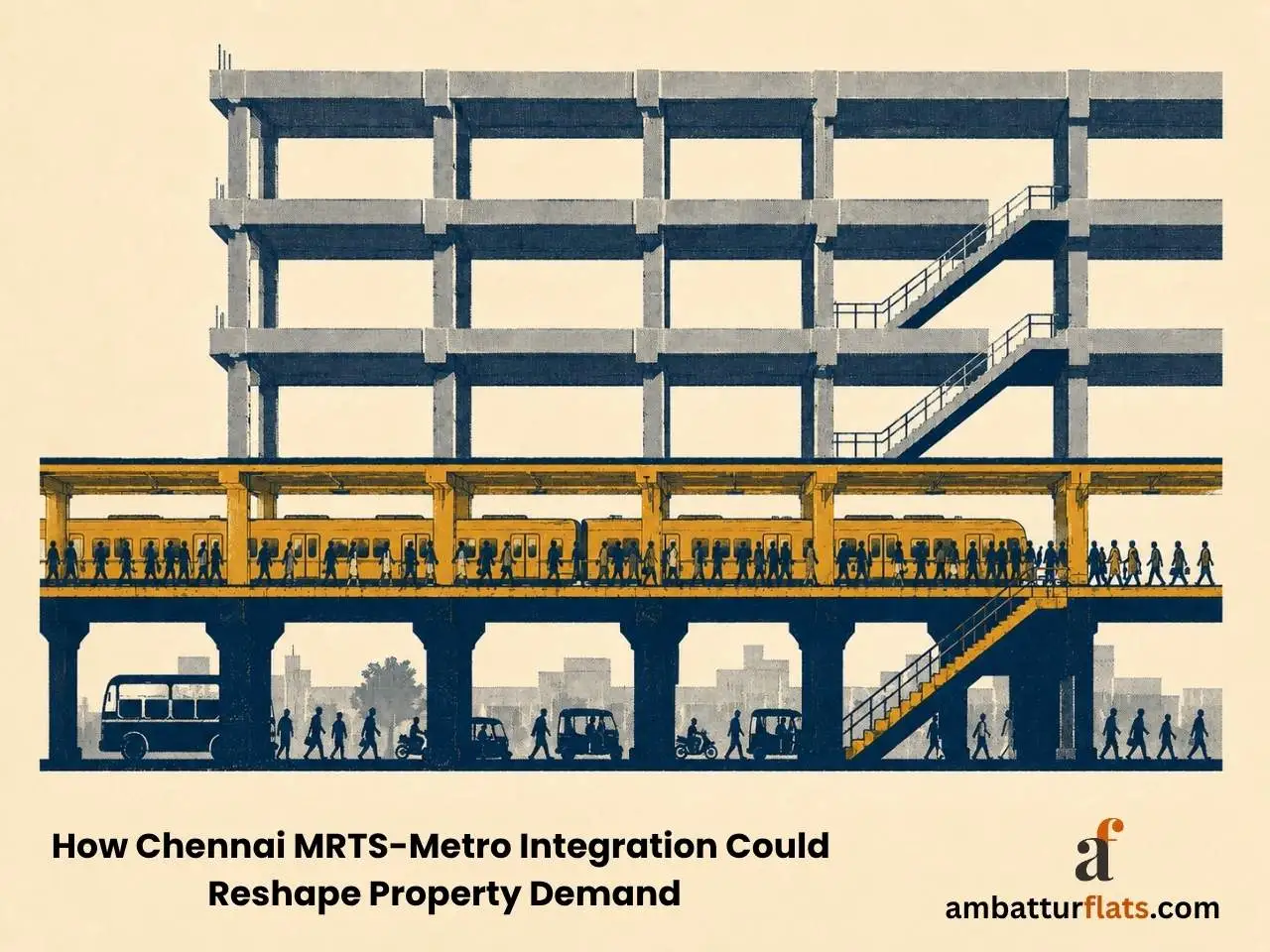

The right to build commercial space above Chennai's MRTS stations is not new. The Chennai Metropolitan Development Authority (CMDA) holds that right over nine stations on the corridor, covering a planned 2,044,400 square feet of floor area at a project cost of Rs. 733 crore. By 2009, at Taramani, Perungudi and Velachery, none of the proposed shops or offices had come up, and the oversized station buildings stood as shells. That is the backdrop to the Chennai MRTS Metro integration cleared by the Railway Board in August 2026, which hands the line to the Tamil Nadu government and then to Chennai Metro Rail Limited over about two years. The merger changes one thing along the corridor that policy could not fix on its own, which is who answers for the condition of the stations. It also leaves a great deal exactly where it was.
What the merger does and what it leaves alone:
The Railway Ministry, acting through the Railway Board, has approved the takeover of Chennai's MRTS by Chennai Metro Rail Limited. A Railway Board circular dated 12 August 2026, addressed to the Southern Railway General Manager, cleared the memorandum of understanding under which Southern Railway hands the line to the Tamil Nadu government. Southern Railway transfers station assets and routine operation and maintenance within 90 days. Core train operations and their maintenance stay with the Railways for up to two years, after which a second agreement between the state and Chennai Metro Rail Limited
completes the move.
Three names matter here. MRTS is the Mass Rapid Transit System, the elevated commuter rail line that runs from Chennai Beach through Mylapore and Thiruvanmiyur to Velachery and now St Thomas Mount. CMRL, or Chennai Metro Rail Limited, is the state owned company that runs the Chennai Metro. CUMTA, the Chennai Unified Metropolitan Transport Authority, is the state body that coordinates transport across modes, and its convenor coordinates the transition committee set up by the
Railway Board.
The assets covered include 19 of the 21 MRTS stations, along with tracks, signalling and telecom systems, lifts, escalators and the electric multiple unit rakes. Reporting on the circular does not identify which two stations are held back. This circular settled a proposal the Tamil Nadu government first sent on
27 January 2011.
Status matters here, and the status is approved, not complete. Nothing about the physical corridor changed on 12 August, and nothing will until the 90 day station handover completes.
The MRTS runs from Chennai Beach to St Thomas Mount with 21 stations. It opened in stages from 1995, reaching Thirumayilai in 1997, Thiruvanmiyur in 2004 and Velachery in 2007. The line then stopped there for close to two decades while the final stretch was held up by land acquisition disputes.
That stretch opened on 14 March 2026. The 4.5 kilometre extension from Velachery to St Thomas Mount added three stations, Puzhuthivakkam, Adambakkam and St Thomas Mount, though Southern Railway announced that trains would not stop at Adambakkam initially and that stoppage would be notified later.
St Thomas Mount is the reason the extension matters more than its length suggests. The station sits alongside the Chennai Metro line that runs to Central and alongside the suburban rail network, which turns a previously dead end line into a route with two onward connections. For a commuter living near Thiruvanmiyur or Taramani, the practical change is the ability to reach the metro network without a road journey at the end of the trip.
Reported terms of the transfer say Tamil Nadu regains more than 120 hectares of land originally allotted for the MRTS project, without payment. Railway owned plots at Chennai Beach, Fort and Park Town are to be leased to the state at 1.5 per cent of prevailing market value, with annual revisions. The state reimburses the Railways for the Railways' one-third share of jointly funded land, with interest linked to government bond yields, and compensates the Centre for the fully centrally funded first phase. Reporting does not make clear whether these payments apply to the same 120 hectares or to a separate category of jointly and centrally funded land.
These figures come from reporting on the draft agreement rather than from a published government notification, so they describe the reported shape of the deal rather than settled fact. The direction is clearer than the detail. A large block of public land inside and around central Chennai moves from an operator with no development mandate to a state government that has one.
That is a supply side event. A large release of public land inside the city that may become developable adds to supply, which cuts against the usual reading of the MRTS land handover, one that treats the merger as a demand story for flats near stations. How much of the 120 hectares is usable for anything other than the corridor itself will not be known until the state says what it intends to do with it.
Premium FSI is the extra floor area a developer can buy from the planning authority above the free entitlement, priced as a percentage of the guideline value of the land. Guideline value is the government's own minimum rate for a property, and it also determines the base for stamp duty and registration costs, which is why how guideline values are fixed and challenged affects both sides of this calculation.
An August 2022 amendment to the Tamil Nadu Combined Development and Building Rules, 2019 introduced transit oriented development provisions. It halved the premium FSI charge for land within 500 metres of Metro Rail corridors, measured from the centre line rather than from a station. A further amendment reported in early 2024 extended the same halving to MRTS and suburban rail corridors. For non high rise buildings the charge fell from 50 per cent to 25 per cent of guideline value. For high rise buildings it fell from 40 per cent to 20 percent.
Alongside that, CMDA holds the right to develop air space above nine MRTS Phase II stations along 11.166 kilometres of the corridor, at a project cost of Rs. 733 crore. MRTS Phase II here is the MRTS project's own second phase, not the Chennai Metro Phase II discussed below.
| Station | Floors | Planned commercial floor area (sq ft) |
| Mandaveli | 4 | 177,540 |
| Greenways Road | 4 | 263,620 |
| Kotturpuram | 8 | 107,600 |
| Kasturba Nagar | 4 | 161,400 |
| Indira Nagar | 4 | 344,320 |
| Thiruvanmiyur | 4 | 344,320 |
| Taramani | 4 | 193,680 |
| Perungudi | 8 | 193,680 |
| Velachery | 4 | 258,240 |
| Total | 2,044,400 |
Source: CMDA. The authority publishes these figures without stating a unit, but every one converts to a round number of square metres at 10.76, and the total to exactly 190,000 square metres, so they are square feet converted from a plan drawn in metric. The cost agrees: Rs. 733 crore across that total is about Rs. 3,585 a square foot. CMDA spells the fourth station Kasturibha Nagar and lists the last two rows as Taramani-I and Taramani-II (Perungudi).
The government approved a build, operate and transfer arrangement for the last three of these, at Taramani, Perungudi and Velachery. CMDA's own description of the programme, which is not dated, says the authority was on the verge of taking up the commercial complexes over the
station buildings.
Reporting from 2009 recorded the outcome at the three build, operate and transfer stations. A 2007 plan for at least one lakh square feet of IT offices and shopping space above each of Taramani, Perungudi and Velachery had produced nothing, and the oversized station structures built to hold that space were described as shells without basic amenities.
Ridership is the missing variable, and for the MRTS there is no reliable number to work with. Southern Railway does not publish a line-wise count for the corridor, and none has been put out since the Velachery to St Thomas Mount extension opened in March 2026. The Chennai Metro provides a cleaner comparison because its numbers are on record. July 2026 was its best month since services began, with 10,623,764 journeys and an average of 342,702 a day, against a detailed project report for the operational Phase I and Phase I extension corridors that had projected 15.69 lakh daily passengers by 2026. The record month came in at roughly a fifth of what the plan assumed.
Set that against a corridor that publishes no figures at all, and the conclusion is hard to avoid. The constraint on station area redevelopment has not been permission. The halved premium FSI charge has applied along the MRTS since the rules were amended in early 2024, and CMDA has held air rights over nine stations since well before that. That extension of the rule to MRTS corridors is only about two years old, which is too short a window to judge it on, and the 2009 outcome describes the corridor before any of these incentives existed. Commercial floor space above a station is underwritten by the people who walk past it, and the footfall has not been there. The right to build is not by itself a reason to build.
The Chennai MRTS merger changes who answers for station condition, which is where the corridor has failed most visibly. Station upkeep, lifts, escalators, ticketing, cleaning and security move to state control within 90 days, and eventually to an operator whose ridership on its own network reached a record in July 2026, low as that record is against the original projection. CUMTA already runs the Chennai One app, launched on 22 September 2025, which at launch covered the metro, MTC buses, Namma Yatri autos and taxis, with the MRTS and suburban trains listed for later integration. That pending item is the clearest illustration of the split the merger closes. Fare and information for the corridor have sat with Southern Railway while the app coordinating every other mode in the city is run by the state, and once the handover completes both sit with the same authority.
What stays the same is longer than what changes. The FSI rules were already in place and are untouched. Guideline values are set by a different department entirely. Train operations, frequency and rolling stock remain with the Railways for up to two years, so the timetable a commuter actually experiences is unchanged for now. Ridership is untouched too, and that is the number that has to move before any of the development rights become commercially interesting.
There is a trap in that sequencing for anyone judging the corridor by eye. The improvements that land first are the ones a buyer can see on a site visit — a working escalator, better lighting, a cleaner platform, someone accountable for the place. The one that decides whether people actually switch to this line, which is how often a train turns up, is the part held back the longest. For the next two years a walk through Thiruvanmiyur or Taramani station will show a corridor that is visibly better and functionally unchanged, and it is the second half the development rights depend on.
The Chennai MRTS CMRL integration puts one input to ridership, the condition of the stations and accountability for it, under a single owner, on a timeline measured in years rather than quarters.
St Thomas Mount is the clearest case, because the value there comes from the interchange rather than from the merger. The MRTS, the metro and the suburban network now meet at one point, and Chennai Metro Phase II will add further crossings. The Union Cabinet approved Phase II on 3 October 2024 at a cost of Rs. 63,246 crore, covering the Madhavaram to SIPCOT corridor of 45.8 kilometres with 50 stations, the Lighthouse to Poonamallee Bypass corridor of 26.1 kilometres with 30 stations and the Madhavaram to Sholinganallur corridor of 47 kilometres with 48 stations. Those corridors run through the same southern employment belt the MRTS serves.
Taramani and Perungudi carry the other kind of exposure. Both sit next to the IT employment concentration on the Old Mahabalipuram Road side of the city, and both are build, operate and transfer stations under the CMDA air rights plan. Perungudi is also one of only two stations in that plan cleared for eight floors of commercial space rather than four, the other being Kotturpuram. If station area commercial development starts anywhere on this corridor, the published plan points here.
The central stretch is different again. Mandaveli, Greenways Road and Kotturpuram sit in established areas where guideline values are high and vacant land is scarce, which makes premium FSI expensive in absolute terms even at the halved rate. Redevelopment there is more likely to come through joint ventures on existing plots than through new construction, and that pathway depends on the arithmetic of undivided share rather than on transit policy. Readers weighing locality choices on infrastructure and employment grounds may find it useful to compare this with which Chennai localities are drawing buyers on
connectivity and jobs.
The 500 metre band is measured from the centre line of the corridor, not from a station entrance. That distinction decides whether a plot qualifies for the reduced premium FS0049 charge, and it is an easy detail to get wrong. Chennai developers were reported to be still seeking clarity from CMDA in July 2026 on how the rule applies when only part of a site falls inside the band, or when the access road lies outside it. That representation concerned the Metro Rail corridor band, but the provision is worded the same way for MRTS and suburban rail corridors, so the same question arises along this corridor. A buyer relying on a builder's claim about transit oriented development benefits should ask to see how the distance was measured.
Because the 500 metre band is measured from the centre line of the corridor, it is triggered by the tracks, not by a train that stops. Adambakkam opened as part of the Velachery to St Thomas Mount extension on 14 March 2026, and Southern Railway said trains would not stop there initially, with a stoppage to be notified later. Land within 500 metres of the corridor at Adambakkam still falls inside the band, so a developer there can buy premium FSI at 25 per cent of guideline value for a non high rise building, or 20 per cent for a high rise, on a plot next to a station no passenger can currently board at. The concession is priced on nearness to a line; whether that line stops for the buyer is a separate fact, and no FSI benefit records it.
Walking distance to the station is a separate question from the FSI band, and it is the one that affects daily life. Chennai buyers have been weighing this more heavily, which is part of why walkable neighbourhoods are pulling buyers away from larger flats in isolated pockets.
Older buildings near the corridor are often bought with redevelopment in mind. The entitlement on a rebuild follows the undivided share recorded in the sale deed, so how undivided share decides what an owner receives in a redevelopment matters more than the age of the building. Financing is the other constraint, and lenders apply their own tests to ageing stock, which is why what banks examine before lending on an older Chennai flat is worth settling before an offer rather than after.
None of this points to a timeline for price movement, and nobody should read it as one. Anyone weighing a purchase on the strength of this announcement is really making a bet on ridership. Housing sales across the major Indian cities were reported to have slowed in early 2026 while prices held, and buyers looking at a market where transactions have cooled but rates have not are in a stronger position to negotiate terms than to
wait for a correction.
Ridership is the number that settles the argument, and the first thing to watch is whether it gets published at all. CMRL reports its own ridership monthly. If it does the same for the MRTS once the handover completes, the air rights CMDA has held since at least 2007 become testable against real footfall rather than assumption. If the corridor changes hands and still goes uncounted, it will have a better landlord and the same empty concourses.
It is the transfer of the Mass Rapid Transit System from Southern Railway to the Tamil Nadu government and then to Chennai Metro Rail Limited. A Railway Board circular dated 12 August 2026 approved the memorandum of understanding. Station assets and routine maintenance move within 90 days, and train operations follow over about two years.
There is no evidence available that supports a price forecast. The development incentives most often cited, the halved premium FSI charge along the corridor and CMDA's air rights over nine stations, were already in place before the merger and have not produced large scale station area development so far. The variable that has not moved is ridership.
CMDA's plan covers nine stations: Mandaveli, Greenways Road, Kotturpuram, Kasturba Nagar, Indira Nagar, Thiruvanmiyur, Taramani, Perungudi and Velachery. The total planned floor area is 2,044,400 square feet. A build, operate and transfer arrangement was approved for Taramani, Perungudi and Velachery.
Within 500 metres of the corridor, measured from the centre line rather than from a station entrance. Developers were reported to have asked CMDA in July 2026 for clarity on sites that only partly fall inside the band, so the treatment of a boundary case should be confirmed with the authority rather than assumed.
Services on the 4.5 kilometre extension began on 14 March 2026, adding Puzhuthivakkam, Adambakkam and St Thomas Mount. Southern Railway announced that trains would not stop at Adambakkam initially.
Phase II is a separate project, approved by the Union Cabinet on 3 October 2024 at Rs. 63,246 crore across three corridors. It matters to the MRTS corridor because its alignments pass through the same southern employment areas, which increases the number of interchange points along the route.