

You've done everything right. You've compared localities, negotiated a fair price, and finally decided to move forward on a property in Chennai. Then, at the Sub-Registrar's office, the numbers don't add up. Your registration costs are higher than expected, not because the property price changed, but because the guideline value for your street was quietly inflated by a premium deal that had nothing to do with your flat.
This has been a real and recurring problem for Chennai homebuyers. The Tamil Nadu Registration Department has now stepped in with a clarification circular that directly addresses this issue. Here's what happened, what the circular says, and what it means for your registration costs.
Before getting into the circular, it helps to understand what guideline value actually is - and how much it costs you.
When you buy a property in Chennai, you pay more than just the agreed price. On top of that, you owe the government 7% as stamp duty and 4% as registration fee - totalling 11% of the property's value. These charges are calculated on whichever is higher: your actual sale price or the guideline value.
In practical terms, if you buy a flat at ₹50 lakh but the guideline value for that street is ₹55 lakh, your stamp duty and registration are calculated on ₹55 lakh - not ₹50 lakh. On a ₹55 lakh base, that's roughly ₹3.85 lakh in stamp duty and ₹2.2 lakh in registration charges. That's ₹6 lakh out of pocket before you've even moved in.
Simply put: guideline value directly controls how much you pay at registration, even if your deal price is lower. You can verify the applicable guideline value for any street or survey number on the official TNREGINET portal before finalising a deal.
Guideline value is the minimum rate set by the Tamil Nadu Registration Department for a specific street or locality. It is not the market price. Under ideal conditions, the guideline value tracks market reality reasonably well. But it is a government benchmark that is fixed periodically, applied uniformly to a street, and it doesn't automatically reflect every spike or dip in actual transactions.
Market value, on the other hand, is what buyers and sellers actually agree to. It fluctuates based on demand, builder reputation, floor level, amenities, and dozens of other factors. The two numbers are rarely identical, and that gap is where the recent problem emerged.
Not every property sale reflects the typical value of a street. Some transactions happen at significantly higher prices because of specific factors: a corner plot with commercial visibility, a main-road-facing property commanding a premium, a deal driven by a particular business requirement, or a buyer willing to pay above market for strategic reasons.
These are legitimate transactions, but they are outliers. They don't represent what an ordinary homebuyer would pay for a standard residential flat two lanes away. The problem arose when field-level officials informally used these outlier deals as reference points to revise guideline values for the entire surrounding area.
According to Credai Tamil Nadu, developers, landowners, and homebuyers across the state faced difficulties as select high-value transactions were treated as informal benchmarks for whole streets and neighbourhoods. The result: guideline values in several areas were pushed up artificially, with no real market justification for the increase on most properties in those localities.
For homebuyers, this had a direct financial impact. Higher guideline values meant higher stamp duty and registration costs, even when the actual sale price hadn't moved. It also created uncertainty during document registration, with buyers unsure what figure the Sub-Registrar would apply until they were already at the office.
The Tamil Nadu Registration Department has issued a clarification circular specifically addressing this practice. The circular makes one thing clear: isolated high-value land or property transactions should not be treated as benchmark rates for an entire locality.
In other words, a single premium deal cannot be used to revise the guideline value for adjacent residential streets, however large it may be. Field officials are now guided against using sporadic transactions to set or justify broader valuation benchmarks. The New Indian Express reported that the circular is expected to bring greater uniformity and transparency to property registrations across the state.
The real estate industry has welcomed the move. Habib WS, president of Credai Tamil Nadu, stated that the government's clarification brings much-needed clarity and balance to the system and should reduce arbitrary interpretation during registrations.
This reaction is consistent with what the industry body had flagged earlier — that upward revisions in guideline values, even modest ones, create compounding difficulty for developers and end-users when applied broadly without justification. The clarification circular, issued amid growing concerns over rising registration costs, signals that the government has heard those concerns.
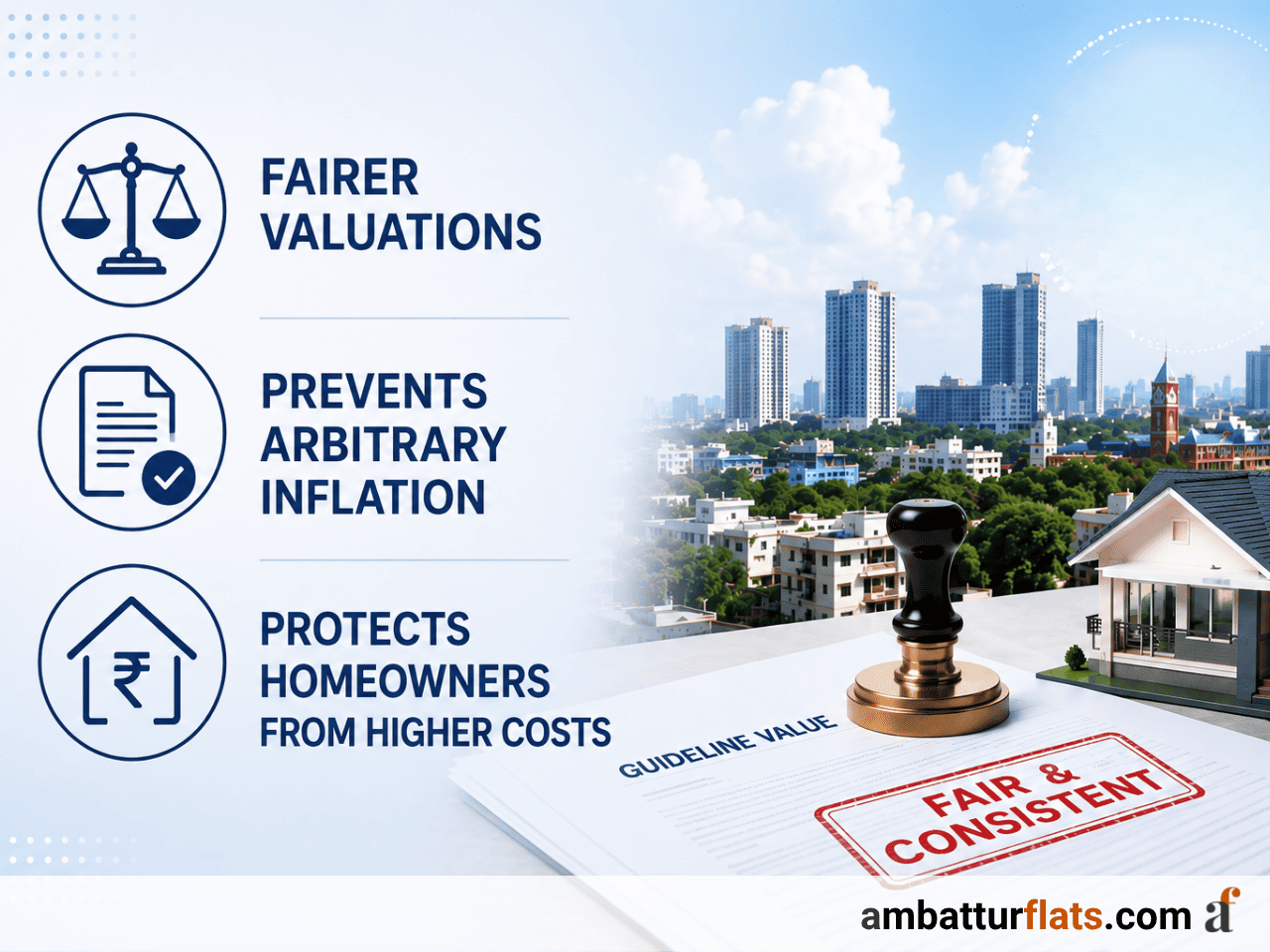
Not automatically, and it's worth being clear about this. The circular does not revise existing guideline values downward. What it does is prevent further arbitrary inflation caused by outlier deals. Going forward, field officials have clearer guidance on what they can and cannot use as a basis for applying or revising guideline values.
For buyers currently in the process of registering a property, this circular reinforces that you have a right to question valuations that appear disproportionate to the locality's general market. If a guideline value applied to your street seems inconsistent with actual residential transaction prices in the area, the circular provides a stronger basis to raise that concern.
Women buyers also have an additional concession worth noting: from April 2026, the Tamil Nadu government offers a 1% reduction in registration charges for properties valued below ₹10 lakh registered in a woman's name.
Yes. If you believe the guideline value applied to a property is higher than what the market genuinely supports, you can approach the District Registrar's office with supporting evidence, recent sale deeds from the same locality, property valuation certificates, or market data. The process typically takes 30 to 60 days. It's not quick, but it is a formal channel.
More practically, checking the guideline value before you finalise any deal is non-negotiable. Knowing the number in advance lets you factor it into your total purchase cost rather than encountering it as a surprise at the registration counter. Understanding Tamil Nadu land records, including how survey numbers, patta details, and guideline values interconnect, is a smart first step before any transaction.
The short answer: yes, if you've done your homework. The Chennai real estate market has seen steady residential demand across localities, and the registration framework is evolving in a more buyer-friendly direction.
The new circular is one part of a broader shift toward greater transparency in property transactions. Combined with digital tools that now make guideline value checks instant and free, buyers today have more accessible information than at any point before. What this means for you is simpler: fewer surprises, more predictable costs, and a clearer picture of what buying a home in Chennai actually involves end-to-end.
Use a solid homebuyer checklist to make sure guideline value verification, stamp duty budgeting, and RERA checks are all accounted for before you sign.
The Tamil Nadu Registration Department's clarification circular is a practical step toward a more consistent and fair property registration process. It doesn't rewrite the rules, but it reinforces that valuations should reflect actual residential market conditions, not isolated premium transactions.
For Chennai homebuyers, the key takeaways are straightforward: check guideline value before finalising any deal, factor in the full 11% registration cost from the beginning, and know that you have formal channels to question valuations that don't reflect your locality's reality.