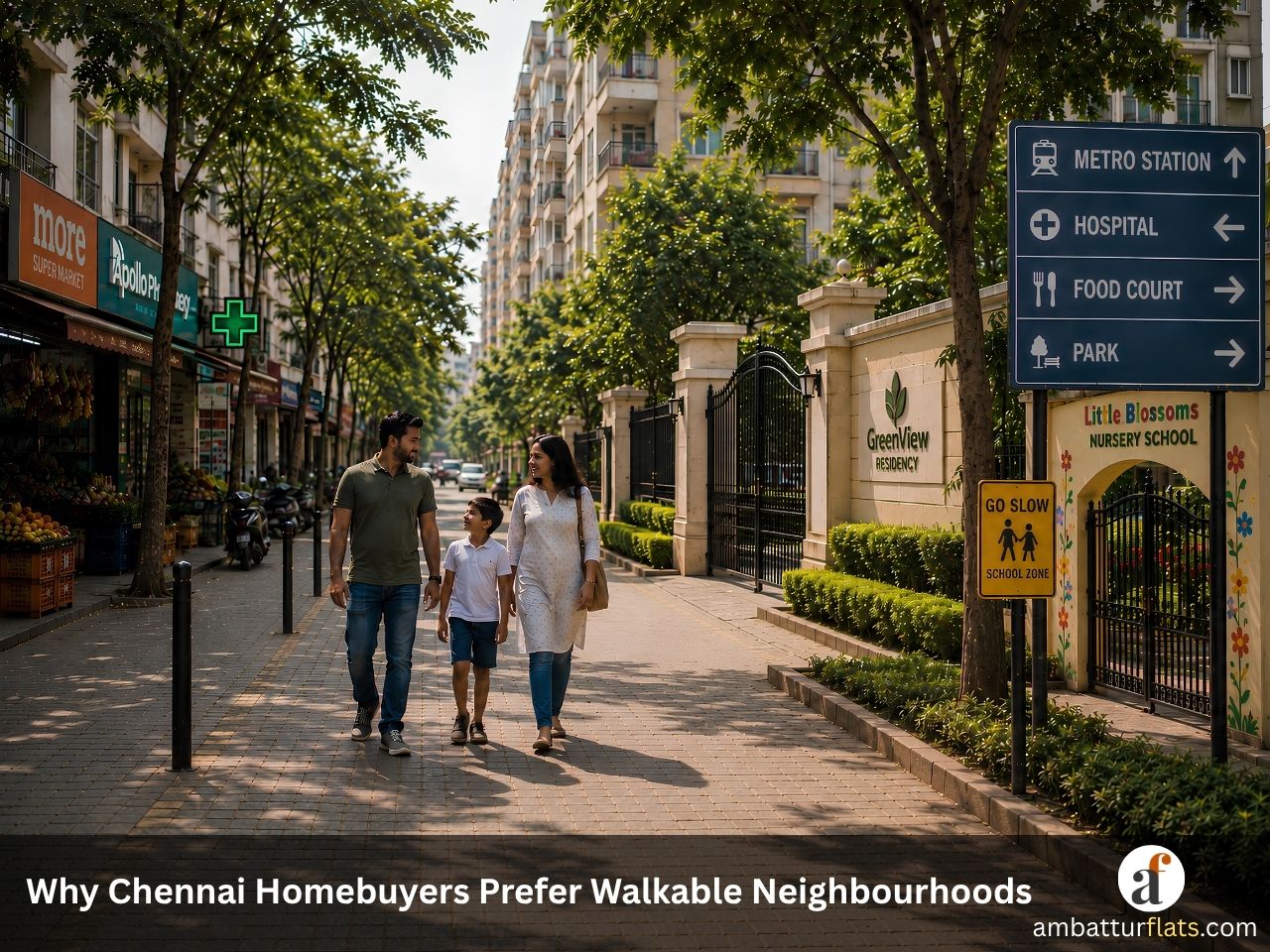

A few years ago, buying a home in Chennai was largely about apartment size, amenities and the reputation of the neighbourhood. While these factors still matter, many homebuyers today are paying closer attention to something far more
practical: convenience.
Whether it is reaching a school, supermarket, hospital, workplace or metro station, people want everyday life to be easier. Long commutes, traffic congestion and changing work patterns have led buyers to look beyond the apartment itself and pay more attention to the neighbourhood around it.
As a result, walkable neighbourhoods have become an important consideration for many Chennai homebuyers. Locations where residents can access daily essentials without spending hours on the road are attracting attention from families, working professionals and even retirees.
In this article, we will look at what makes a neighbourhood walkable, why Chennai homebuyers value walkability, how it can affect property demand and how infrastructure projects are shaping connected residential locations across the city.
A walkable neighbourhood is one where residents can comfortably access daily essentials without relying heavily on private vehicles. Schools, supermarkets, pharmacies, hospitals, parks, workplaces and public transport are all located within
convenient reach.
For many families, walkability is no longer just a lifestyle preference. It has become an important factor when choosing where to live. Easy access to everyday necessities can save time, reduce travel stress and make everyday life
more convenient.
Many buyers now look beyond amenities that exist inside a residential community. As the Chennai Metropolitan Development Authority (CMDA) Area Development initiatives continue to support better urban planning and mixed-use development, buyers are paying closer attention to what is available outside their apartments
Is there a good school nearby? Can residents buy groceries without a long drive? Is a hospital easily accessible during an emergency? Is there a metro station within a reasonable distance?
For many homebuyers, these questions matter just as much as the apartment itself.
For many years, homebuyers compared residential projects mainly based on apartment size, amenities and price. While those factors remain important, buyer priorities have changed.
A family may use a swimming pool once a week. They may visit the clubhouse occasionally. But they interact with their neighbourhood every day. The nearest grocery store, local pharmacy, school and public transport connection often have a greater impact on daily life than buyers initially realise.
This shift is encouraging people to evaluate the neighbourhood with the same attention they give to the apartment itself. Many buyers now prefer locations that make daily life easier rather than properties that simply offer more amenities. This is one of the main reasons why Chennai homebuyers are no longer focused on prestige locations alone and are instead paying more attention to accessibility, convenience and connectivity.
Walkability is not only about convenience. It can also affect how attractive a location remains over time. Neighbourhoods with easy access to educational institutions, healthcare centres, public transport, retail centres and employment hubs often continue to attract interest from both homebuyers and tenants.
When people can comfortably reach everyday services, the area becomes more practical to live in. This steady appeal can help increase property values and keep demand healthy even as market conditions change.
In many cases, buyers are willing to choose a slightly smaller home in a convenient location over a larger home that requires long daily commutes.
Infrastructure plays an important role in creating connected neighbourhoods. The ongoing Chennai Metro Phase 2 Yellow Line project is expected to improve accessibility across several residential corridors. Better public transport connections make daily travel easier and help residents reach workplaces, educational institutions, hospitals and commercial centres
more efficiently.
As metro connectivity improves, homebuyers are showing greater interest in locations that can benefit from shorter travel times and easier access to important parts of the city.
Valasaravakkam is a good example of how connectivity and convenience can influence buyer interest. In many ways, Valasaravakkam offers some of the same everyday conveniences that make nearby locations such as Vadapalani popular among homebuyers, while remaining more accessible for buyers with
different budgets.
Located close to established areas such as Vadapalani, the neighbourhood offers access to well-known schools, established hospitals like SIMS, shopping centres like Nexus Mall and entertainment options while remaining more affordable than some nearby locations.
The upcoming metro corridor is expected to improve connectivity further, making daily travel easier for residents. Better connectivity can make commuting easier and improve access to workplaces across Chennai. For buyers looking at connected residential locations, Valasaravakkam shows how infrastructure improvements can strengthen a neighbourhood's appeal without relying solely on premium pricing.
If you want to compare this area with other neighbourhoods attracting attention from buyers, take a look at where Chennai buyers are looking next across the city's emerging residential locations. Homebuyers considering nearby alternatives can also look at the best apartments in Porur and compare the advantages offered by different residential corridors in
West Chennai.
A walkable neighbourhood is about more than proximity. It is about how easily residents can go about their daily lives without depending on long drives for every task.
When evaluating a location, pay attention to the overall convenience of the area, the quality of its infrastructure and how comfortable it is to move around. Well-planned neighbourhoods often make everyday routines simpler while offering better access to the places people visit most often.
Taking the time to evaluate the neighbourhood alongside the property can help homebuyers choose a location that suits their lifestyle and everyday needs.
Because people are tired of spending hours in traffic just to run basic errands. While a big apartment or a nice clubhouse is great, you only use them occasionally. Having a supermarket, a pharmacy, or your kid's school right down the street is something that makes your actual everyday life easier.
The Chennai Metro Phase 2 Yellow Line is expected to improve connectivity across several residential corridors. Locations with easier access to metro stations often attract greater buyer interest because they can reduce travel times and improve access to different parts of the city.
Valasaravakkam is often considered a well-connected residential location due to its access to schools, hospitals, shopping centres and nearby commercial areas. Ongoing infrastructure improvements and its proximity to established neighbourhoods have also contributed to buyer interest.
They do, because they are highly practical to live in. Neighbourhoods where you can walk to schools, hospitals, and transit hubs stay popular with both homebuyers and tenants. This steady demand keeps property values healthy, even when the broader real estate market goes through quiet phases.
Porur is a popular residential location in West Chennai due to its connectivity, access to major roads and proximity to employment hubs, healthcare facilities and educational institutions. It is often considered by buyers looking for well-connected neighbourhoods.