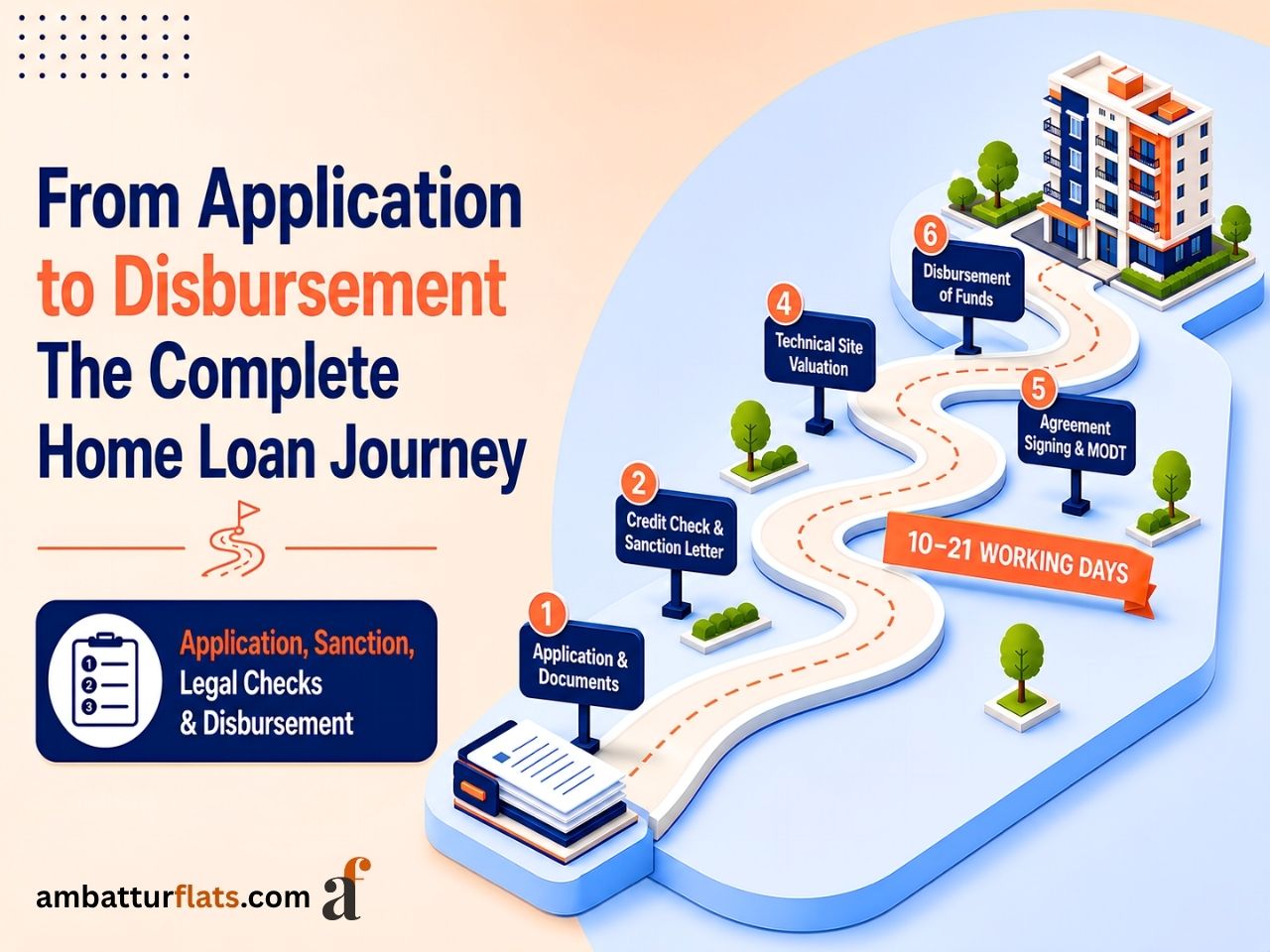
From Application to Disbursement: The Complete Home Loan Journey

[DISCLAIMER]: Loan processing timelines, stage-wise documentation requirements, and site inspection procedures vary by bank and property type. Borrowers should maintain organized copies of all submitted documents to prevent unnecessary turnaround delays.
Navigating the home loan application landscape in India can often feel complex due to banking terminology, credit underwriting protocols, and extensive legal verifications. Whether purchasing a ready-to-move apartment or an under-construction unit, understanding the end-to-end processing roadmap helps buyers streamline property acquisition and eliminate avoidable friction. For a holistic overview of regional financing, exploring a comprehensive Chennai home loan advisory resource provides foundational clarity on lender expectations and local market dynamics. This step-by-step breakdown illuminates every milestone from initial file submission to final fund disbursement.
Average Processing Time: Turnaround ranges between 10 to 21 working days for standard properties upon submitting complete documentation.
Sanction Letter Validity: An in-principle sanction letter remains valid for 3 to 6 months, giving buyers a fixed window to finalize property selections.
Verification Protocols: Lenders conduct dual checks—combining digital background authentication with physical field visits to residence and workplace.
Independent Legal & Technical Vetting: Legal vetting of property title and physical valuation are conducted concurrently by empanelled specialists.
Fund Release Modes: Disbursement is issued via electronic transfer or Demand Draft (DD) directly to the seller, developer, or takeover bank.
The home loan journey begins with completing the lender's application form - either through a digital portal or branch office. During this preliminary stage, the applicant and any co-applicants submit essential personal and financial credentials. Gathering all mandatory documentation required for home loan approval - including PAN cards, Aadhaar cards, salary slips, Form 16s, bank statements, and Income Tax Returns (ITR) - ensures immediate onboarding into the underwriting system.
Alongside the application dossier, the borrower pays an initial, non-refundable processing fee. Lenders charge this fee (ranging from 0.25% to 0.50% of the requested loan quantum, plus applicable taxes) to cover administrative costs, credit bureau pulls, and initial file processing. Thoroughness at this point prevents immediate file queries or processing halts.
Once the file is logged, the bank’s underwriting team initiates credit appraisal. Underwriters pull CIBIL reports to review credit history, repayment track records, and existing liabilities. They calculate the Fixed Obligation to Income Ratio (FOIR) to determine maximum monthly EMI capacity relative to net income. Simultaneously, field verification agents make physical or telephone contact at the applicant's residence and office to verify employment stability and residential credentials.
Upon satisfying credit criteria, the bank issues an In-Principle Sanction Letter. This preliminary approval document specifies the maximum sanctioned loan amount, baseline interest rate, repayment tenure, and general conditional requirements. Before locking in an offer, borrowers benefit from comparing home loan interest rates across major public and private banks to ensure they secure competitive pricing tailored to their credit score.
After securing the sanction letter, attention shifts to property-level scrutiny. The lender assigns the property title documents to an empanelled legal advocate. The legal advisor executes a thorough search covering 13 to 30 years of parent documents, previous sale deeds, Encumbrance Certificates (EC), mutation records, and local authority construction approvals (such as CMDA or DTCP plans).
The legal advocate issues a Title Search Report (TSR) confirming whether the property possesses a clear, marketable, and unencumbered title free from litigation, mortgage claims, or legal disputes. If discrepancies emerge, the bank requests supplemental clearance documents, draft agreements, or a builder NOC before clearing the legal stage.
In parallel with legal scrutiny, the bank commissions a technical appraisal. Empanelled civil engineers or certified valuers visit the physical property site. They evaluate construction progress, building code compliance, carpet area measurements, setback alignments, and general construction quality.
The engineer establishes the fair market value and realizable value of the structure. Lenders strictly enforce Loan-to-Value (LTV) limits set by regulatory frameworks (typically 75% to 90% of the property value). The technical report determines the maximum actual loan amount the bank will finance, irrespective of the initial in-principle sanction limit.
With legal and technical approvals secured, the transaction transitions to formal contract execution. The borrower reviews and signs the binding home loan agreement, which details final loan parameters, pre-payment rules, reset dates, and terms. During this stage, borrowers should pay close attention to evaluating legal, processing, and ancillary fees to understand the true all-inclusive cost of borrowing beyond headline interest rates.
To create security for the loan, the property owner executes a Memorandum of Deposit of Title Deeds (MODT). This formal legal document records that original property title deeds have been deposited with the bank to establish an equitable mortgage. The MODT is registered at the jurisdictional Sub-Registrar Office with applicable state stamp duty and registration fees paid. Finally, auto-debit mandates (National Automated Clearing House - NACH or Electronic Clearing Service - ECS) are activated for seamless monthly EMI deduction.
The final phase is the actual release of funds. The buyer must provide proof of having paid their own contribution (down payment) to the seller or builder, alongside original property title documents and builder demand letters. The bank then issues loan funds payable directly to the developer, seller, or balance transfer lender via Demand Draft or direct RTGS transfer.
Fund disbursement follows two primary models based on property status:
Full Disbursement: For ready-to-move-in flats or resale properties, the sanctioned loan amount is released in a single lump sum upon sale deed registration.
Tranche-Based Disbursement: For under-construction projects, funds are disbursed in partial installments linked directly to completed construction milestones verified by civil engineers. Borrowers typically pay simple interest (Pre-EMI) on the disbursed quantum until full property completion.