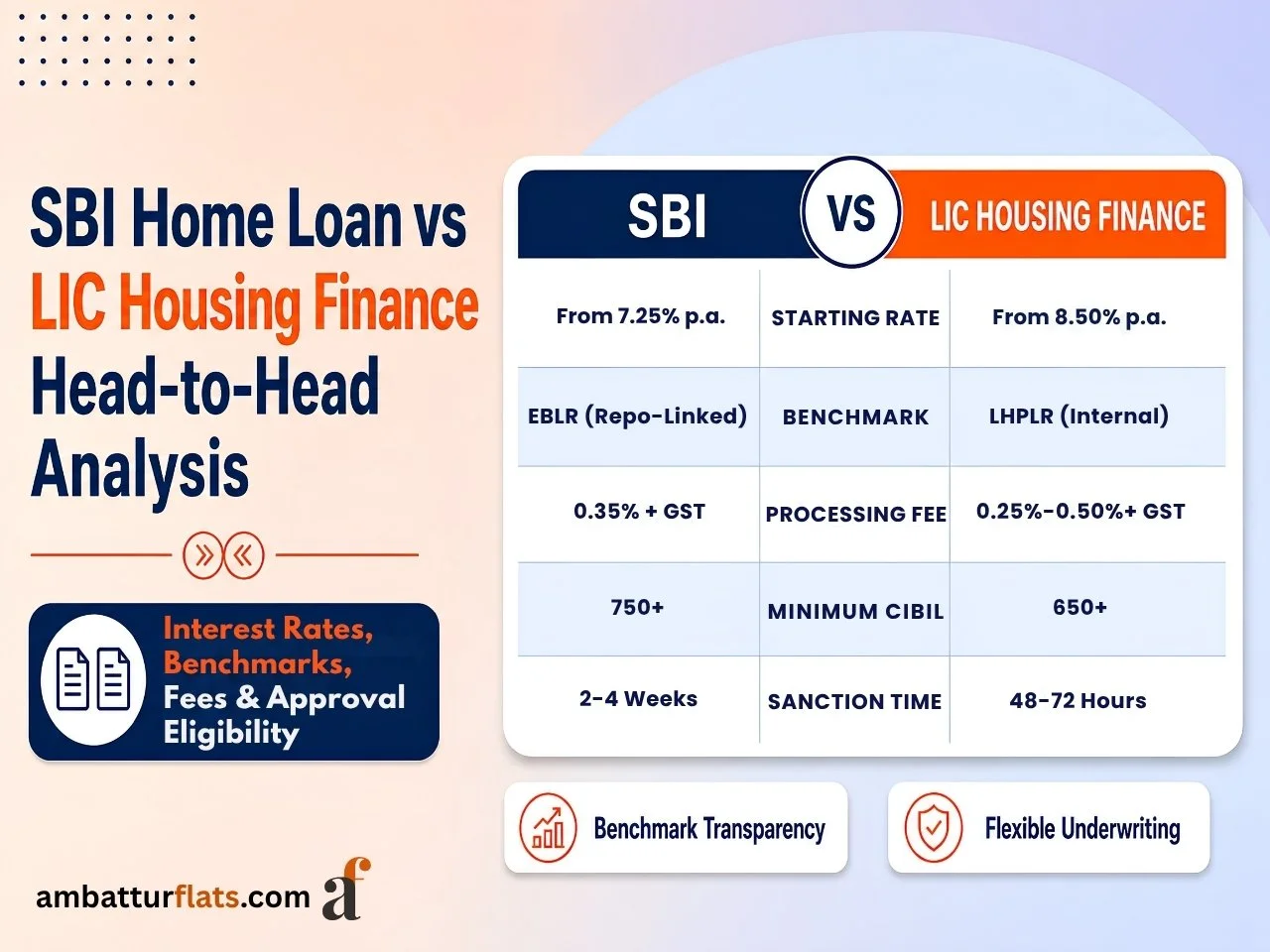
SBI Home Loan vs LIC Housing Finance: Head-to-Head Analysis

[DISCLAIMER]: Interest rates, benchmark spreads, and processing fees referenced are based on current 2026 lending guidelines by State Bank of India and LIC Housing Finance. Final terms depend on individual underwriting assessments, property legal approvals, and credit score evaluations.
Navigating the Indian mortgage market often narrows down to a choice between two giants: State Bank of India (SBI), the country's premier public sector bank, and LIC Housing Finance Limited (LICHFL), India's flagship Housing Finance Company (HFC) promoted by the Life Insurance Corporation of India. While both entities enjoy immense trust and command a massive market share, their institutional structures, regulatory frameworks, and operational models differ fundamentally.
SBI operates as a commercial bank governed directly under Reserve Bank of India (RBI) regulations. Consequently, its floating-rate housing loans are strictly anchored to an external benchmark, ensuring instantaneous monetary policy transmission. In contrast, LIC Housing Finance is an HFC regulated by the RBI under the National Housing Bank (NHB) umbrella. LICHFL prices its loans against an internal prime lending rate, allowing for greater underwriting flexibility but operating with a different interest rate adjustment cadence.
Selecting between SBI and LICHFL requires looking beyond the advertised headline interest rates. Borrowers must evaluate benchmark transparency, credit score sensitivity, processing fees, and title clearance protocols. For those seeking a comprehensive guide to home financing in Chennai, understanding these institutional differences is essential for securing optimal long-term credit terms.
Starting Interest Rates: SBI offers entry-level floating rates starting from 7.25% p.a., whereas LIC Housing Finance rates begin around 8.50% p.a. for prime profiles.
Benchmark Models: SBI utilizes an RBI Repo-linked External Benchmark Lending Rate (EBLR). LIC HFL relies on its internal benchmark, the LIC Housing Prime Lending Rate (LHPLR).
Loan-to-Value (LTV) Ratios: Both lenders offer up to 90% LTV for property loans up to Rs. 30 lakh, 80% for loans between Rs. 30 lakh and Rs. 75 lakh, and 75% for loans above Rs. 75 lakh.
Processing Fee Caps: SBI charges a standard 0.35% of the loan amount plus GST (capped between Rs. 2,000 and Rs. 10,000 + GST). LIC HFL charges between 0.25% and 0.50% of the loan amount + GST (typically capped up to Rs. 15,000 + GST depending on profile).
Minimum CIBIL Cutoffs: SBI maintains strict tier-based interest rates, penalizing scores below 750 with higher risk spreads. LIC HFL accommodates borrowers with CIBIL scores down to 650+ under flexible credit brackets.
Gender Concessions: SBI provides an explicit 0.05% (5 bps) interest rate discount for female primary applicants. LIC HFL offers equivalent concessions on select low-ticket schemes.
The core operational divide between SBI and LIC Housing Finance lies in how floating interest rates are calculated and revised.
SBI’s rates are pegged directly to its External Benchmark Lending Rate (EBLR), which moves in tandem with the RBI’s Repo Rate. When the monetary policy committee adjusts the repo rate, SBI is mandated to reset its EBLR accordingly. This provides transparent, automated rate adjustments for existing borrowers. If repo rates drop, SBI home loan holders receive instant reductions in their Equated Monthly Installments (EMIs) or loan tenures without needing to request manual rate conversions. Borrowers interested in comparing home loan interest rates across top public and private banks will find that EBLR mechanisms offer some of the most transparent pass-through benefits in retail banking.
LIC Housing Finance determines its floating interest rates using its internal benchmark, the LHPLR (LIC Housing Prime Lending Rate). When LICHFL adjusts its LHPLR, rates change across its home loan portfolio. However, because LHPLR is an internal prime lending rate rather than an external repo-linked benchmark, rate cuts may not pass through automatically or at the same speed as public sector banks. During rate reduction cycles, existing LICHFL borrowers may need to pay a nominal conversion fee to align their spread with the prevailing lower rates offered to new applicants.
Credit risk evaluation methodologies diverge significantly between these two lenders. SBI operates a rigid, risk-based pricing framework tied heavily to credit bureau scores. To qualify for SBI’s lowest tier interest rates (7.25%–7.50% p.a.), applicants generally need a CIBIL score of 750 or higher. If an applicant’s CIBIL score drops into the 700–749 band, SBI adds a credit risk premium that elevates the interest rate by 20 to 40 basis points. Applicants with CIBIL scores below 680 often face outright rejections or require substantial co-borrower credit enhancements.
LIC Housing Finance exhibits greater underwriting flexibility. While LICHFL reserves its lowest brackets (8.50% p.a.) for applicants with 750+ CIBIL scores, it maintains established lending criteria for scores ranging from 650 to 749. Furthermore, LICHFL evaluates self-employed applicants, business owners with complex income streams, and cash-earning profiles with broader risk-acceptance criteria. Understanding these key profile and macroeconomic factors that decide interest rates allows applicants with non-standard credit histories to target the lender best suited to their financial standing.
Evaluating the true price of a loan requires analyzing upfront administrative, legal, and statutory fees alongside headline interest rates.
SBI offers a highly competitive processing fee structure:
Processing Fee: 0.35% of the loan amount plus GST, subject to a minimum of Rs. 2,000 and capped at a maximum of Rs. 10,000 + GST. (SBI also frequently waives processing fees during seasonal festival campaigns).
Legal and Technical Charges: Charged at actuals, usually ranging between Rs. 2,500 and Rs. 5,000 depending on the advocate and valuer panel fees.
Memorandum of Deposit of Title Deeds (MODT): Stamp duty charges assessed per state government regulations.
LIC Housing Finance charges a tiered processing fee:
Processing Fee: Typically ranges from 0.25% to 0.50% of the loan amount, with minimum thresholds starting at Rs. 5,000 and caps up to Rs. 15,000 + GST.
Valuation & Title Search: Administrative and technical search fees are charged separately per property inspection slab.
Ancillary Fees: LICHFL imposes administrative charges for document retrieval, statement generation, and re-issuance of title deeds upon loan closure.
Carefully evaluating the effective interest rate and processing fees ensures that lower initial processing charges do not obscure higher long-term interest burdens over a 20- to 30-year tenure.
The loan sanction and disbursement process reveals distinct operational styles between SBI and LIC Housing Finance.
SBI is renowned for its exhaustive legal and technical due diligence. The bank’s legal counsel scrutinizes parent documents, encumbrance certificates, and local planning permits thoroughly. While this rigorous verification can stretch approval timelines to 2 to 4 weeks, it offers immense peace of mind to buyers by ensuring the property has an unencumbered, fully marketable title. However, SBI’s administrative procedures can feel slower for applicants needing rapid turnarounds.
LIC Housing Finance offers a streamlined loan processing workflow. Leveraging an extensive direct sales agent (DSA) network and dedicated home loan centers, LICHFL frequently issues in-principle sanctions within 48 to 72 hours. Its pre-approved project (APF) network across major residential developments enables faster technical clearances. For borrowers facing strict developer payment schedules, LICHFL’s quicker turnaround times provide a distinct execution advantage.
Choose State Bank of India (SBI) if:
You are a salaried employee or professional with a CIBIL score above 750 seeking the lowest baseline interest rates.
You prefer absolute benchmark transparency where rate cuts are automatically passed on via RBI Repo-linked EBLR.
You want capped processing charges and strict legal verification of all property title deeds.
Choose LIC Housing Finance (LICHFL) if:
Your CIBIL score falls between 650 and 749, or you have non-standard income documentation.
You are self-employed or require higher loan eligibility based on tailored financial assessment models.
You need faster sanction timelines and hassle-free processing through pre-approved property networks.