Comparing Home Loan Interest Rates Across Public, Private & HFC Lenders

[DISCLAIMER]: Interest rates, processing charges, and benchmark spreads are dynamic and subject to periodic revisions by lending institutions based on RBI Monetary Policy updates, credit risk assessments, and internal pricing strategies. Request an official quote before applying.
Selecting the right mortgage provider goes far beyond simply looking for the lowest advertised percentage. Understanding the structural differences between how public banks, private banks, and Housing Finance Companies (HFCs) calculate their lending rates is the most effective way to lower long-term mortgage costs. Even a minor 0.25 percent difference in your interest rate can save or cost you lakhs of rupees over a 20 to 30 year tenure. As of late 2026, with the RBI maintaining its neutral stance and holding the benchmark repo rate at 5.25 percent, borrowers have a stable environment to evaluate these lending models. For regional homebuyers navigating these complexities, reviewing a comprehensive guide to home financing in Chennai provides the foundational knowledge needed to choose the right financial partner.
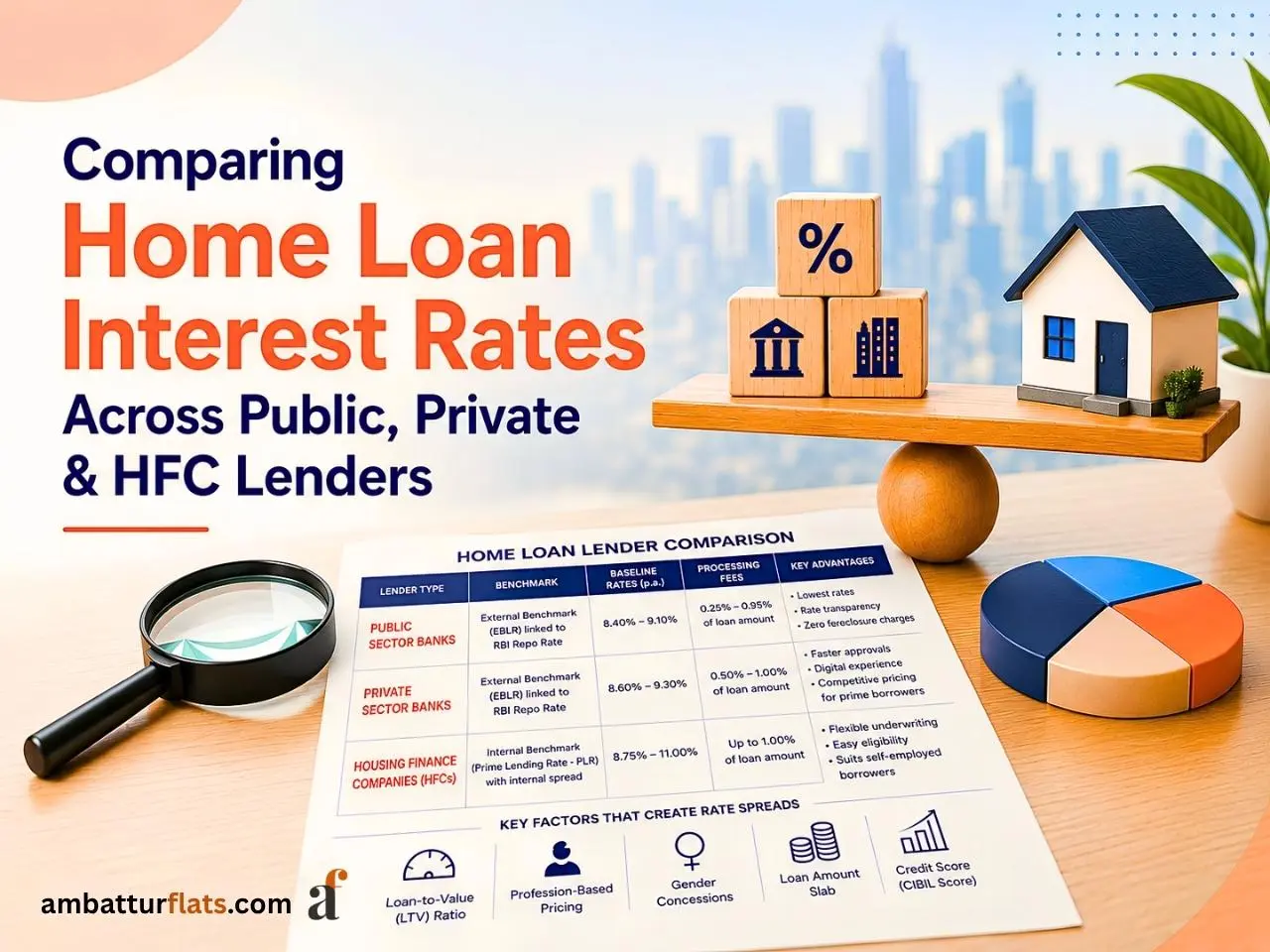
Benchmark Transparency: Public and private banks must link floating home loan rates to an external benchmark, usually the RBI repo rate (EBLR). HFCs use an internal Prime Lending Rate (PLR) which gives them more control over rate adjustments.
Baseline Interest Rates: Public sector banks consistently offer the lowest starting interest rates in the market, often operating on razor-thin margins to capture market share.
Processing Turnaround: Private sector banks dominate in speed, utilizing advanced digital underwriting to issue sanctions in days, whereas public banks often require longer, manual verification processes.
Underwriting Flexibility: HFCs have the most lenient eligibility criteria, making them ideal for self-employed individuals or those with non-standard income documentation that traditional banks might reject.
Customer Service: Private banks and HFCs typically assign dedicated relationship managers to guide borrowers from application to disbursement, while public banks generally rely on standardized branch-level customer support.
Institutions like the State Bank of India (SBI), Bank of Baroda (BoB), and Punjab National Bank (PNB) are the traditional heavyweights of the Indian mortgage market. By law, these banks must link their floating rate home loans to an External Benchmark Lending Rate (EBLR), which is almost always the RBI repo rate. This means the pricing mechanism is entirely transparent. If the RBI reduces the repo rate, public sector banks are obligated to pass on the rate cut to borrowers rapidly without artificial delays.
Public banks are highly favored for their low base interest rates, zero foreclosure penalties, and absence of hidden charges. However, these low rates come with a trade-off. Their eligibility requirements are exceptionally rigid. If your income documentation is not perfectly aligned with their standard templates, or if a property lacks specific municipal approvals, your application may face delays or rejection. When comparing public banks like SBI with housing finance institutions like LIC HFL, borrowers quickly realize that while SBI offers unmatched rate transparency, it requires an impeccable borrower profile and immense patience during the paperwork and legal verification phases.
Private banking giants such as HDFC Bank, ICICI Bank, and Axis Bank bridge the gap between competitive pricing and premium customer experience. Like public banks, their floating home loans are also tied to the EBLR system, ensuring fairness and regulatory compliance. However, private lenders differentiate themselves through aggressive, risk-based pricing models and superior operational efficiency.
These institutions leverage advanced analytics to assess creditworthiness in real time. They reward prime borrowers with substantial rate discounts, which emphasizes exactly how credit scores impact home loan interest rates. A borrower with a CIBIL score of 800 or above might secure a rate from a private bank that directly rivals the lowest offers from public sector lenders. Additionally, private lenders excel in turnaround times, offering fast-track digital approvals, doorstep document collection, and flexible solutions for co-applicants. The caveat is that private banks may charge slightly higher upfront processing fees or implement steeper risk premiums for borrowers with average credit histories.
Housing Finance Companies like LIC Housing Finance and Bajaj Housing Finance operate under a different regulatory framework than traditional commercial banks. Instead of being strictly bound to the external repo rate, HFCs benchmark their home loans to their internal Prime Lending Rate (PLR). Your specific interest rate is calculated as the PLR minus a predetermined discount spread.
This internal benchmarking means that when the RBI increases interest rates, HFCs might be slower to pass on the hike, but conversely, they are often slower to reduce rates during a falling interest rate cycle. The primary advantage of an HFC lies in its underwriting flexibility. They specialize solely in property financing, which makes them highly adaptable when exploring different types of home loan products in India. Whether it is a composite loan for plot purchase and construction, or financing for a self-employed business owner with complex tax filings, HFCs take a pragmatic, case-by-case approach to property valuation and income assessment that rigid banking algorithms cannot accommodate.
Even within the same bank or HFC, two applicants rarely get the exact same interest rate. Lenders apply various spreads based on specific risk and internal policy factors. The Loan-to-Value (LTV) ratio is a massive determinant; loans that cover a smaller percentage of the property value are considered less risky to the lender and therefore attract lower rates.
Profession-based pricing is another major factor. Salaried employees working for top-tier multinational corporations or government agencies often receive preferential rates compared to self-employed individuals, due to the perceived stability and predictability of their income. Furthermore, many public and private lenders offer gender concessions, providing a standard 0.05 percent rate discount if a woman is the primary applicant or co-applicant on the property title. Finally, the loan amount slab itself dictates the rate, with jumbo loans often carrying a slightly higher premium due to the concentrated risk exposure for the bank.
Focusing solely on the advertised interest rate is a common borrower pitfall. To understand the true cost of borrowing, you must evaluate the entire fee structure and policy framework of the institution. Always review the processing fees upfront, which can range from a flat minimal fee at public banks to a percentage of the entire loan amount at HFCs and private banks.
Additionally, scrutinize the legal and technical valuation fees, which are sometimes billed separately and can add unexpected costs to your disbursement process. It is also vital to ask about the lender's rate conversion flexibility. Over a 20-year term, you will inevitably want to renegotiate your spread or switch to a lower base rate as market conditions evolve. Knowing the exact administrative cost to execute a rate conversion with your existing lender will help you avoid being trapped in an uncompetitive mortgage years down the line. Ultimately, choose a lender that balances a highly competitive interest rate with transparent administrative costs and reliable, accessible service.
SBI Home Loans vs LIC Housing Finance: Comprehensive Comparison
Types of Home Loans in India: Purchase, Plot, Construction & Renovation