Nominal Rate vs Effective Rate: The Real Cost of Borrowing

[DISCLAIMER]: Annual Percentage Rate (APR) calculations, statutory fees, and insurance bundling terms vary by financial institution. Review the official Key Fact Statement (KFS) provided by your lender under RBI guidelines to evaluate all annualized credit costs.
When shopping for a home loan, most prospective property buyers focus almost exclusively on the advertised annual interest rate. Lenders prominently feature low rate figures in their marketing campaigns to attract customers. However, relying solely on this nominal figure can lead to significant financial miscalculations.
The true financial obligation of borrowing money extends well beyond the advertised interest rate. Ancillary upfront administrative charges, statutory levies, legal and technical assessment fees, and mandatory insurance premiums create a noticeable gap between what a bank advertises and what a borrower actually pays. To understand your actual financial commitment, you must evaluate the Effective Interest Rate—also known as the Annual Percentage Rate (APR). This metric accounts for all mandatory cash outflows, expressing the total annual cost of credit as a unified percentage.
To build a grounded financial baseline across different housing loan models, explore our comprehensive guide to home financing options in Chennai to learn how structural loan terms influence long-term affordability.
Nominal Rate Definition: The basic benchmark percentage charged on the principal balance, excluding external setup charges or recurring fee additions.
APR Composition: The unified percentage representing the true cost of credit, incorporating interest, upfront lender charges, third-party processing expenses, and mandatory insurance add-ons.
Impact of Upfront Charges: Non-refundable upfront fees reduce the net capital received, which raises the effective cost of the remaining principal balance.
Mandatory Property Insurance: Adding property cover or term insurance premiums into the sanctioned loan amount increases your principal balance, resulting in higher long-term interest charges.
Role of the RBI Key Fact Statement (KFS): Reserve Bank of India guidelines mandate that lenders disclose a standardized KFS to borrowers. This statement clearly outlines the calculated APR, detailed fee schedules, and net disbursement amounts before a loan contract is finalized.
The fundamental difference between the nominal rate and the effective interest rate centers on cash flow timing and total net disbursement.
The nominal interest rate is the simple benchmark percentage applied directly to your outstanding principal balance to determine your monthly interest obligation. Lenders publish these base rates to allow borrowers to compare primary pricing models.
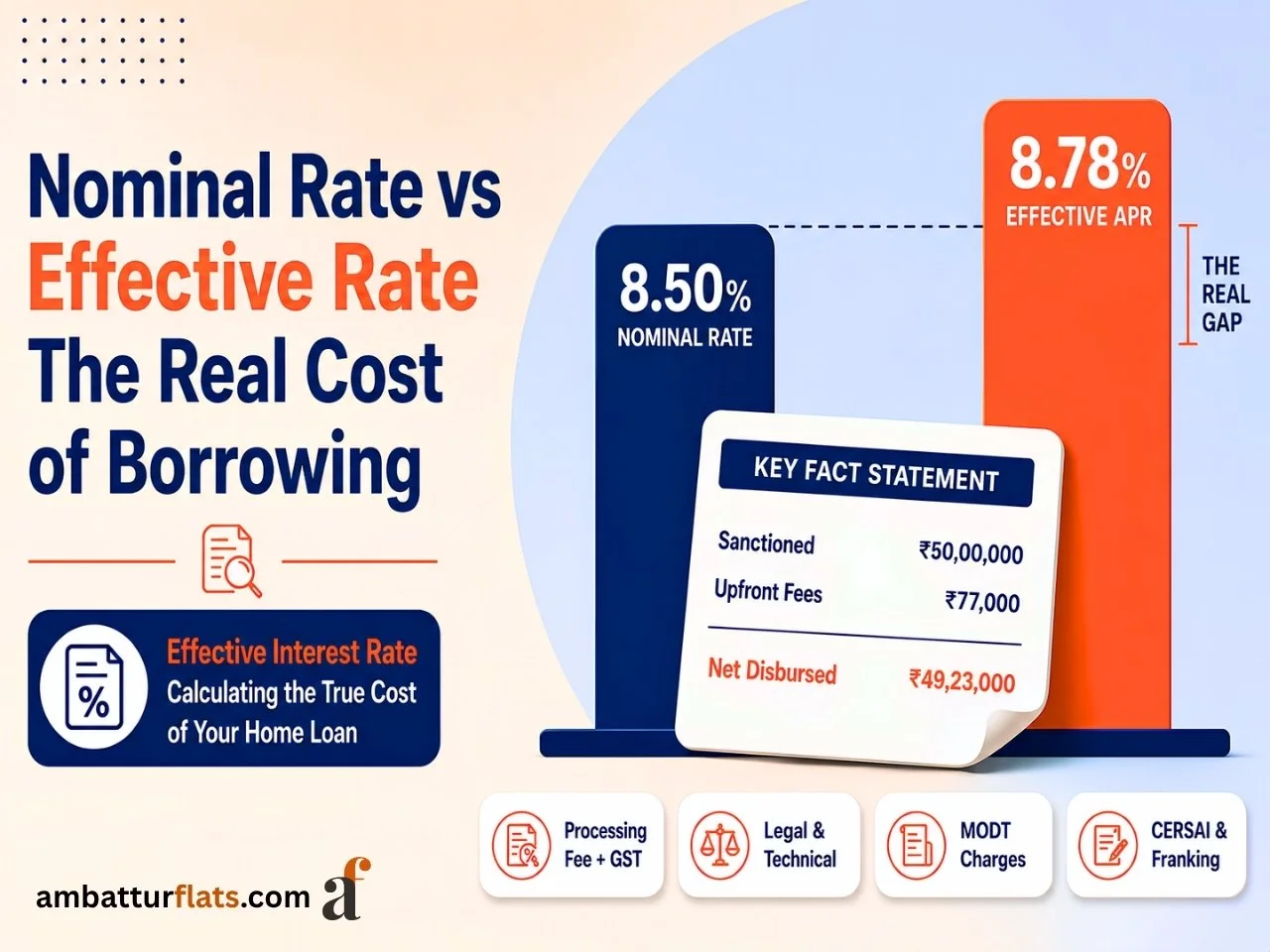
The effective interest rate (APR) reflects the true financial impact on the borrower. It accounts for the actual capital deposited into your account versus the total money you must pay back over time. If a lender approves a ₹50 Lakh loan but deducts ₹75,000 in processing fees, legal expenses, and statutory charges, your actual disbursed capital is ₹49.25 Lakh. However, your monthly repayment schedule is calculated based on the full ₹50 Lakh principal. Paying interest on funds you never actually received increases your real annualized borrowing cost above the advertised rate.
Before committing to a specific lender's pitch, take time to check comparing headline home loan interest rates across major banks to see how nominal starting rates vary across retail financial institutions.
Multiple mandatory out-of-pocket expenses contribute to pushing your real borrowing costs above the advertised headline rate:
Non-Refundable Processing Fees & GST: Lenders levy an administrative processing fee ranging from 0.25% to 1.00% of the loan amount, subject to applicable Goods and Services Tax (GST) at 18%.
Legal Assessment Charges: Lenders retain empirical panel advocates to review property title chains, encumbrance certificates, and local planning permits. These legal verification costs are billed directly to the applicant.
Technical Valuation Fees: Independent structural engineers or certified valuers must inspect the site, verify construction progress, and assess market value. The applicant pays for these valuation services.
CERSAI Registration Fees: A nominal statutory charge paid to the Central Registry of Securitisation Asset Reconstruction and Security Interest to record the mortgage and prevent fraudulent duplicate financing on the same property.
Franking and Documentation Fees: Local charges for stamp paper franking and physical execution of loan agreements.
Gathering your paperwork early helps avoid unexpected delays and processing costs. Review our guide on essential documents needed for home loan processing and title verification to streamline your application setup.
A subtle way effective borrowing costs rise is through bundled insurance products. Lenders frequently encourage or require applicants to purchase bundled coverage, such as loan protection term plans or home structure insurance.
While property insurance protects against physical damage, the way these premiums are financed can significantly increase your costs. Lenders often add a single upfront insurance premium (which can range from ₹50,000 to over ₹1,500,000) directly into the total sanctioned loan amount rather than collecting it separately.
This bundling practice means you borrow a larger total sum. As a result, you end up paying compound interest on that insurance premium for the entire 15 to 30-year life of the loan. This structural addition quietly drives up your real effective borrowing rate over time.
To protect consumers and improve financial transparency, the Reserve Bank of India mandates that regulated lenders provide a standardized Key Fact Statement (KFS) for retail credit products. This requirement ensures borrowers receive clear, comparable loan information before signing a binding contract.
The KFS presents critical loan terms in a simple, easy-to-read summary box:
Explicit Annual Percentage Rate (APR): The all-inclusive annualized cost of credit expressed as a single percentage.
Itemized Fee Schedule: A complete breakdown of all administrative, legal, valuation, and statutory charges collected by the lender or third parties.
Net Disbursed Amount: The exact dollar amount credited to your account after deducting all upfront charges.
Total Interest Payable: The sum of all interest payments due over the full loan term based on the agreed repayment schedule.
Mandatory Evaluation Period: Guidelines grant borrowers a minimum period (typically 3 business days) to review the KFS terms before deciding whether to proceed with the loan agreement.
Evaluating your true borrowing cost involves calculating the internal rate of return (IRR) based on your actual cash flows.
Practical Calculation Example:
Sanctioned Loan Amount: ₹50,000,000
Advertised Nominal Interest Rate: 8.50% per annum
Tenure: 20 Years (240 months)
Monthly EMI Payment: ₹43,391
Upfront Deductions & Statutory Fees:
Mathematical Result: While your monthly EMI payment is calculated on the full ₹50 Lakh principal, you only received ₹49.23 Lakh in usable funds. Recalculating the internal rate of return using the net disbursed amount raises the actual Effective Interest Rate (APR) to approximately 8.78% per annum. Adding a bundled ₹1 Lakh insurance premium into the financed principal pushes the true effective cost even closer to 9.00%.
To see how variations in your principal balance impact long-term payment schedules, review our detailed guide on understanding how monthly EMIs and interest amortization are calculated.