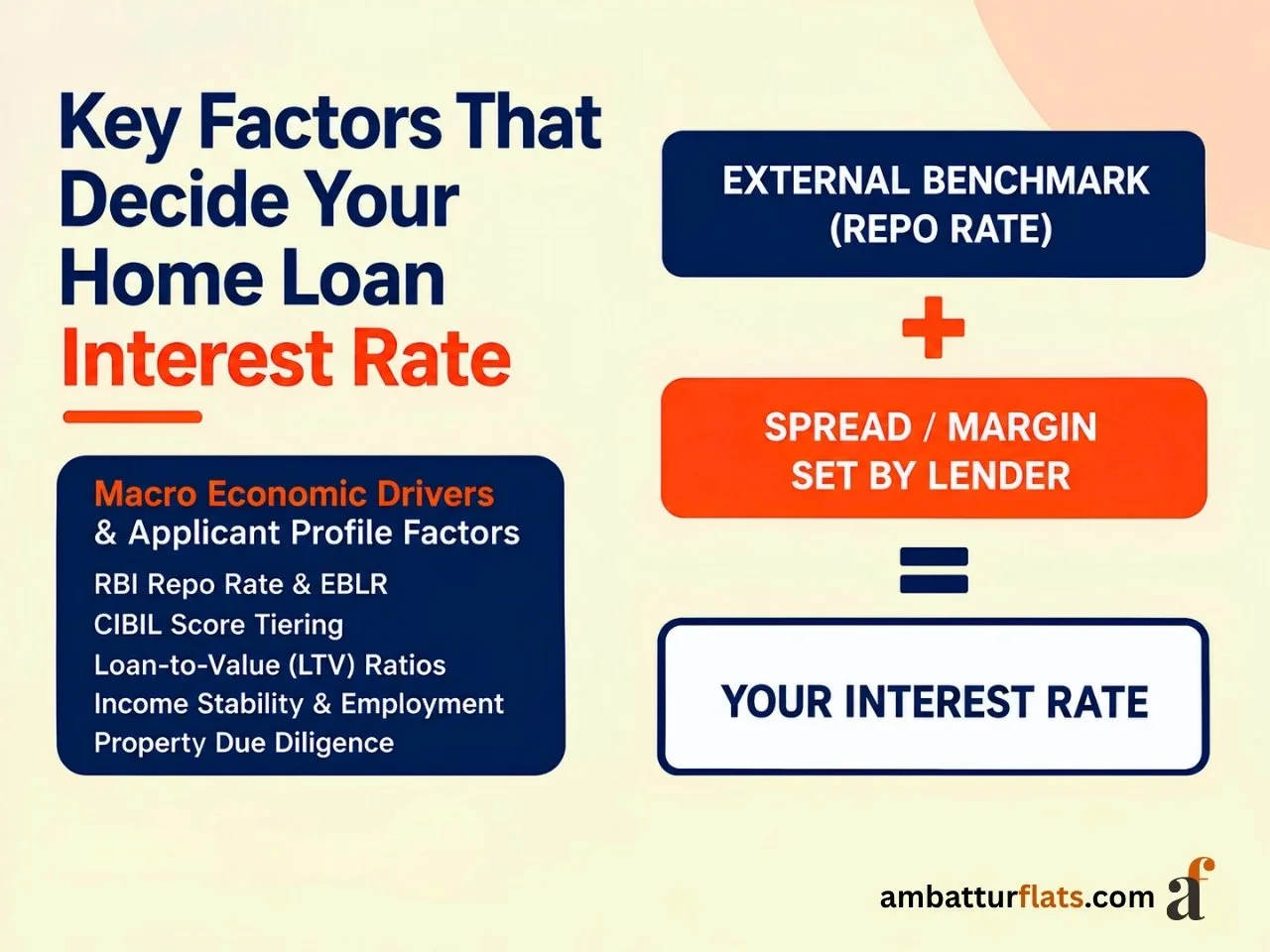
Key Factors That Decide Your Home Loan Interest Rate

[DISCLAIMER]: Interest rate pricing models, risk premium markups, and benchmark spreads are calculated independently by individual banks and Housing Finance Companies (HFCs) under RBI guidelines. Final rates offered depend on comprehensive underwriting assessments.
Securing a mortgage is one of the most significant financial commitments a homebuyer will ever undertake. However, many applicants assume that interest rates are rigid numbers uniformly applied to all borrowers. In reality, home loan pricing operates on a highly dynamic model driven by two distinct forces: macroeconomic policies established by central regulatory authorities and personal risk metrics evaluated by individual lenders.
When you apply for a mortgage, financial institutions do not offer an arbitrary rate. Instead, they start with a standardized external benchmark - governed by national monetary policy - and layer on a customized risk spread based on your financial standing, asset viability, and income stability. Understanding how these macro drivers and profile-specific variables interact gives you the leverage to optimize your credit profile, negotiate better terms, and significantly lower your total cost of borrowing. For an end-to-end overview of navigating mortgages, prospective buyers can consult our comprehensive Chennai home loan guide.
At the broadest level, home loan interest rates are tied to national monetary policy regulated by the Reserve Bank of India (RBI). Under RBI mandates, commercial banks must benchmark all floating-rate retail loans to an External Benchmark Lending Rate (EBLR), which in most cases is the RBI's Repo Rate.
The Repo Rate is the interest rate at which the central bank lends short-term funds to commercial banks. When the RBI alters this policy rate to manage inflation or stimulate economic growth, banks are legally required to pass this change on to existing and new borrowers transparently.
Your final interest rate under an EBLR structure consists of two distinct components:
External Benchmark (Repo Rate): The variable base rate set by the central bank.
Spread / Margin: The fixed or risk-adjusted markup added by the lender to cover operating costs and credit risk.
Because the external benchmark moves strictly in tandem with central bank policy decisions, any variation in interest rates between different applicants at the same bank comes down to the lender's spread. To make an informed choice on floating vs. fixed structures, buyers frequently start by comparing home loan interest rates across major Indian banks.
While macroeconomic policy dictates the benchmark rate, your personal credit history determines the exact spread a bank charges above that benchmark. The primary metric used to evaluate this risk is your CIBIL score, which summarizes your repayment track record, credit utilization, and credit mix.
Lenders categorize applicants into credit risk tiers:
750 to 900 (Low Risk): Applicants in this tier receive the lowest available spread, unlocking the bank's baseline home loan rate.
700 to 749 (Moderate Risk): Lenders may add a minor risk premium (typically 10 to 25 basis points above baseline).
Below 700 (High Risk): Applicants face substantial credit risk premiums ranging from 0.25% to 1.50% above baseline rates, or risk outright application rejection.
Maintaining a clean repayment record without defaulted credit cards or missed EMIs ensures your spread remains minimal. A deeper analysis of how credit scores specifically influence home loan interest rates reveals how even a 20-point drop in CIBIL can cost lakhs of rupees over a 20-year tenure.
The Loan-to-Value (LTV) ratio represents the proportion of the property's total appraised value that the bank is willing to finance through debt. The remaining portion must be funded out of the buyer's pocket as a down payment.
The Reserve Bank of India imposes strict regulatory caps on maximum LTV ratios to curb system-wide financial risk:
From a pricing perspective, choosing a lower LTV ratio (for instance, opting for a 65% loan instead of pushing for the maximum allowable 80%) significantly reduces the lender's risk exposure. Lenders often reward borrowers who make higher personal down payments with discounted interest rate spreads. Additionally, higher loan quantum tiers (above ₹75 Lakh) require banks to set aside higher capital risk weightings under statutory norms, which can translate into slightly higher baseline spreads compared to smaller micro-housing loans.
Lenders assess your monthly cash flow to confirm that home loan repayments will not disrupt your overall financial stability. A critical metric used during underwriting is the Fixed Obligation to Income Ratio (FOIR), which measures what percentage of your net monthly income already goes toward existing debts (including the proposed home loan EMI). Lenders generally cap FOIR between 50% and 60%. Exploring options for calculating borrowing limits based on salary and monthly income helps applicants maintain their FOIR within optimal ranges before formal submission.
Beyond income volume, the stability of your profession alters risk pricing:
Salaried Individuals: Employees working in government organizations, public sector undertakings (PSUs), or top-tier MNCs are classified as low-risk due to stable income streams. They consistently receive preferred interest spreads.
Self-Employed Professionals & Non-Professionals: Business owners, consultants, and entrepreneurs experience seasonal cash flow variations. To offset this perceived risk, banks often charge a marginal premium (typically 15 to 50 basis points higher than salaried rates).
Gender Concessions: Most major public and private sector banks offer a standard interest rate concession—usually 0.05% (5 basis points)—when a woman is either the primary applicant or a sole property owner. Over a long tenure, this modest discount yields meaningful savings on total interest payouts.
The physical property acts as primary collateral for the loan. Consequently, the technical and legal health of the asset directly impacts the bank's underwriting decision and pricing structure.
Lenders evaluate properties using several risk parameters:
Approved Municipal Plans: Properties constructed with strict adherence to local development authority permits, occupancy certificates, and planning approvals represent zero legal risk. Conversely, unapproved layouts or deviation-heavy structures invite pricing surcharges or outright denial.
Approved Project Finance (APF): When buying in a multi-unit project where the developer has secured pre-approval (APF) from the bank, legal titles and construction timelines have already been vetted. This streamlines processing and eliminates property-risk markups.
Clear Title and Chain of Ownership: An unbroken, legally verified chain of title documents ensures the property can be easily liquidated if a default occurs, keeping the lender's collateral risk minimal.