

The old Chennai buyer waited. Salary first, then savings, then a plot or a flat somewhere the family already knew, usually after the children were half grown. That buyer still exists. He is just no longer the one setting the pace.
Yes, young homebuyers in Chennai are changing the Chennai housing market, though not in the way most articles claim. Prices are not being pushed up by a wave of 27 year olds. What has changed is the moment the decision gets made, and where the money lands once it does.
What follows is the evidence for that: the rent versus EMI arithmetic at today’s rates, what the rental yields in five micro markets say about which of them are genuinely cheap and which only look it, and one risk almost nobody prices.
A young buyer in Chennai rarely decides to buy because a savings plan matured. The decision usually arrives with a rent renewal notice or an appraisal letter. Both land on an eleven or twelve month cycle. Call it the renewal clock. It shapes this market more than any price chart does, and it is why two buyers on identical salaries can behave nothing alike.
A short decision window narrows the shortlist. A buyer with twelve months of patience will not wait four years for a launch to finish. He/She will take a smaller flat further out, or a project close to handover, because the alternative is signing another lease at a higher number. Sales offices feel this as sudden decisiveness. It is not confidence. It is a deadline.
It also explains a pattern that looks odd from outside. Sales teams across the city report the same thing: a rent increase moves enquiries faster than a price cut does. The two land differently. A discount saves money on a purchase the buyer has not committed to yet. A rent hike costs money now, every month, with nothing at the end of it. One is a hypothetical gain and the other is a live loss, and buyers move on the loss.
Not yet, if you only compare the two monthly numbers. A lot of writing on young buyers in Chennai gets loose here, so this is the arithmetic with market figures attached.
ANAROCK’s Chennai viewpoint for the first quarter of 2026 puts Perumbakkam at ₹6,350 a square foot, with quoted rents there between ₹18,200 and ₹25,500 a month for a two bedroom flat of about 700 square feet. Take a flat that size at that rate, and note that the quoted rate is on built up area, not the super built up figure most builders quote. The base cost works out to about ₹44.5 lakh before registration, GST and the other charges builders add at the end. Stamp duty at 7 percent and registration at 4 percent add roughly ₹4.9 lakh, and if the flat is under construction, 5 percent GST adds about ₹2.2 lakh on top. Against a 20 percent down payment of about ₹8.9 lakh, that is closer to ₹16 lakh of day one cash. Fund 80 percent of the base cost with a twenty year loan and the EMI sits near ₹28,600 at 7.5 percent and near ₹30,900 at 8.5 percent. That rate band is not a forecast. The RBI has held the repo rate at 5.25 percent through 2026, so 7.5 to 8.5 percent is roughly where a salaried borrower with a clean file sits right now, near the floor of the cycle rather than the middle of it.
| Cost & Return Metric | Estimated Amount | Calculation Basis |
| Quoted rate, Perumbakkam | ₹6,350 per sq ft | ANAROCK, Q1 2026, on built up area |
| Base cost, 700 sq ft flat | About ₹44.5 lakh | Excludes registration, GST, other charges |
| Loan at 80 percent | About ₹35.6 lakh | Twenty year tenure |
| EMI at 7.5 to 8.5 percent | ₹28,600 to ₹30,900 | Illustrative, rates vary by lender and profile |
| Quoted rent, same area | ₹18,200 to ₹25,500 | ANAROCK, Q1 2026, 700 sq ft 2 BHK |
| Day one cash, all in | About ₹16 lakh | Down payment plus stamp duty, registration and GST |
| Gross rental yield | About 5.9 percent | Mid point rent over quoted rate; before maintenance, vacancy and tax |
| Cost of the loan | 7.5 to 8.5 percent | Repo held at 5.25 percent through 2026, so this band is near the floor |
The EMI is roughly 1.2 to 1.6 times the rent. So the case for buying is not that it is cheaper this month. It is that part of the EMI is savings, the rent is not, and the rent number resets every year while the principal does not. Young professionals buying homes are making a trade, not finding a bargain, and it is a trade many households are right to make. It should be presented to them as one.
There is a cleaner way to size that trade. Run the quoted rents in the table further down against the quoted rates and Chennai’s young buyer belt yields roughly 4.9 to 5.9 percent gross, before maintenance, vacancy and tax. The loan costs 7.5 to 8.5 percent. The asset earns two to three percentage points less than the money used to buy it, and that gap is what you are paying for the option on appreciation and for the right to stop moving house. Over a ten year hold that is defensible. It is not rent replacement, and it is not free.
One more figure worth holding on to. The same ANAROCK report puts the city average at ₹7,165 a square foot, with unsold stock at about 33,500 units. The quarter after that was weaker again: Chennai sales fell 9 percent year on year in the second quarter of 2026, and new launches fell 38 percent. Prices holding while volumes slide is the signature of a market where sellers have not blinked and buyers have room to push. Most first time property buyers in Chennai do not push.
The reason is the same deadline that brought them into the market. A buyer with two months left on a lease finds it harder to walk away from a deal, and a good sales team can read that across a table. The saving on the rent increase tends to come back quietly, in the price or in the payment schedule.
Two directions, and they are not the same story.
South Chennai still absorbs the largest share of tech salaries, mostly along OMR and the roads feeding it. West and northwest Chennai are taking a different kind of buyer, one working in manufacturing, auto, logistics or a back office campus rather than a software park. That mix is a large part of why buyers keep moving toward west Chennai. Avadi at ₹5,360 a square foot and Oragadam at ₹4,920 sit at roughly three quarters of the city average or below, which is the entire reason a first salary can reach them. Guduvanchery at ₹5,420 does the same job in the south, out on GST Road.
Ambattur sits in the same northwest corridor but does not appear in the ANAROCK table, so it is worth stating separately rather than smuggling into a column. Asking prices there run at about ₹6,300 a square foot as of August 2026, though that single number hides an unusually wide spread: ready to move stock quotes closer to ₹5,350 while under construction inventory quotes near ₹7,900. In a market that dispersed, the average is close to meaningless and the only figure that matters is the one on the project in front of you. What Ambattur does have, and the metro dependent micro markets do not, is a suburban rail line that already runs.
| Micro market | Quoted rate, Q1 2026 | Quoted rent per month | Who is buying | Gross yield |
| Perambur | ₹8,070 per sq ft | ₹19,000 to ₹27,000 | Buyers wanting a north Chennai address with rail access | About 4.9 percent |
| Perumbakkam | ₹6,350 per sq ft | ₹18,200 to ₹25,500 | IT and GCC couples working the OMR belt | About 5.9 percent |
| Guduvanchery | ₹5,420 per sq ft | ₹15,000 to ₹22,000 | Younger single income buyers on GST Road | About 5.8 percent |
| Avadi | ₹5,360 per sq ft | ₹13,300 to ₹18,000 | Manufacturing, defence and services households in the west | About 5.0 percent |
| Oragadam | ₹4,920 per sq ft | ₹14,000 to ₹20,000 | Auto and industrial belt employees | About 5.9 percent |
Rates and rents for the five micro markets above: ANAROCK Chennai residential viewpoints, first quarter of 2026. Gross yield is our own calculation, taken as twelve months of the mid point rent against the quoted rate on 700 square feet. It is a gross figure and ignores maintenance, vacancy and tax, so read it as a way of ranking micro markets rather than as a return you will collect. GCC stands for global capability centre.
Read the columns together and two cases need stating carefully. Avadi is the first. The gap between rent and a likely EMI is smaller there in rupee terms, but only because the ticket size is smaller. Avadi’s rents are weak against its prices: about 5.0 percent gross, against 5.9 percent in both Oragadam and Perumbakkam. The case for buying in Avadi rests on the smaller absolute outlay, not on a better rent to EMI trade, and those are not the same argument.
Perambur is the second, and it is the more revealing one. It is the most expensive market in the table and the weakest yielder in it, at roughly 4.9 percent. Buyers there pay the highest price per square foot and collect the least rent per rupee invested. That is what an address premium looks like once someone puts a number on it, and it is a large part of why a prestige address matters less than it used to for buyers in their late twenties. They are not rejecting the good address. They are declining to fund it.
Transit is the other pull, and it needs care. Chennai Metro Phase II is under construction, with no corridor yet carrying passengers. CMRL puts the network at 118.9 km across three corridors, with completion proposed by the end of 2028. The Poonamallee Bypass to Vadapalani stretch cleared its Commissioner of Metro Railway Safety inspection in February 2026. Six months on, the trainsets have been delivered, the corridor is finished and the line still has no opening date, because the inauguration is waiting on a clearance in Delhi. A stretch that is physically complete and safety certified has taken half a year to not open. Whatever you assume about the corridors still being dug, add that delay to it, and check CMRL’s status page for the specific corridor near you before paying a premium for a station that is still a construction site. Paying today for a 2028 benefit is a choice, not a discount.
Chennai’s employment base has widened past the classic IT services campus. Global capability centres, the offshore units multinational banks, insurers, carmakers and pharma companies run for their own work, now hire across engineering, analytics, finance and design. These jobs pay early, and they pay two people in the same household, because couples in this bracket almost always both work.
Payroll explains homebuying trends in Chennai better than sentiment does. The weight of young professionals in Chennai real estate shows up first in loan eligibility, not in showroom footfall. A household with two documented salaries in the same city clears eligibility for a ₹45 lakh to ₹60 lakh flat several years earlier than a single earner does, and the bank is comfortable because both incomes are on paper. Note what that means, though. The market did not get more affordable. It got more borrowable. Those are different things, and only one of them is a good sign. If you want the longer version of this argument, we have written separately on how GCC growth is feeding Chennai property demand.
Survey evidence backs the intent. Knight Frank’s 2025 home buyer study found Chennai reporting the highest preference for owning rather than renting of any Indian city surveyed, at 86 percent, with about half of Chennai respondents buying for the first time and for their own use. Millennials in the same study leaned toward ownership more strongly than Gen Z, whose hesitation the report links to money and to career mobility rather than to any dislike of owning.
When a couple both work in technology, and one of them borrows against both salaries, the household has not diversified its income. It has doubled a single bet. A slowdown that reaches one employer in Sholinganallur usually reaches the other one too, because hiring across GCCs and IT services moves on the same cycle. The old Chennai buyer, a single earner in government service or a family business, had a smaller income and a steadier one. The trade the current generation has made is more money, less insulation, and the loan is written against the money.
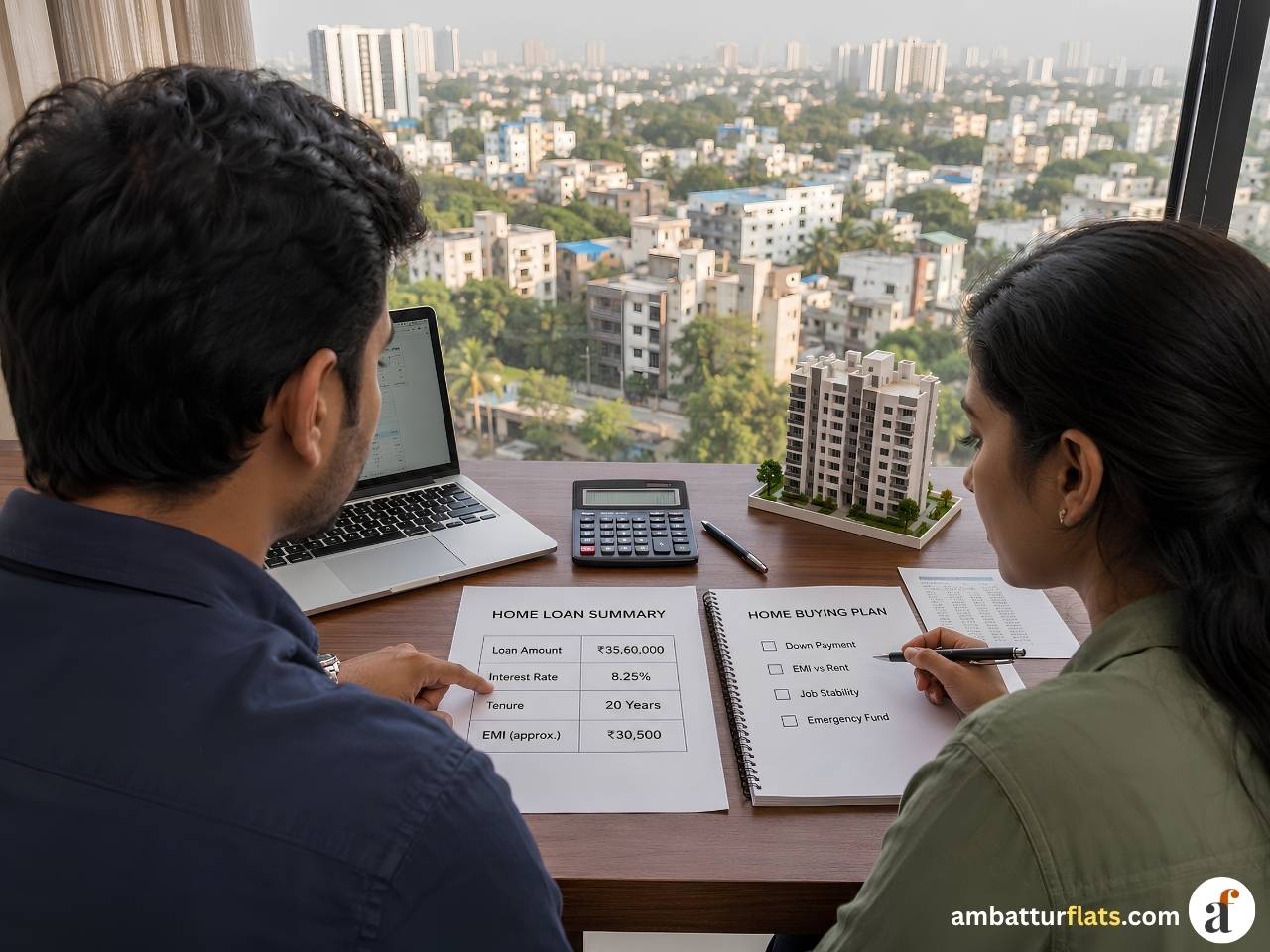
The mid segment loan book in this city is a different animal than it was ten years ago. Larger tickets, younger borrowers, and two incomes that rise and fall in step. Nothing in the current data says this is going wrong. It does suggest the standard advice has not quite caught up with the borrower.
The correlation follows the flat into resale, which is the part that rarely gets said out loud. A tower in Perumbakkam filled with IT and GCC couples will draw most of its resale buyers from the same employment base that pays the seller. In a weak hiring cycle a household may need to exit at precisely the moment the local pool of buyers turns cautious. The concentration is not only in the loan file. It is in the exit.
So stress test on one salary rather than two, and stress test the rate upward while you are at it. The repo has been flat at 5.25 percent through 2026, which means the EMI in your spreadsheet sits near the best case rather than the middle of the range, and a floating loan taken at the bottom of a cycle has more room to reset up than down. If the larger income alone cannot carry the EMI for six months at one percentage point above your quoted rate, the flat is too big or too early. Keep a buffer covering EMI and maintenance together, because maintenance in a gated project is not a rounding error. And treat a joint loan as a joint decision about careers as much as about property, because a sabbatical or a move into a startup gets much harder to take once the EMI is set.
Builder product has changed in response, and you can see it in the layouts being launched.
The 1BHK starter flat has lost ground with this group. A working couple needs a corner where one of them can take a call without the other being audible, so half rooms, study nooks and wider balconies have become the negotiating point instead of raw square footage. Buyers also ask about water before they ask about the clubhouse, which is rational in a city where the tanker season is a normal part of the year. Sewage treatment and rainwater harvesting come up early on site visits, along with a straight answer about where the water comes from in May.
Two cautions. Amenity counts are easy to inflate, and floor area language is easy to misread. Read the difference between carpet area, built up area and super built up area before comparing two projects on price per square foot, because two builders quoting the same rate can be selling you very different homes.
Run these in order. Skipping the first two makes the rest pointless.
1.Confirm the project and promoter are registered with TNRERA and match the numbers on the portal against the brochure.
2. Check the parent document, the title chain and the approved plan, ideally with a lawyer you appointed rather than one the builder recommended.
3. Time the commute at 9 am on a working day, not on a Sunday visit.
4. Ask for the water source in writing, including whether supply is metro water, borewell or tanker in summer.
5. Add maintenance, corpus, registration and GST to the EMI before deciding the flat is affordable.
6. Stress test the EMI on the larger single income alone, for six months, at one percentage point above the rate you were quoted.
7. For an under construction flat, ask what happens to your payment schedule if the handover slips by a year.
Our longer homebuyer checklist for buying property covers the document side in more detail, and if you are still choosing an area, start with the emerging residential localities in Chennai rather than with a project.
They are changing what gets built, where it gets built and how fast it has to be delivered. Compact two bedroom homes with a work corner, in places with a job within reach and water in the pipe, on a timeline a buyer can see from where she is standing. That is a different brief than the one Chennai builders worked to fifteen years ago, and builders who are still writing the old brief are the ones sitting on the unsold stock.
What they have not changed is the arithmetic. Renting is still cheaper month to month across most of the city. The flat still yields less than the loan costs. Buying still wins over a long enough hold, provided the household can carry the EMI through a bad year.
So the honest answer to the question in the title is a qualified yes. Young buyers are changing this market through what they ask for, where they are willing to live and how fast they need an answer. They are not making Chennai cheaper, and nothing in the data suggests they are about to. A generation that decides on a twelve month clock will keep reshaping what gets built and how quickly it gets handed over. Affordability is a separate problem, and it is not one that buyer behaviour can solve.
Many are buying in their late twenties or early thirties rather than their forties, mostly because two documented salaries clear loan eligibility years sooner than one did. Knight Frank’s 2025 survey found Chennai with the country’s highest stated preference for owning, at 86 percent, with about half buying for the first time. Worth separating the two things, though: eligibility arrived earlier, affordability did not.
Renting is cheaper month to month in most areas. In Perumbakkam, quoted rents run ₹18,200 to ₹25,500 for a 700 square foot two bedroom flat, while the EMI on a flat that size works out near ₹28,600 to ₹30,900 at current rates. The gross yield of about 5.9 percent also sits below the 7.5 to 8.5 percent the loan costs. Buying wins over a long hold, not immediately.
Budget decides more than anything else. Guduvanchery, Avadi, Oragadam and Perumbakkam all quote below the city average of ₹7,165 a square foot, which puts them within reach of a single or early dual income household. Avadi and Oragadam, in the west, serve buyers working outside the OMR belt, while Guduvanchery and Perumbakkam sit to the south.
Only if you plan to hold well past the opening. Phase II is under construction across 118.9 km and three corridors, with completion proposed by the end of 2028. The first stretch, Poonamallee Bypass to Vadapalani, cleared its safety inspection in February 2026 and six months later still has no opening date. If a finished, certified corridor can wait that long, treat every other corridor’s timeline as a range rather than a date, and check CMRL’s project status page for the one nearest you.
Underwriting the loan on two salaries from the same industry. If both earners work in tech or in linked GCC roles, the incomes move together in a downturn, and so does the pool of buyers you would sell to. Test whether the larger salary alone can carry the EMI for six months before signing.
Plan for registration and stamp duty at 11 percent between them, GST on under construction property, interiors, and a reserve covering at least six EMIs plus maintenance. On a ₹44.5 lakh flat that is roughly ₹16 lakh of day one cash against a ₹8.9 lakh down payment. Buyers who budget only for the down payment are the ones stretched in the first year of possession.
On the quoted rates and rents for the first quarter of 2026, the west and south belt clusters tightly at the top: Oragadam about 5.9 percent gross, Perumbakkam about 5.9 percent, Guduvanchery about 5.8 percent. Avadi is weaker at about 5.0 percent and Perambur weakest at about 4.9 percent, which is what paying for an address costs in yield terms. These are gross figures before maintenance, vacancy and tax, and every one of them sits below current home loan rates, so use yield to rank micro markets rather than to project a return.