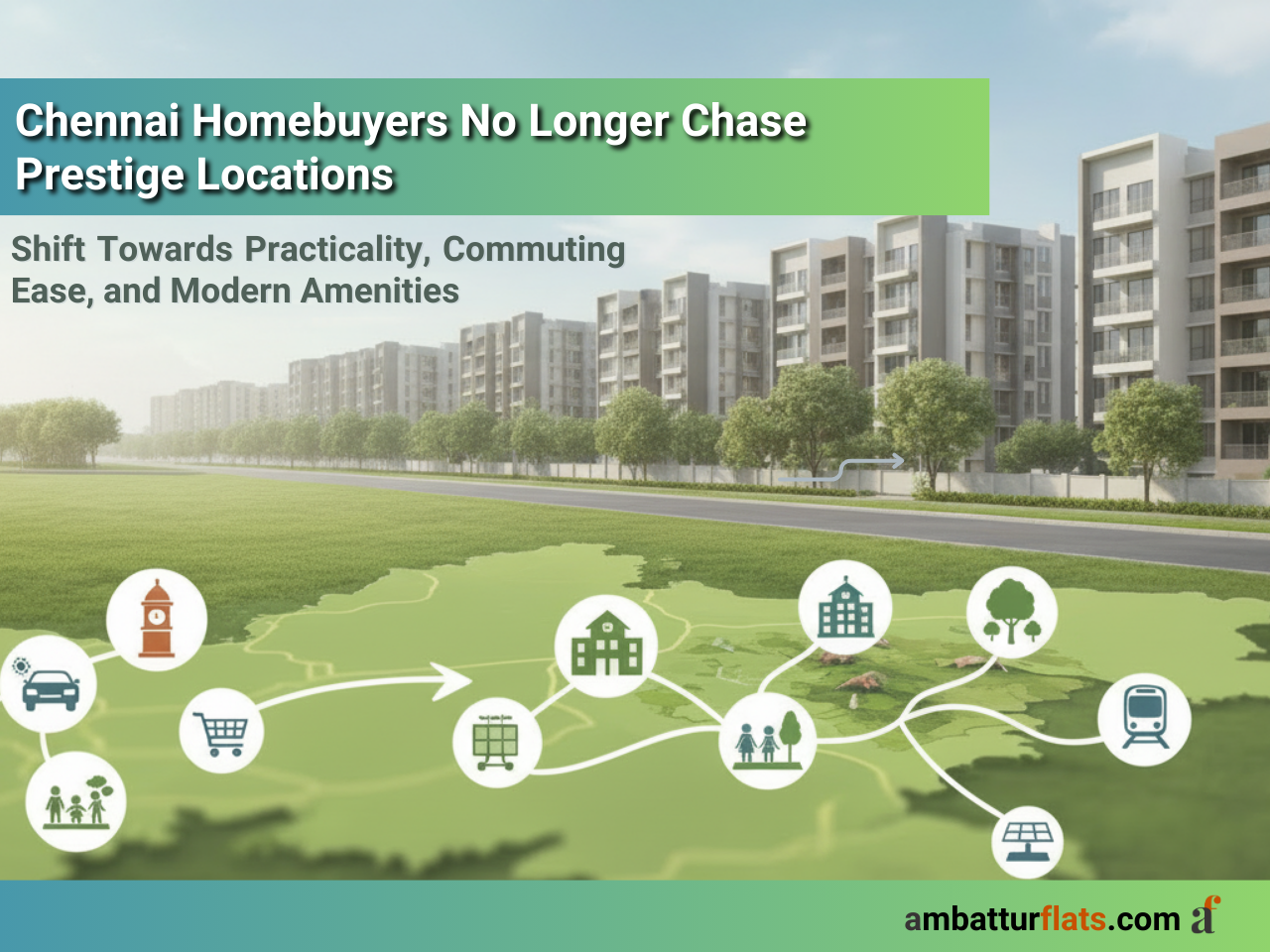

For years, Chennai’s property market revolved around a familiar idea: the closer you lived to traditional hotspots, the better your home was considered. Central neighbourhoods carried social status, long-term value, and a sense of permanence. Large homes in well-known areas were treated as the ideal milestone.
That mindset is changing fast.
Today’s Chennai homebuyer is far more focused on practicality than prestige. Commute time, affordability, connectivity, and everyday convenience are shaping decisions more than legacy pin codes or oversized apartments. This shift is not temporary. It reflects bigger changes in work culture, infrastructure, family structures, and financial realities.
The traditional definition of a prime location used to be simple. It meant central neighbourhoods, established areas, and addresses that carried social value. Buyers tolerated traffic congestion, high prices, and limited space because the location itself was seen as the ultimate asset.
That logic has weakened significantly.
Modern buyers evaluate neighbourhoods through a practical lens. Instead of asking whether an address is prestigious, they ask whether it supports daily life. Questions about commute time, school access, pricing, and convenience now dominate the decision process.
Traffic pressure in Chennai has turned travel time into a major lifestyle concern. Long commutes directly reduce personal time, especially for dual-income households.
Infrastructure upgrades are playing a major role in this shift. The expansion of Chennai Metro, particularly Phase 2, is changing how buyers evaluate locations. Metro connectivity is not just about reducing travel time. It is opening peripheral areas for development.
These areas offer two advantages:
The steady growth of office hubs, especially along the OMR corridor, has strengthened this pattern. Many families now aim to live closer to work to reduce time spent commuting and increase time spent at home.
Time has effectively become a lifestyle currency.
Market data shows strong residential supply growth in micro-markets such as Perambakkam, Avadi, and Perambur. These locations combine improving connectivity with comparatively affordable pricing.
Average property prices in these areas currently range between ₹5,250 and ₹7,870 per square foot. This price band is attractive to middle-income working families who need a balance between affordability and connectivity.
These neighbourhoods also support gated community projects that provide:
For working parents, these practical advantages often outweigh the appeal of traditional city hotspots.
Despite aspirational lifestyles, budget remains the biggest reality check in the housing market. It influences not only the size of the home but also how far families are willing to live from offices or schools.
Two clear decision patterns have emerged.
Some buyers prioritise proximity over space. They choose smaller apartments in central or well-connected areas to reduce travel stress.
Others prioritise space over proximity. They buy larger homes in peripheral areas where prices are lower, even if it means longer commutes.
A third approach is also gaining traction. Some families rent homes near workplaces or schools while purchasing property in developing corridors for long-term investment and future use. This hybrid strategy separates immediate lifestyle needs from long-term financial planning.
Check out our guide on New launch vs Resale Home
Developers in Chennai are adjusting quickly to changing buyer expectations. Project planning has become more family-centric than before.
There is a growing demand for:
Buyers want homes that are efficient, safe, and manageable alongside busy work schedules.
Amenities have also evolved. Buyers now expect more than basic clubhouses. Projects increasingly include:
These features are no longer viewed as luxuries. They are becoming expected components of modern housing.
The experience of working families reflects the broader shift in the market. Many buyers are choosing smaller homes if it allows them to live closer to offices and schools. The time saved from shorter commutes is often valued more than additional square footage.
This reflects a wider sentiment across the city. Homes are now chosen for how well they support daily routines, not just long-term aspirations.
As infrastructure improves and office hubs expand, residential demand is spreading beyond traditional hotspots into well-connected, value-driven micro-markets.
For dual-income households, the ideal neighbourhood is one that simplifies commuting, supports children’s education, and provides a safe and well-planned environment.
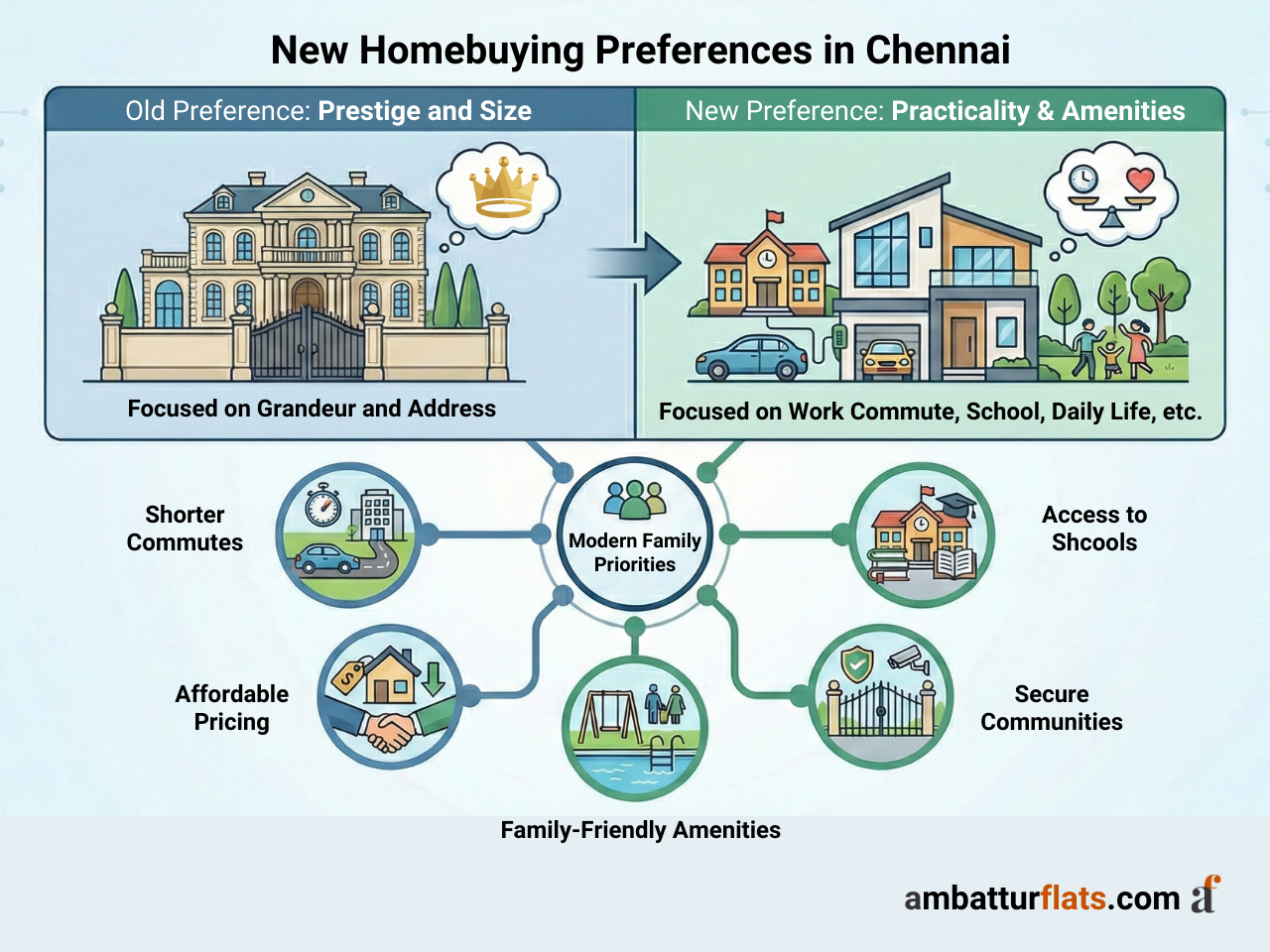
Chennai’s housing market is aligning with the realities of modern family life. The definition of a desirable home has shifted from prestige and size to practicality and balance.
Today’s buyers are prioritising:
In Chennai’s current market, the smartest homes are not defined by their address. They are defined by how effectively they support work, school, and daily life.