Conceptual illustration of residential development in West Chennai

West Chennai is drawing homebuyers away from OMR, Anna Nagar and Adyar because jobs have spread across the city, connectivity has improved and homes in Porur, Ambattur, Poonamallee and Mogappair still cost less than in established neighbourhoods.
Homebuyers rarely change direction without a reason. The growing interest in West Chennai suggests that something bigger is changing across the city. Anyone looking for the best places to buy property in Chennai naturally looked towards the city's southern and coastal neighbourhoods. Old Mahabalipuram Road (OMR) became the default choice for IT professionals and Anna Nagar stood for premium living.
Adyar meant established luxury.
However, that pattern is changing, More homebuyers are now looking at places like Porur, Poonamallee, Ambattur, Vanagaram and Iyyappanthangal. These areas were once seen as the edges of the city, but today they are becoming some of Chennai's busiest residential markets.
The reason is structural, not a single project or announcement. The way Chennai works has changed: jobs are spreading beyond one part of the city, road networks have improved and buyers now prefer shorter, predictable daily commutes over traditional prestige locations.
Demand for West Chennai property is rising and the price data backs it up.
One sign of this shift is the strong price appreciation seen in several emerging residential neighbourhoods across Chennai. Perambur recorded a 35% year-on-year increase in residential prices, followed by Perumbakkam at 20% and Mogappair at 13%. These gains reflect the growing appeal of locations that offer better infrastructure, improved connectivity and easier access to employment hubs. While rising prices alone do not define a strong residential market, they often indicate increasing buyer confidence and sustained demand.
This trend is especially relevant for Mogappair, which sits at the centre of West Chennai’s evolving residential landscape. Similar factors are influencing homebuyers in nearby areas such as Porur, Ambattur and Vanagaram. Instead of choosing locations based solely on their reputation or popularity, today’s buyers are placing greater importance on practical factors such as commute times, transport connectivity, everyday convenience and
long-term liveability.
How long will the commute take?
Can different parts of the city be reached easily? Are schools, hospitals and shopping areas nearby? Will this location still make sense if job locations change in the future?
West Chennai property is attracting attention because it offers answers to these questions. Buyers are often looking for locations that are practical and offer long term value. Many of these locations are also appearing in discussions around emerging residential areas in Chennai as buyers look beyond traditional hotspots.
| Area | Major Growth Driver | Buyer Interest |
|---|---|---|
| Porur | Access to multiple employment hubs | High |
| Poonamallee | Land availability and improving connectivity | Growing |
| Ambattur | Industrial and manufacturing jobs | High |
| Mogappair | Established social infrastructure | High |
| Vanagaram | Access to Chennai Bypass and ORR | Growing |
OMR remains one of Chennai's largest employment corridors and continues to attract IT professionals. However, Chennai's economy is no longer centred around one road. Employment hubs have grown in Guindy, Ramapuram, Ambattur, Manapakkam and Sriperumbudur, creating opportunities across multiple parts of the city.
This has directly influenced buying decisions. A professional working in Ramapuram, Manapakkam or Guindy may find West Chennai far more practical than living in the southern IT corridor. A resident in Porur can reach Guindy, Vadapalani, Koyambedu and Ambattur relatively easily using existing road infrastructure.
Commute time has become one of the biggest factors influencing residential decisions. Saving even thirty minutes a day may not seem significant initially, but over a year it adds up to hundreds of hours that can be spent with family rather than
in traffic.
Pricing also plays a big role. Many western neighbourhoods are still in an earlier stage of development, which means buyers can often find larger homes and newer communities at budgets that would buy smaller homes in more established locations.
Buyers are also reconsidering what makes a location valuable, increasingly prioritising convenience and accessibility over status and reputation, a pattern explored further in why Chennai homebuyers do not prefer prestige locations anymore.
One of the biggest reasons behind the growth of West Chennai property is the changing distribution of employment opportunities across the city. Chennai's economic growth is no longer tied to a single corridor. Instead, the city is developing multiple employment centres that support different industries
and professions.
Ambattur Industrial Estate continues to support manufacturing and engineering jobs, while DLF Cybercity in Ramapuram has become one of Chennai's major office campuses. The L&T campus in Manapakkam and industrial growth around Sriperumbudur have further strengthened employment opportunities closer to
western suburbs.
This changes the way buyers think about location. Earlier, buying near work for many professionals often meant buying near OMR. Today, many professionals prefer locations that give them access to multiple employment options rather than depending on a single corridor.
For families, this means they no longer have to choose between living near work and finding an affordable home. West Chennai offers access to both office and industrial employment centres while maintaining competitive property prices compared to many established neighbourhoods.
The idea of a work corridor is gradually being replaced by the idea of a commute corridor. Buyers are now choosing locations based on how easily they can reach different parts of the city rather than how close they are to one office.
This is where West Chennai has a clear advantage. Locations such as Porur and Vanagaram sit close to the Chennai Bypass, Mount Poonamallee Road and the Outer Ring Road, creating multiple travel options depending on where someone works. This flexibility becomes particularly valuable for households where two family members work in different parts of Chennai.
Public transport improvements are also contributing to this shift. Chennai Metro Phase 2 gets most of the attention, but it isn't the only project moving. The Poonamallee to Vadapalani corridor received its safety clearance in February 2026 and is still awaiting an inauguration date, one more sign that infrastructure is catching up to where people are actually choosing to live.
The broader impact of roads, public transport and civic projects on home values has become higly visible across the city. Buyers trying to understand this relationship can also look at how infrastructure influences property prices in Chennai and the role of government investment in creating growth corridors across Chennai.
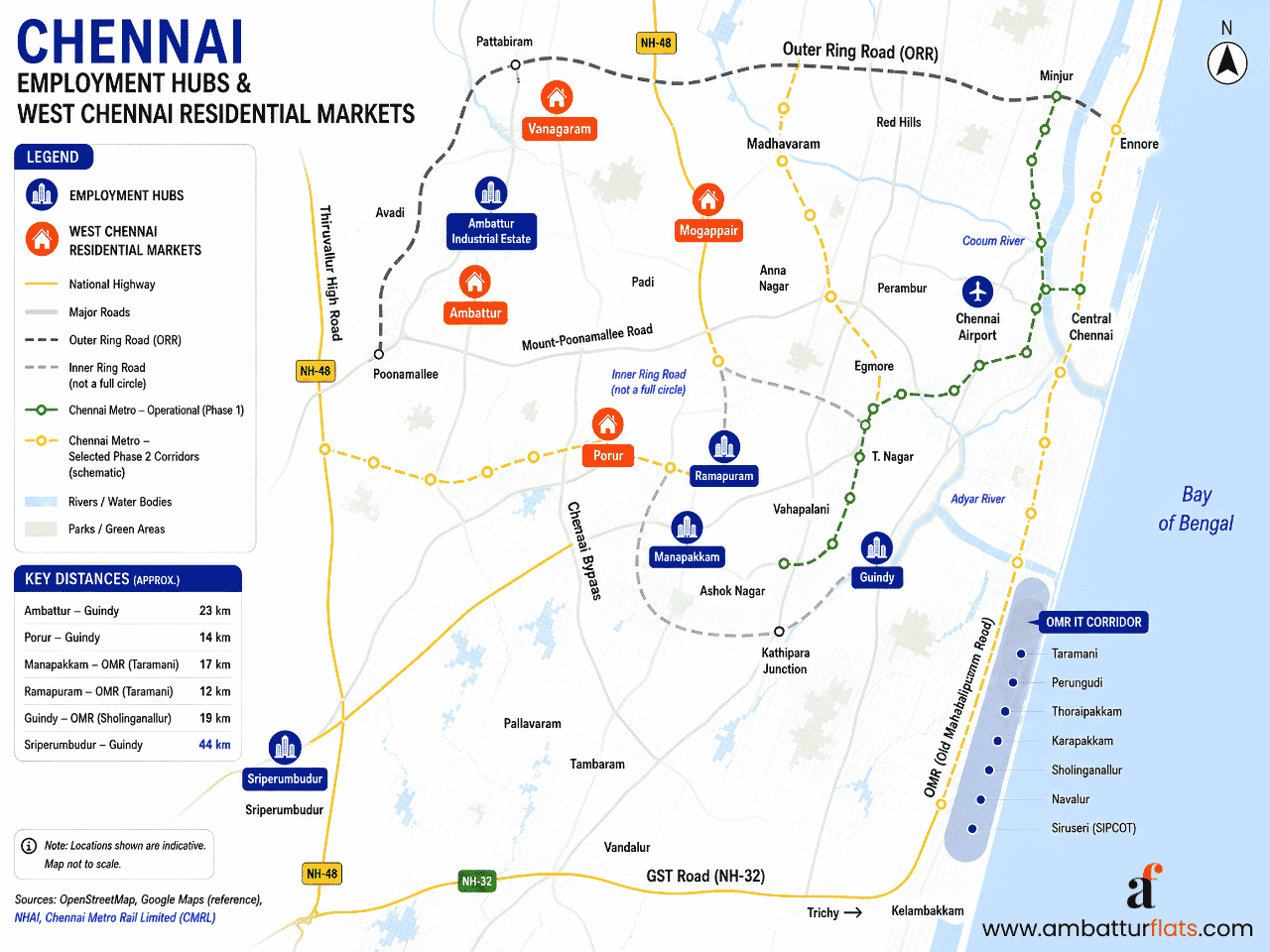
Map showing Chennai's employment hubs, key transport corridors and West Chennai's residential markets
Developer activity often provides one of the clearest signals about where future housing demand may emerge. One reason builders are increasingly focusing on western corridors is land availability. Finding large land parcels within central Chennai has become very difficult, making large scale residential communities
harder to develop.
The west offers opportunities to build projects with parks, walking tracks, open spaces and community facilities that are difficult to accommodate in older neighbourhoods with dense urban development. Buyers are preferring projects that combine residential units with lifestyle amenities, especially families looking for long term homes.
This trend is also visible in recent investment activity. Over the past two years, developers have invested more than ₹2,500 crores across nearly 80 acres of land in Chennai as they prepare for future housing demand. These acquisitions are spread across established city locations and fast-growing suburban corridors, reflecting confidence in Chennai's next phase of residential growth and the importance of areas where larger lands
remain available.
Porur offers access to Guindy, Ramapuram, DLF Cybercity and the Chennai Bypass while also connecting residents to several major commercial zones across the city. Established schools, hospitals and retail infrastructure make it attractive for families looking for convenience alongside connectivity.
Improving connectivity and the availability of larger land parcels make Poonamallee attractive to first time buyers and long term investors. Compared to more mature neighbourhoods, it still offers relatively lower entry prices in several micro markets.
Ambattur benefits from an existing employment base. Ambattur Industrial Estate continues to support thousands of jobs across manufacturing and engineering sectors, creating stable residential demand from employees who prefer living closer to work. Buyers specifically evaluating the locality can also look at whether Ambattur is a good place to buy a home in Chennai.
Mogappair combines established infrastructure with good access to both central Chennai and western employment centres. Schools, hospitals and shopping centres are already in place, making it attractive for families looking for ready neighbourhoods rather than
future promises.
Compared to many established parts of Chennai, West Chennai still offers relatively attractive entry points for buyers. However, affordability rarely remains unchanged as infrastructure improves and demand grows.
This does not happen overnight and not every neighbourhood will experience the same level of price growth. Local factors such as infrastructure delivery, employment opportunities and housing demand all influence property values differently.
For buyers, this means evaluating locations individually rather than looking at West Chennai as a single market. Some areas may mature faster than others depending on how these factors develop over time.
The broader pattern, however, remains clear. Buyers who enter a market before it becomes fully established often pay less than those who arrive after demand has already accelerated. This connects to a broader question: why Chennai property prices continue to rise despite affordability concerns.
| Buyer Type | Why West Chennai Appeals |
|---|---|
| IT Professionals | Access to Guindy, Ramapuram and Manapakkam |
| Manufacturing Professionals | Proximity to Ambattur and Sriperumbudur |
| Families | Larger communities and established infrastructure |
| Investors | Improving connectivity and long term demand |
West Chennai is no longer a location that buyers consider only after ruling out other parts of the city. For many people, it has become one of the first regions they evaluate when deciding where to buy property in Chennai.
The region still contains locations at different stages of development, which gives buyers options depending on their budget, commute requirements and long term goals. Some may prefer established locations such as Mogappair or Porur, while others may look at Poonamallee for its future growth potential.
Ultimately, this westward shift is Chennai itself evolving: jobs are more distributed, connectivity keeps improving and convenience counts for more than it used to. For a growing number of homebuyers, West Chennai has become the first place they look, not the last one.
Jobs have spread beyond the traditional IT corridor, and commute times now matter more to buyers than the reputation of a neighbourhood. Areas like Porur, Ambattur and Mogappair offer access to multiple employment hubs along with larger homes for the same budget.
In most micro markets, yes, though prices are rising quickly in some pockets. Perambur recorded a 35% year on year increase in residential prices, Perumbakkam grew 20% and Mogappair rose 13%, so the affordability gap is narrowing as demand picks up.
Ambattur Industrial Estate continues to support manufacturing and engineering roles. DLF Cybercity in Ramapuram has grown into a major office campus, and the L&T campus in Manapakkam has added further options. These are functioning employment centres, which explains why interest in the area has grown alongside them.
Porur and Vanagaram sit close to the Chennai Bypass, Mount Poonamallee Road and the Outer Ring Road, giving residents multiple route options depending on where they work. The Poonamallee to Vadapalani metro stretch cleared safety inspections in February 2026 and is awaiting an inauguration date, which will add a rail option alongside the existing
road network.
Growth is unlikely to be even across every locality. Areas like Perambur, Perumbakkam and Mogappair have already shown strong price appreciation, while places such as Poonamallee and Vanagaram are still earlier in their development and may take longer to see the
same movement.
Both, depending on the locality. Families tend to prefer Mogappair and Porur for their established schools, hospitals and retail access, while investors and first time buyers often look at Poonamallee and Vanagaram, where entry prices are lower and connectivity is still improving.
Commute and budget usually decide it. Buyers working near Guindy, Ramapuram or Manapakkam tend to find Porur convenient, those in manufacturing or engineering roles often lean toward Ambattur, and buyers who want established infrastructure over future potential tend to settle on Mogappair.