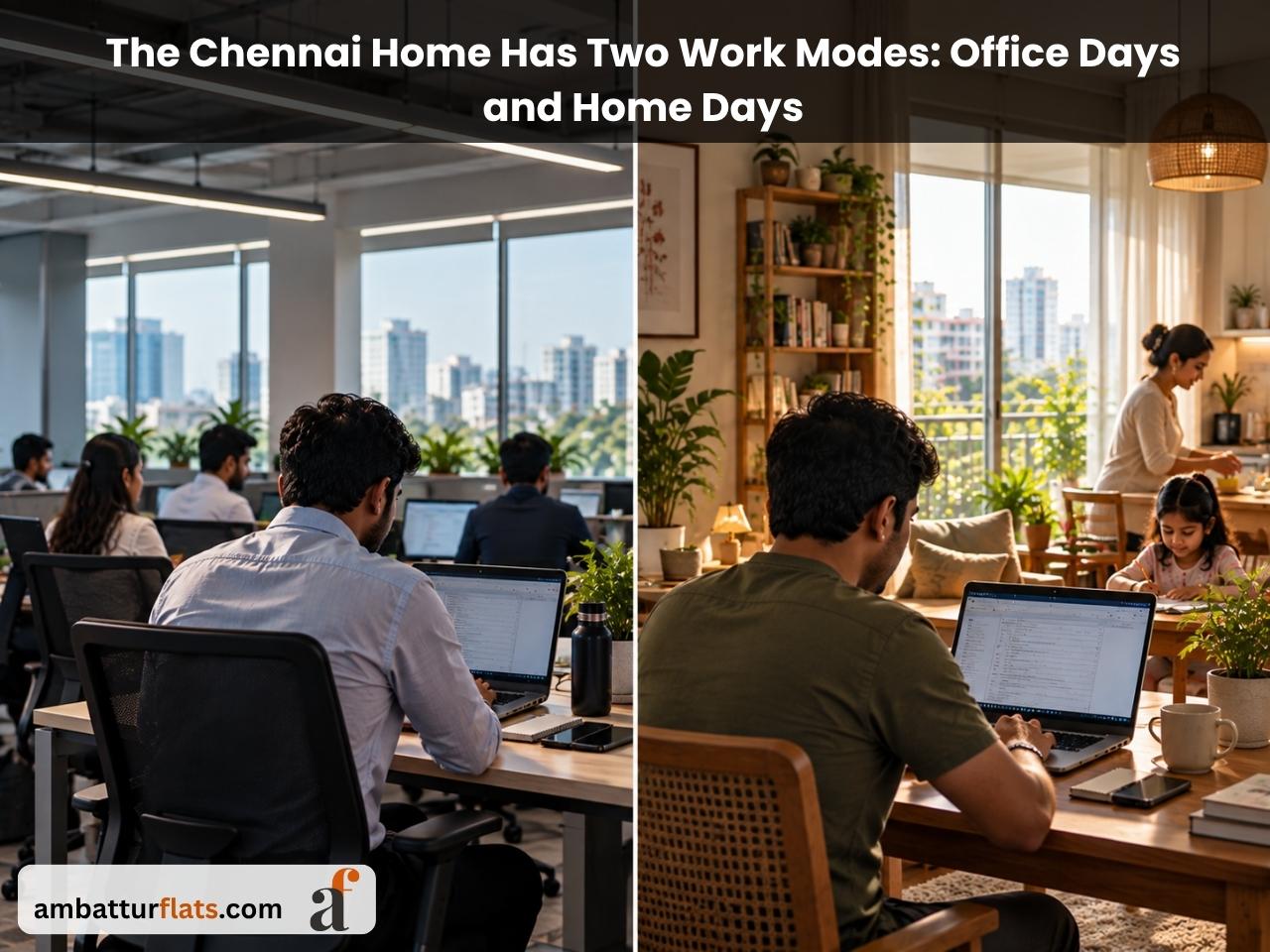

Two developments since early 2025 seem to point in opposite directions. Three major Indian IT services companies have tightened how they enforce office attendance, and TCS expects staff in five days a week. Yet buyers still want more room at home. In Anarock's consumer survey for the first half of 2026, 53 per cent of Chennai respondents said they preferred a 3 BHK, above the 48 per cent recorded across the 14 cities surveyed.
Both hold at once, and together they explain where hybrid work and home buying in Chennai stand today. Hybrid work changed what a home has to handle on the days people stay in. It did not take the office out of the decision. So the test for a flat has two parts: it should work through a full day at home, and its location should still work on a five-day office week.
Hybrid work in Chennai has changed how homebuyers use a home on working days. Buyers look for a room where one person can work and take calls through the day, and for power and internet that hold up during office hours. The commute still matters, because large IT employers have tightened office attendance rules since early 2025.
The shift is about when a flat is occupied. A home that stood empty from morning until evening on weekdays is now in use through the working day for part of the week. Faults that an evening-only household rarely noticed, such as afternoon heat in a west-facing room, a weak mobile signal in the bedroom or a scheduled daytime power cut, now cost working hours.
A hybrid worker still reports to an office, on a schedule the employer sets. For Chennai IT professionals at TCS, Infosys and Wipro, that schedule is now enforced more strictly than before.
Look at what three major Indian IT services companies have done since early 2025. Their office-day requirements were already set by late 2023, so the change has been in how strictly they are applied.
| Company | Base rule (in place by late 2023) | What changed in 2025 and 2026 |
| TCS | Five days a week | Appraisals halted for staff who stayed non-compliant through July to September 2025 (reported January 2026) |
| Infosys | At least 10 days a month | System limits on work-from-home requests from 10 March 2025 |
| Wipro | Three days a week, from 15 November 2023 | At least six hours in the office on each office day from 1 January 2026 |
The broader office market points in the same direction. In CBRE's 2025 India Office Occupier Survey, which collected views from over 100 C-suite executives, 94 per cent of occupiers preferred at least three office days a week.
For anyone buying a home, the dates matter as much as the rules. Infosys changed its enforcement in March 2025, and Wipro added an hours requirement ten months later. A home is usually owned for far longer than that, so the rules in force on the day of purchase are a weak guide to the commute over the years of ownership.
Anarock's Consumer Sentiment Survey for the first half of 2026 found that 53 per cent of Chennai respondents preferred a 3 BHK home, compared with 48 per cent across the 14 cities in the survey. Two-bedroom homes came second nationally at 38 per cent.
The survey does not say why. Hybrid work is one possible reason a household might want a third room, but the same survey found that the ₹90 lakh to ₹1.5 crore bracket was the most preferred budget, chosen by 34 per cent of respondents against 25 per cent in Anarock's H1 2021 survey. Anarock chairman Anuj Puri said the findings "clearly point towards a continued premiumisation of housing demand". These are stated preferences rather than completed purchases, and they do not separate hybrid work from rising budgets as the cause.
There is another side to the 2 BHK vs 3 BHK decision in Chennai: affordability. Before treating a third bedroom as a work necessity, check how much home loan your salary can support, because the extra room is paid for every month, including the months when an employer wants staff in the office five days a week.
Some listings for apartments in Chennai describe a flat as a 2.5 BHK, or label a small room as a study. The RERA Act, 2016 does not define either term. What it does define is carpet area: the net usable floor area of an apartment, excluding external walls, service shafts, exclusive balconies or verandahs and exclusive open terraces, but including internal partition walls. That figure tells you the size of the flat. It does not tell you whether the flat has usable home office space.
The floor plan and a site visit answer that better than the label:
• Ask for room-wise dimensions on the floor plan, and confirm a desk and chair fit with space to move.
• Look for a door that closes and a window that opens to the outside. A room that draws light and air only from a balcony or passage tends to get stuffy by afternoon.
• Note what the room shares a wall with. A study beside the kitchen or the main living area puts every call next to household noise.
• Count the power points and work out where the Wi-Fi router will sit.
Working couples face a harder version of this, because two people on calls at the same time need two separate spaces. A private corner for calls is part of what young Chennai homebuyers are looking for, along with half rooms and study nooks.
An owner who was out all day may never have tested a flat for the faults that show up during office hours.
Planned maintenance shutdowns in Chennai can fall within normal working hours. Notices for areas such as Perungudi and Tambaram have listed a 9 am to 2 pm window, with supply restored earlier if the work finishes. For a hybrid worker, that means several hours in which the backup has to keep a laptop and a router running. Before buying, ask the builder or the residents' association what the backup supply covers in each flat, and whether lifts and water pumps run on the same system.
The telecom regulator TRAI notified rules in October 2024 for rating buildings from one to five stars on their indoor digital connectivity. In announcing them, it noted that the coverage and quality of connectivity inside buildings remained a major issue despite 4G coverage and the 5G rollout.
TRAI's assessment manual rates a property on fibre readiness, in-building mobile coverage, Wi-Fi coverage, broadband speeds and overall user experience. An amendment issued in May 2026 added half-star levels and a staged process for projects still under construction, which starts with a "Designed For" certificate based on the approved plans. Rating is largely voluntary, so a building may not have one. For an under-construction flat, ask whether the developer has applied for that certificate.
Whatever the rating says, test calls on your own network from the room you would work in, and ask which broadband providers already run fibre into the building. If the association allows only one provider, residents have no fallback when that line goes down.
A west-facing room or a top-floor flat takes the afternoon sun during the hours a home worker sits at the desk, and a low-floor flat facing a busy road gets the daytime traffic noise. The trade-offs in how floor level affects heat, noise and airflow carry more weight once someone is at home through the afternoon.
The usual advice says hybrid workers can trade a longer commute for more space by buying homes in Tambaram, Guduvancheri, Porur or the southern stretches of OMR. That trade holds only if the commute is bearable on the employer's strictest likely schedule.
Before deciding that hybrid work lets you live farther from the office, work out the journey as if you had to make it five days a week:
• Time the trip at peak hour, in both directions.
• Check whether a suburban train or metro route gives you a fallback to the road.
• Add up fuel, parking or cab costs for a full month of office days.
• Repeat the exercise for every earner in the household, since two earners may work in different parts of the city.
• Ask what the household would do if office attendance rules tightened again.
If the flat still works under that test, the hybrid days are a bonus. If it only works because you expect to commute twice a week, the purchase rests on an employer policy you do not control, and the table above shows how much those rules have changed since 2023.
Rail access matters here. Tambaram and Guduvancheri are both stations on the Chennai Beach to Chengalpattu suburban rail line, so a household whose offices sit near that line faces a different commute from one that depends on road travel to OMR. The same weighing of commute time against budget lies behind why Chennai homebuyers are moving away from prestige locations.
Some Chennai developers now list co-working spaces among the clubhouse amenities in their gated communities. A shared room with Wi-Fi helps when the flat is noisy, but it does not replace a private room for confidential calls. Its running costs also become part of the maintenance charge every resident pays. Before counting it as a reason to buy, ask who will run it after the builder leaves and check how shared facilities shape the maintenance bill after handover.
Days at home also raise the value of what lies outside the gate. A household that is home on weekdays uses nearby shops and clinics more than one that leaves at 8 am and returns at night, which makes the case for walkable neighbourhoods stronger for hybrid workers in particular.
Most of what decides whether a flat suits hybrid work can be checked before booking: the size of the work room, the backup supply, the indoor signal and the commute at peak hour. The number of days an employer will want staff in the office three years from now cannot.
Test the location against a five-day office week and the work room against a full day at home before deciding whether a third bedroom is worth its EMI. One question stays open: whether Chennai's strong stated preference for 3 BHK homes will turn into purchases at today's prices, since Anarock's figures measure what buyers want rather than what they bought.
It can be, if one bedroom or a separate corner can hold a desk, with a door that closes and a window to the outside. A 2 BHK gets harder when two people in the household work from home on the same days and both take calls. In that case a 3 BHK, or a 2 BHK with a usable study, is the safer layout if the budget allows.
It usually describes a flat with two bedrooms and a smaller extra room sold as a study. The RERA Act does not define the term, so check the extra room's dimensions, door and window on the floor plan rather than relying on the label.
Only if the commute still works at five office days a week. Major IT employers have enforced attendance more strictly since early 2025. TCS has halted appraisals for staff who did not meet its five-day office requirement, and Wipro now asks for at least six hours in the office on each of its three office days. A location chosen around two office days carries the risk that the policy changes.
Test calls on your own mobile network from the room you would work in, and ask which broadband providers have fibre into the building. TRAI's rating framework for indoor digital connectivity is largely voluntary, so many buildings will not carry a rating. For a project still under construction, ask whether the developer has a "Designed For" certificate under the framework as amended in May 2026.
Shutdown notices for areas such as Perungudi and Tambaram have given a five-hour window, from 9 am to 2 pm, and supply can return earlier if the work finishes. Check what the building's backup supply covers for a cut of that length.