

Growth corridors in Chennai are developing faster along major transport networks supported by government infrastructure. Large public investments such as Chennai Metro Phase 2, new highways and industrial corridors improve connectivity, reduce travel time and attract businesses. As employment grows, demand for housing, schools, hospitals and other essential services follows. This is why government led infrastructure often becomes the foundation for long term
residential growth.
Two decades ago, few people expected Old Mahabalipuram Road (OMR) to become one of Chennai's leading IT and residential corridors. Today, similar changes are taking shape in other parts of the city. While residential projects often receive the most attention, the real transformation usually begins much earlier through government investments in infrastructure.
Long before developers launch apartment projects, governments invest in roads, Metro lines, industrial parks, water supply, drainage systems and other civic infrastructure. These investments improve accessibility, attract businesses and create the conditions needed for steady residential growth.
Most successful residential neighbourhoods in Chennai have followed a similar
pattern of development.
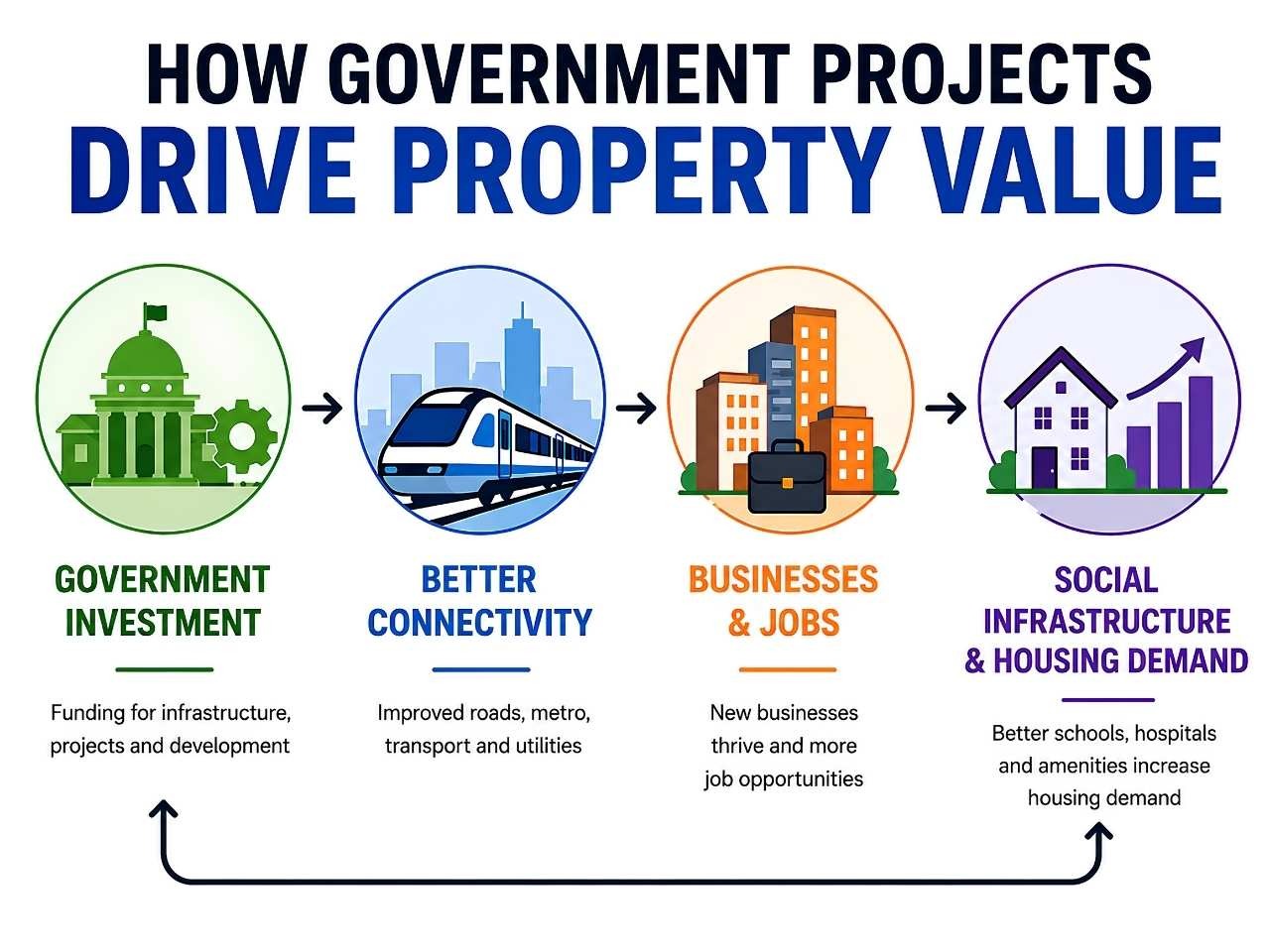
Government investment strengthens connectivity, businesses generate employment and growing populations encourage schools, hospitals, retail centres and other civic amenities. As these elements develop together, residential demand increases and property values become stronger
over time.
Recognising this pattern helps buyers make better decisions rather than relying only on current market trends. Areas receiving major public investment today often become the city's strongest residential markets over the next decade.
Neighbourhoods located just a few kilometres apart can experience very different levels of development. One area may attract apartment projects, commercial spaces and public facilities within a few years, while another with similar land availability sees little change.
The difference comes down to long term infrastructure planning rather than developer activity alone. Developers typically invest where governments have already improved connectivity, public transport and civic infrastructure.
To see how public spending impacts local real estate, you can read our detailed breakdown on how infrastructure shapes property value in Chennai. Government investment often provides a clearer indication of where future residential demand is likely to grow.
A growth corridor is more than a road, Metro station or housing project. It is an area where transport infrastructure, employment centres, public facilities and residential development grow together to create a well connected community.
Future growth depends on several factors working together. Better transport improves accessibility, which quickly attracts businesses. These businesses create employment, driving up the demand for housing. Finally, growing residential communities encourage schools, hospitals, retail centres and other civic facilities to set up businesses. When these developments happen together, a neighbourhood becomes a preferred place to live, work and invest.
Many buyers compare apartments based on price, floor plan or amenities. While these factors are important, the future of the surrounding neighbourhood often has a greater impact on long term value.
Consider two residential projects with similar prices. One is located in an area where government investments are improving connectivity, employment opportunities and civic infrastructure. The other is in a location with little planned development beyond the apartment project itself.
Five or ten years later, the difference can be substantial. The first location may offer better schools, stronger transport links, higher rental demand and better resale value, while the second may continue to depend on nearby areas for essential services. For anyone tracking Chennai real estate market growth, understanding government led development provides a clearer picture of where future demand is likely to emerge.
Residential growth rarely begins with apartment construction. It is usually the result of years of planned public investment. Governments first improve connectivity, strengthen infrastructure and create employment opportunities before large scale residential development begins.
Investments in roads, Metro networks, industrial parks and civic infrastructure improve accessibility, making these locations more attractive for businesses. As commercial activity expands, residential demand naturally follows.
Homebuyers can evaluate emerging locations differently by shifting focus away from where developers are building today and looking at where the city is investing for the future. Areas receiving continuous government investment often have stronger long term growth potential.
Transport infrastructure does much more than reduce travel time. It improves access to employment centres, educational institutions, healthcare facilities and commercial districts, making neighbourhoods more attractive for businesses and residents alike.
The Chennai Metro Phase 2 project is a good example. Beyond adding new stations, it connects residential areas with major employment hubs and commercial centres that were previously less accessible. Better connectivity not only improves daily commuting but also encourages businesses and homebuyers to consider these locations.
The same pattern can be seen in major road projects. New bypasses and highway expansions improve freight movement between ports, industrial parks and commercial centres. As industries expand, employment opportunities increase, creating steady demand for nearby residential developments.
Residential projects are often seen as the driving force behind neighbourhood development, but businesses usually arrive first.
Companies choose locations with reliable infrastructure, efficient transport and room for future expansion. Once employment opportunities become established, residential demand grows as more people choose to live closer
to their workplaces.
As the population increases, schools, hospitals, supermarkets, banks and other essential services naturally follow. A neighbourhood becomes a desirable place to live because it supports everyday life, not simply because new apartments have
been built.
Transport and employment drive the early stages of development, but long term residential growth depends on strong civic infrastructure. Families also consider access to drinking water, drainage systems, healthcare, schools, parks and public spaces before choosing where to live.
Government investment in these essential services builds confidence among both homebuyers and businesses. Well planned civic infrastructure indicates that an area is being developed as a permanent community rather than a short term real estate opportunity.
This confidence also encourages private investment. Hospitals, educational institutions, retail chains and financial institutions are more likely to expand into locations with growing populations and reliable public infrastructure.
Several neighbourhoods across Chennai demonstrate how government investment has influenced residential growth.
Two decades ago, OMR was largely undeveloped. Government investment in road infrastructure, IT parks and supporting public facilities transformed the corridor into one of India's leading technology hubs. Today, it connects major IT campuses, business parks and residential communities, making it one of Chennai's strongest examples of infrastructure led growth. You can see how this growth continues further along the OMR corridor by exploring the best flats in Navalur for modern residential options.
Porur has grown through a combination of healthcare institutions, commercial expansion and transport improvements. Together, these developments have strengthened its position as one of Chennai's preferred residential locations. Homebuyers looking at this western hub can browse the best flats in Porur to see current
market options.
Industrial development continues to drive growth in Sriperumbudur. Large manufacturing investments within SIPCOT Industrial Parks have attracted businesses, suppliers and supporting industries, creating consistent demand for residential housing across the region.
Several large scale infrastructure projects are expected to influence the next phase of Chennai real estate market growth. Tracking these developments can help homebuyers identify locations with strong long term potential before they become established residential hotspots.
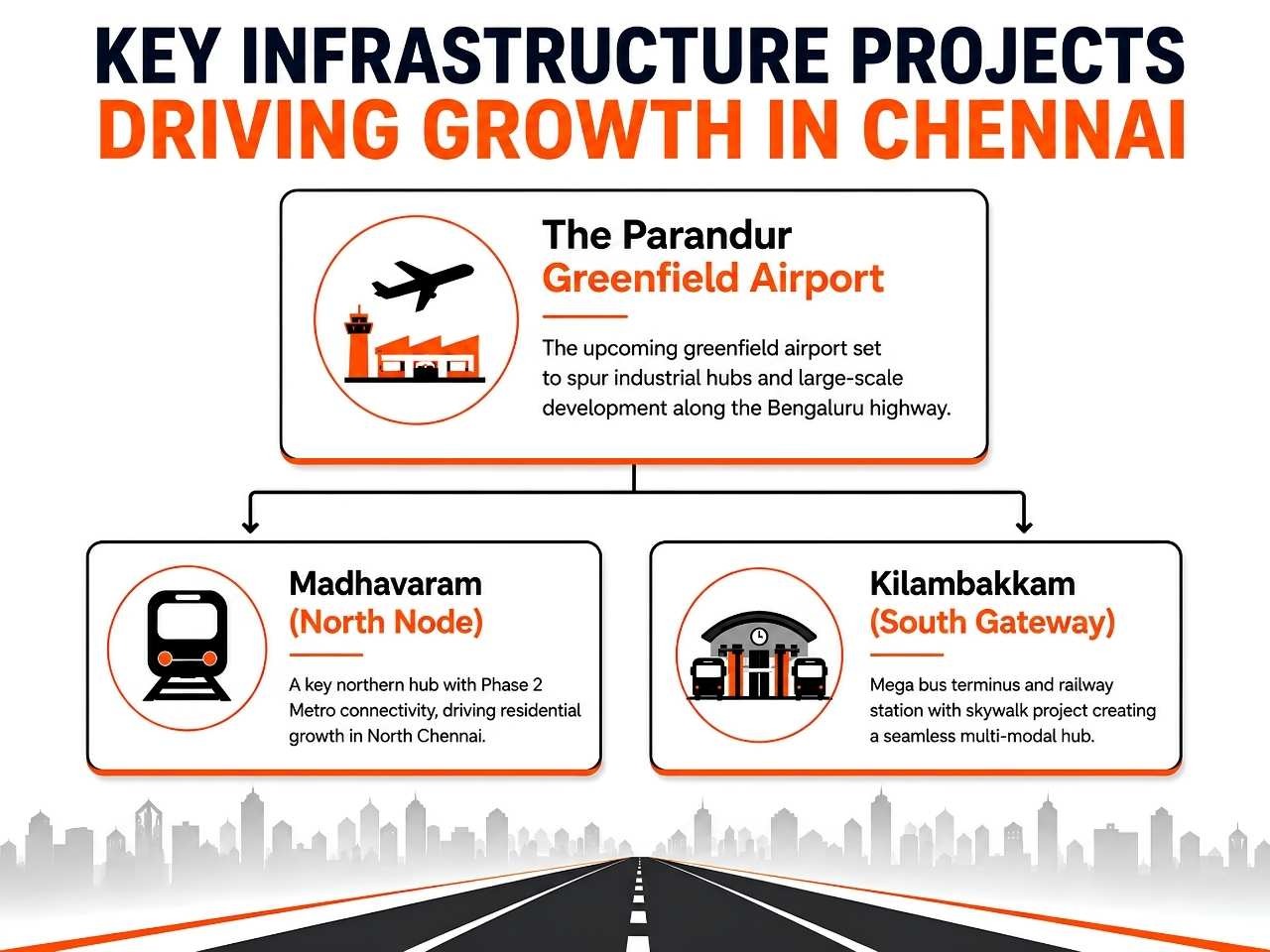
The proposed Parandur Greenfield Airport is likely to become one of Chennai's most influential infrastructure projects. Large transport hubs typically attract supporting developments such as expressways, rail connectivity, logistics facilities and
commercial spaces.
As these projects progress, the corridor between Sriperumbudur and Parandur is likely to experience increased industrial activity and residential development, creating new opportunities for both homebuyers and investors. For a deeper look at how this mega project alters land dynamics, check our analysis on the parandur airport land acquisition impact on real estate.
North Chennai is steadily moving forward, with Madhavaram emerging as a key transport and infrastructure hub. Improved regional connectivity is gradually transforming the area from a logistics focused location into a well connected residential destination. As ongoing infrastructure projects are completed, Madhavaram is expected to play an even larger role in North Chennai's future growth.
The opening of the Kilambakkam Bus Terminus has extended residential interest further along the GST Road corridor. Its importance will grow further with the Kilambakkam Railway Station and Skywalk Project which will improve connectivity between bus and suburban rail services. This integrated transport network is likely to support steady housing demand across the
surrounding neighbourhoods.
Many buyers begin considering a location only after shopping centres, schools and commercial developments are fully established. By then, property prices have often risen considerably. Recognising growth corridors during the early stages of infrastructure development can provide better long term value and stronger appreciation potential.
Government announcements provide useful information, but ongoing construction offers stronger evidence of future development. Roads, Metro stations, flyovers and public infrastructure projects under construction usually indicate that future investment is already underway.
Neighbourhoods where different transport networks intersect often experience faster growth. Locations connected by Metro lines, railway stations, major highways or bus terminals generally become attractive residential destinations because of improved accessibility.
Before purchasing a property, assess the availability of essential services such as drinking water, drainage systems, road widening projects and public utilities. Strong civic infrastructure plays a major role in improving property values and quality of life.
Neighbourhoods that offer easy access to public transport, schools, supermarkets and daily conveniences continue to attract buyers as traffic congestion increases across Chennai. This is why Chennai homebuyers prefer walkable neighbourhoods when choosing a home.
Before investing in an emerging location, ask these
important questions.
Residential demand is closely linked to employment opportunities. Areas located near business districts, IT corridors or industrial parks are more likely to maintain healthy rental demand and stronger resale value.
Projects that improve connectivity across Chennai, such as Metro corridors, major highways or regional transport hubs, generally have a greater impact on long term property appreciation than smaller local developments.
Large infrastructure projects often take several years to complete. Evaluating the actual progress on site before making an investment decision is safer than relying only on marketing material or early announcements.
Compare current prices with historical market trends to understand whether the location is still in the early stages of development or has already experienced significant appreciation. A detailed Chennai real estate trend analysis can help you make a more informed decision.
When exploring properties in Chennai for sale or searching for apartments in Chennai for sale consider more than the apartment itself. The long term value of a home is closely linked to the growth of the surrounding neighbourhood.
Government investments in transport, employment hubs and civic infrastructure often shape the city's future residential destinations years before large scale housing projects begin. Recognising these early signs helps homebuyers identify locations with stronger long term
growth potential.
Looking closely at where Chennai is investing for the future reveals the best opportunities. Growth corridors built on strong infrastructure are more likely to deliver better connectivity, improved quality of life and lasting property value.