

India’s housing market experienced a noticeable shift in 2025. After several years of strong growth, many major metropolitan real estate markets entered a phase of consolidation. Housing demand slowed in several large cities, reflecting rising prices, changing buyer expectations, and cautious investor sentiment. However, one major metro stood out for a very different reason.
Chennai continued to record steady growth in residential sales while several other metropolitan markets slowed down. The city’s real estate sector demonstrated resilience driven by affordability, infrastructure expansion, diversified employment opportunities, and an end-user–focused buyer base. These structural strengths helped Chennai outperform other urban housing markets in India during a year when many cities experienced declining sales.
Understanding why Chennai’s property market performed differently offers useful insights for homebuyers, investors, and developers evaluating long-term opportunities in the city.
The overall housing market across India’s seven major cities experienced a decline in sales during 2025.
Approximately 3,95,625 housing units were sold across the top seven cities in 2025, compared with 4,59,645 units in 2024. This represents a 14 percent decline in annual housing sales.
Several factors contributed to this slowdown. Property prices had risen significantly in many metropolitan areas during the previous growth cycle. At the same time, developers in some markets are increasingly focused on premium and luxury housing segments. These projects often target a smaller buyer pool, which can slow absorption when economic sentiment becomes cautious.
While the broader market showed signs of cooling, Chennai moved in the opposite direction.
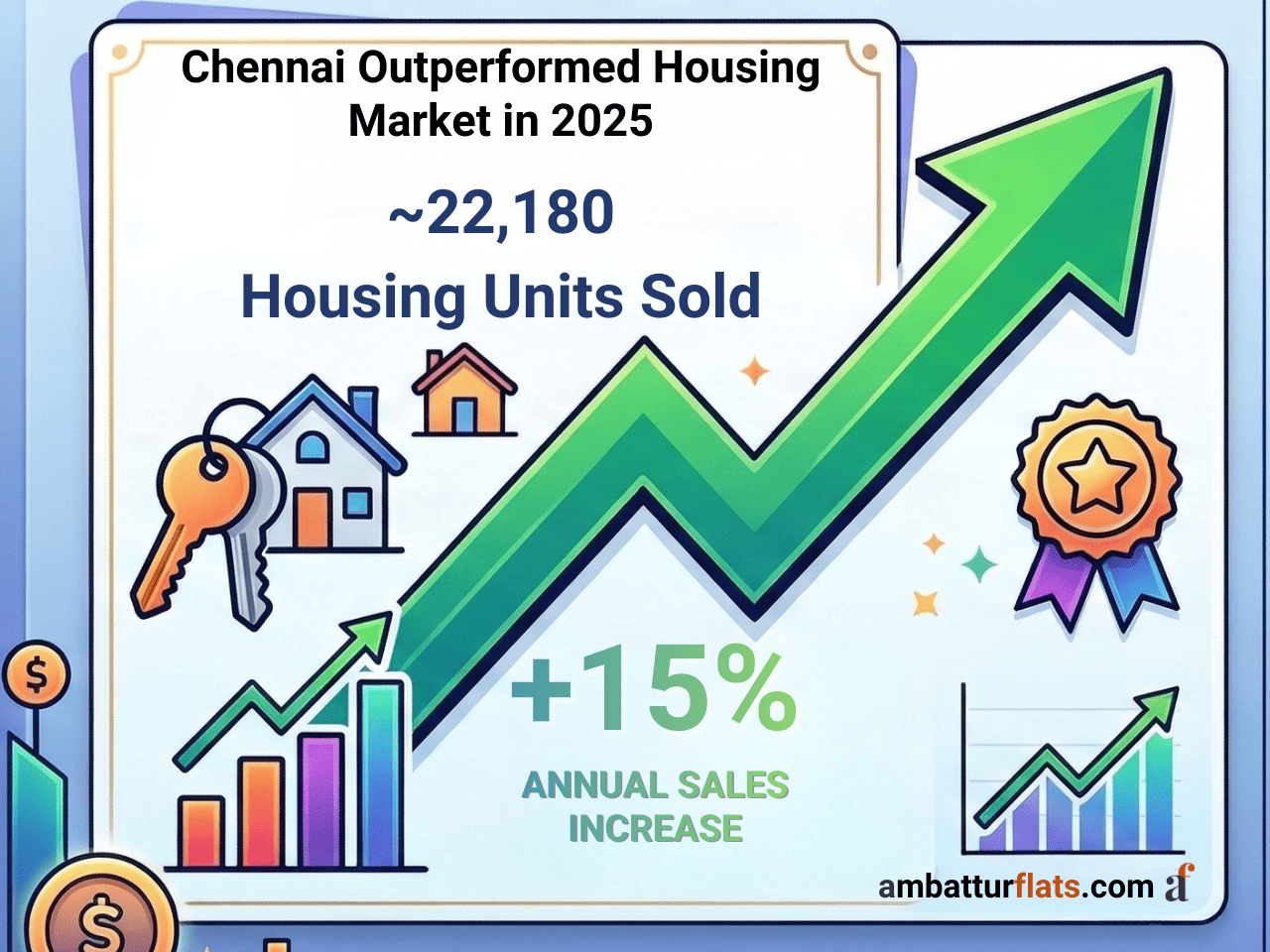
Chennai recorded around 22,180 housing units sold in 2025, representing a 15 percent increase in annual housing sales. Among India’s top seven metropolitan housing markets, Chennai was the only city to register an annual growth in residential sales during the year.
This contrasting performance highlights a key characteristic of Chennai’s real estate market: its growth is primarily supported by genuine housing demand rather than speculative investment activity.
One of the most important reasons behind Chennai’s stable housing market is the strong presence of end-user buyers.
In many major cities, a large portion of housing demand comes from investors who purchase property expecting rapid price appreciation. These investment-driven markets often experience stronger price volatility and cyclical slowdowns when investor sentiment changes.
Chennai’s housing market, by contrast, is largely driven by buyers who plan to live in the homes they purchase. This creates a more stable demand pattern.
End-user demand supports consistent absorption across multiple housing categories, particularly:
Because the market is less dependent on speculative investment activity, property sales tend to reflect real housing needs rather than short-term financial trends.
This structural characteristic has helped preserve buyer confidence even during periods when other metropolitan markets experience fluctuations.
Another major factor strengthening Chennai’s real estate market is ongoing infrastructure development across the metropolitan region.
Large infrastructure projects often influence housing demand by improving connectivity between residential areas and employment centers. When commuting becomes easier, peripheral areas become more attractive for residential development.
Several projects are currently transforming connectivity across the city, including:
These projects are gradually improving connectivity across South, West, and North Chennai, allowing residential development to expand beyond traditional city centers.
Improved connectivity has also unlocked new Chennai suburban housing markets that were previously less accessible. As commuting times decline, these areas become viable options for homebuyers seeking larger homes at relatively affordable prices.
This expansion of housing corridors is contributing to stronger demand for both apartments and plotted developments in emerging locations.
Housing demand in large cities is closely linked to employment growth. Cities with diversified economies tend to experience more stable real estate demand because job creation occurs across multiple industries.
Chennai benefits from one of the most diversified urban economies in India.
Key sectors supporting employment in the city include:
Because employment opportunities are spread across several sectors, the city is less vulnerable to slowdowns in any single industry. This diversified economic base helps maintain a steady flow of new homebuyers entering the housing market.
Job growth across multiple industries also supports demand across different income segments. Professionals working in technology, manufacturing, healthcare, and corporate services contribute to consistent housing demand in the mid-income and upper-mid-income segments.
Affordability continues to be one of Chennai’s strongest advantages compared with other major metropolitan housing markets.
In cities where property prices have risen sharply, many potential homebuyers postpone purchase decisions due to financial pressure. High prices also push developers toward luxury housing projects, further reducing affordability.
Chennai’s residential property prices remain relatively accessible for middle-income households. Several high-activity residential areas in 2025 reported average prices ranging between ₹5,250 per square foot and ₹7,870 per square foot.
Some of the active housing markets include:
These areas have seen a significant number of new residential project launches, offering homes with modern amenities at relatively affordable price points.
Compared with many other metropolitan markets, Chennai still provides a balance between price stability and livability. This balance allows middle-income households to enter the housing market without excessive financial strain.
Chennai’s residential supply also increased significantly during 2025. More than 27,190 housing units were launched during the year, representing the highest annual supply recorded in the city since 2015.
Another important trend in Chennai’s housing market is the price range of new project launches. Approximately 71 percent of the housing supply introduced in 2025 was priced below ₹1.5 crore.
This is a significant contrast with several other metropolitan markets where developers have increasingly focused on luxury housing projects priced above ₹1.5 crore.
Chennai’s supply strategy appears more closely aligned with the purchasing capacity of its primary buyer segment.
Homes priced between ₹50 lakh and ₹1 crore have seen particularly strong demand. These properties are typically purchased by:
Because developers continue to launch projects within this price bracket, housing supply remains closely matched with buyer demand.
This balance between supply and affordability plays an important role in maintaining steady sales momentum.
Another trend shaping Chennai’s real estate market is the changing behaviour of Chennai homebuyers.
Buyers are increasingly:
This shift is contributing to a more efficient housing market. When buyers make decisions based on practical housing needs, projects with good planning and reliable delivery timelines tend to perform better.
The result is a market environment where genuine demand translates into faster sales for well-planned residential developments.
Chennai’s 2026 real estate trend shows several factors supporting continued housing market stability.
Infrastructure development is progressing across multiple corridors, improving connectivity between residential areas and employment centers. At the same time, residential supply continues to focus on price segments that match the purchasing power of the city’s primary buyer groups.
Pricing transparency, more realistic project delivery timelines, and increasing project choices are also strengthening buyer confidence.
These factors collectively suggest that Chennai’s housing market is moving toward a phase of steady, confidence-driven growth rather than speculative expansion.
For both homebuyers and developers, this environment offers a relatively predictable real estate landscape compared with markets that experience rapid price fluctuations.
While many major metropolitan housing markets in India experienced a slowdown in 2025, Chennai demonstrated a different trajectory. The city recorded a 15 percent increase in residential sales, supported by strong end-user demand, affordable housing options, infrastructure expansion, and a diversified economic base. As the market moves through 2026, the city is increasingly viewed as one of India’s most dependable residential property markets for both homebuyers and long-term investors.