

Chennai’s residential real estate market is entering 2026 in a very different position from where it stood five years ago. The volatility and uncertainty that marked the post-pandemic period have largely settled. What remains is a market that is steady, measured, and increasingly driven by real demand rather than speculation.
Multiple indicators now point to the same conclusion. Sales are growing, but at a controlled pace. New supply is entering the market, but without excess. Buyer preferences are evolving, but not erratically. Together, these trends suggest that Chennai is moving into a phase of maturity where long-term planning matters more than short-term timing.
This article brings together insights from recent institutional research and market commentary to present a grounded view of where Chennai’s residential market stands in 2026, what is shaping it, and what this means for buyers and investors.
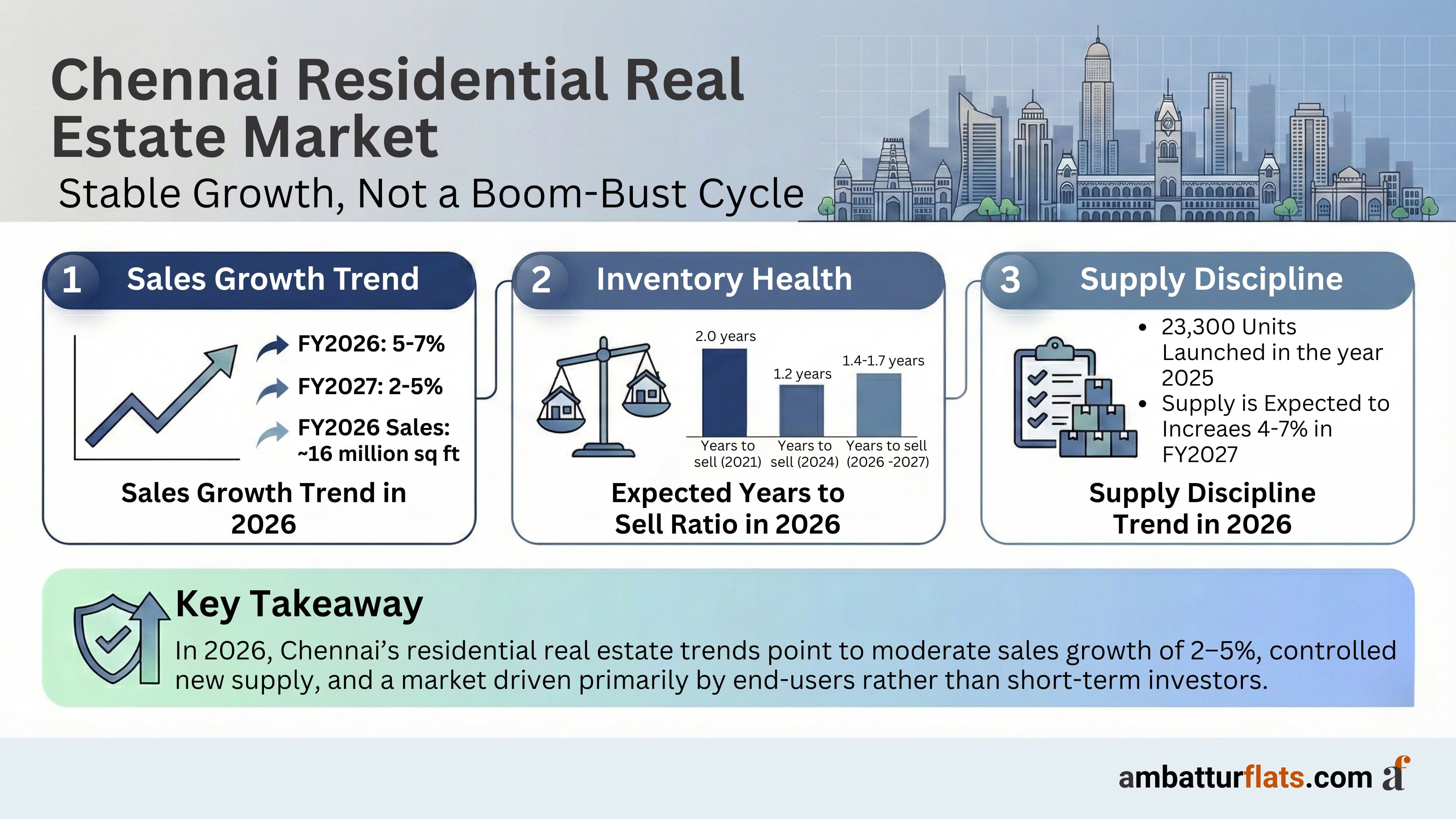
In 2026, Chennai’s residential real estate trends point to moderate sales growth of 2–5%, controlled new supply, and a market driven primarily by end-users rather than short-term investors.
Southern corridors such as OMR and GST Road continue to dominate new launches, while West Chennai is emerging as a metro-led growth zone.
Buyer demand is shifting toward larger and premium homes, with luxury housing accounting for a rising share of new supply, even as mid-segment housing remains the volume driver.
Property prices are increasing steadily, not sharply, while rents are growing faster than capital values in key employment-linked locations.
Inventory levels remain comfortable, indicating low oversupply risk, making 2026 a year defined by stability, infrastructure-led growth, and long-term investment clarity rather than speculative cycles.
One of the most important contexts for understanding 2026 is recognising how much the market has already grown.
Between FY2021 and FY2024, Chennai witnessed a strong recovery cycle. Residential sales volumes expanded at an annualised pace of roughly 15%, reaching close to 26 million square feet by FY2024. This growth was largely end-user led, supported by stable employment, moderate pricing compared to other metros, and improving access to suburban locations.
Note: FY refers to Financial Year, which is calculated from 1st April of the current year to March 31st of Coming Year.
By FY2025, growth had naturally slowed to around 2%. This moderation was not caused by falling demand. It happened because the market was already operating on a high base after several strong years. In practical terms, this means that even modest percentage growth going forward represents healthy absolute volumes.
Looking ahead, residential sales are expected to grow by about 5–7% in FY2026 and moderate further to around 2–5% in FY2027. This trajectory reflects a market that is stabilising rather than losing momentum.
Recent sales data reinforces this view. In the first half of FY2026 alone, Chennai recorded approximately 16 million square feet of residential area sold, marking a 17% year-on-year increase. This spike was supported by accelerated project launches earlier in the cycle.
However, sales in the second half of the year are expected to remain relatively flat. This pullback is not unusual. It reflects the normal absorption process after periods of higher supply. Importantly, there are no signs of demand stress. Buyer enquiries, booking conversions, and loan disbursements continue to show stability.
What stands out is the quality of demand. Chennai remains predominantly an end-user market. Investors are present, but they are largely yield-focused rather than speculative. This distinction matters because it reduces the risk of abrupt corrections.
Supply trends further support the narrative of balance. During calendar year 2025, Chennai recorded roughly 23,300 new residential unit launches, representing a 13% increase over the previous year. While quarterly numbers softened toward the end of the year, this slowdown was deliberate. Developers chose to consolidate inventory and phase launches rather than flood the market.
Looking ahead, new supply is expected to increase by about 5–7% in FY2026 and a further 4–7% in FY2027. These are measured increases, broadly aligned with expected sales growth. There is little evidence of aggressive overbuilding.
This discipline is also reflected in inventory metrics. Chennai’s years-to-sell ratio improved significantly from about 2.0 years in 2021 to nearly 1.2 years by early 2024. Although this ratio has edged up to around 1.4 years more recently, it remains well within what is considered comfortable for a large metropolitan market.
Note: Year to Sell Ratio is a measure of how long it would take to clear existing inventory at current sales rates.
Geographically, the market’s centre of gravity remains firmly in the southern part of the city.
The OMR corridor and the GST Road belt together account for over 80% of new residential supply. These locations combine proximity to employment hubs with expanding infrastructure, making them attractive to both buyers and developers.
OMR, in particular, continues to function as Chennai’s technology spine. Areas such as Sholinganallur and surrounding micro-markets see consistent demand from professionals working in IT and allied sectors. The addition of metro connectivity under Phase II has further strengthened long-term confidence in this corridor.
GST Road and its adjacent zones benefit from a similar mix of connectivity, affordability, and access to industrial and logistics clusters. These factors ensure steady absorption even during periods of slower overall growth.
While the south dominates volumes, West Chennai is emerging as an important secondary growth corridor.
Areas such as Poonamallee and Thirumazhisai have gained prominence due to metro expansion and improved road connectivity. These locations offer relatively lower entry prices compared to established corridors, attracting first-time buyers as well as early-stage investors.
The appeal here is not immediate returns but gradual appreciation. As infrastructure projects progress toward completion, these micro-markets are likely to integrate more closely with the city’s employment and commercial zones.
Find out more about Chennai’s upcoming real estate hotspots here!
One of the most notable changes in recent years has been the shift in what buyers are looking for.
Historically, Chennai has been dominated by mid-income housing. That segment continues to account for the largest share of demand. However, since FY2023, there has been a visible move toward larger and more premium homes.
This shift is reflected in launch data. The share of luxury housing in total new supply has risen steadily. It has increased from single digits in FY2021 to nearly one-fifth by FY2025. In the first half of FY2026, luxury launches accounted for over 40% of new supply, temporarily overtaking mid-income housing.
This does not indicate a decline in affordability-led demand. Instead, it suggests diversification. Higher-income households, including senior professionals and NRIs, are increasingly choosing Chennai for long-term ownership rather than short-term investment.
Home prices across Chennai have been rising, but in a calm and predictable way. In most parts of the city, property prices have increased by about 6–12% over the past year, depending on the area.
Central city locations have seen slower but steady price growth, while some suburban areas have recorded slightly higher increases, mainly because of better roads, metro connectivity, and improved infrastructure.
What stands out is what did not happen. There were no sudden price jumps or speculative bubbles. Prices moved up gradually, which gives buyers enough time to plan their purchase and helps developers keep pricing realistic.
Rents, on the other hand, have grown faster in many residential areas where working professionals prefer to live. In several parts of South Chennai, rents have increased by 9–15% in a year, supported by strong demand from people working in IT and related sectors. Because of this, rental income has improved, and in some locations, the cost difference between renting a home and owning one has become much smaller.
Viewed together, recent market data and on-ground trends point to a clear conclusion. Chennai’s residential real estate market in 2026 is stable, end-user driven, and structurally supported by infrastructure and regulation. Growth is likely to continue, but in a measured and predictable manner. For participants willing to think long term, this phase offers clarity. Not because the market promises extraordinary returns, but because it offers consistency.