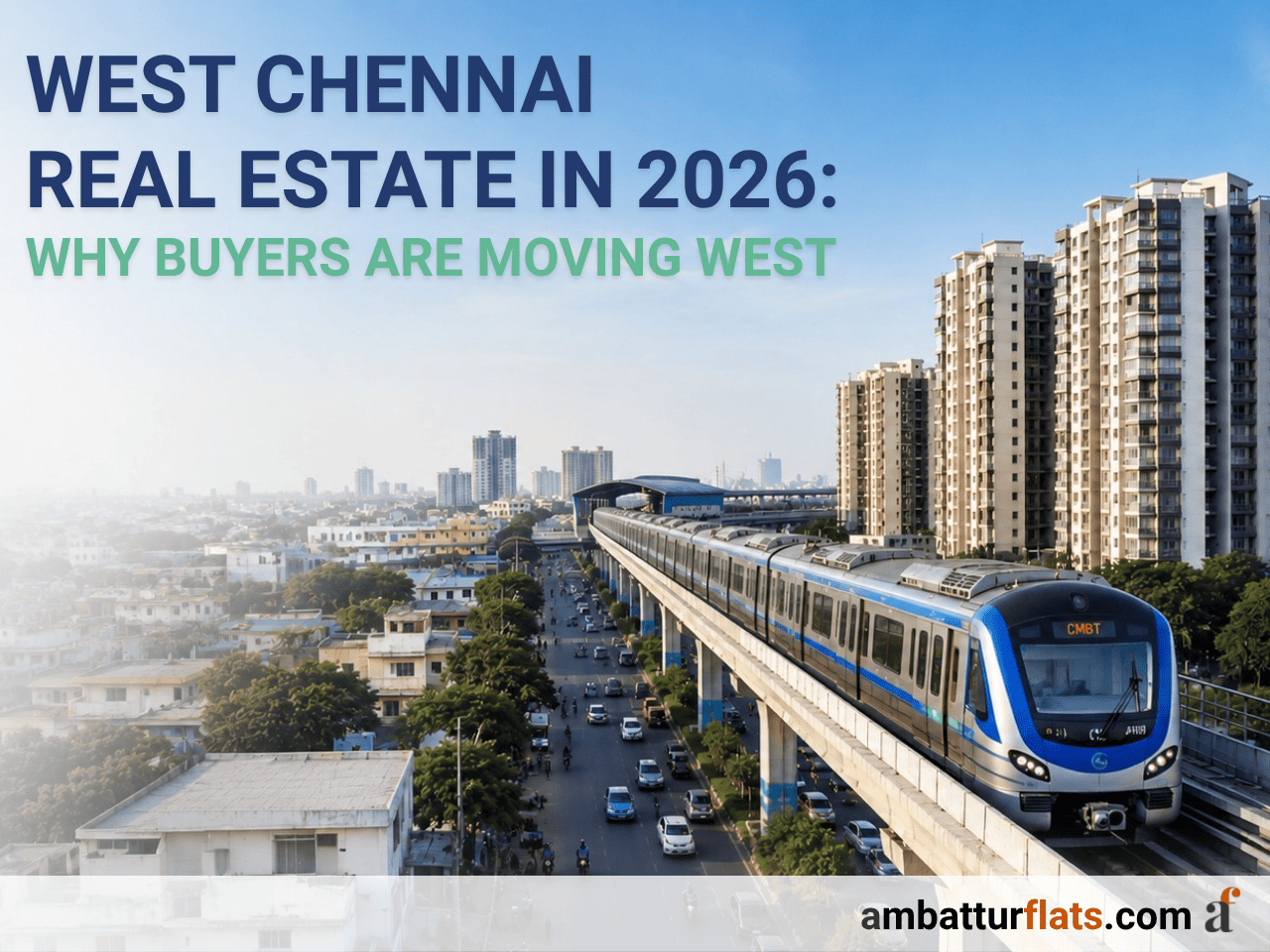

Ask most Chennai homebuyers where they want to live, and you will likely hear the same shortlist: Anna Nagar, Velachery, OMR, maybe Adyar. The mental map has been the same for years. South Chennai for IT professionals, central neighbourhoods for families who want established infrastructure. West Chennai, if it came up at all, was the answer you gave when you had no other choice.
That is changing in 2026. And the shift is not subtle.
Driven by Metro Phase 2 expansion, improving road connectivity, and a wave of commercial development, western suburbs that were once dismissed as industrial fringe are now drawing serious attention from homebuyers, working professionals, and property investors. If you have been tracking Chennai real estate lately, the story of West Chennai is one you cannot afford to ignore.
For decades, localities like Ambattur, Avadi, and parts of Poonamallee were defined by their industrial identity. SIDCO estates, manufacturing units, and long stretches of highway dominated the landscape. Families looking for residential options rarely put these areas on their shortlist.
What has changed is the mix. Industrial zones still exist, but they now sit alongside gated communities, schools, hospitals, retail centres, and IT parks. The economic activity that once pushed residents away is now pulling them in, because employment hubs and residential demand tend to move together over time.
West Chennai in 2026 is offering what many buyers genuinely want: lower property prices, wider roads, larger apartment layouts, and proximity to growing commercial zones — all in a single package that established city-centre neighbourhoods can no longer match on price.
No single factor has done more to reframe West Chennai's residential appeal than Metro Phase 2. The project is bringing rail connectivity to corridors that previously relied entirely on road transport, and the impact on both buyer sentiment and property prices is already visible.
The Poonamallee–Porur stretch of Corridor 4 is in advanced stages, with the section covering 10 stations expected to be operational by late 2025 to mid-2026. Once complete, this will connect Porur directly into the east–west metro spine, linking it to Vadapalani, T. Nagar, and eventually to Chennai's wider Phase 2 network of 128 stations across 118.9 km.
In practical terms, this means a commuter living in Porur or Poonamallee will no longer be entirely dependent on road travel to reach central Chennai. For anyone who has experienced the Porur junction during peak hours, that is a significant quality-of-life improvement — and buyers are already factoring it into their decisions.
Porur is the area developers most frequently describe as the "new Anna Nagar," and the comparison is not entirely without merit. The locality sits at a strategic intersection of NH45, NH48, and NH716, giving it strong road connectivity in multiple directions. Add DLF IT Park, Sri Ramachandra Medical Centre, and several large residential communities, and you have an area that checks most of a working professional's boxes.
Property prices in Porur currently range between ₹8,500 and ₹10,500 per square foot. Rental yields are climbing toward 3.2%, driven by consistent demand from IT professionals and healthcare workers. The one genuine trade-off is traffic congestion around the Porur junction, which remains a real concern for daily commuters even though Metro connectivity is expected to ease some of that pressure over time.
Ambattur represents perhaps the most dramatic transformation story in West Chennai. What was once a predominantly industrial suburb is now a functioning mixed residential-commercial zone, with new apartment projects, retail developments, and improving social infrastructure sitting alongside its established employment base.
Property prices in Ambattur remain the most accessible in the region, ranging between ₹5,500 and ₹7,500 per square foot. Suburban rail connectivity is strong, and proximity to multiple employment hubs, from the SIDCO Industrial Estate to the broader corridor linking Ambattur to Porur and beyond, makes it a genuine value proposition for first-time homebuyers. For a detailed look at why the locality holds long-term appeal, the Ambattur investment hotspot guide on Ambattur Flats covers the key fundamentals in depth.
If you are still weighing up the area, the post on reasons to buy a home in Ambattur is worth reading before you make a decision.
Mogappair continues to hold its ground as one of West Chennai's most stable residential neighbourhoods. Its appeal is straightforward: planned layouts, good schools, parks, and a relatively calm residential environment close to Anna Nagar but without Anna Nagar's price tag. Property prices here range between ₹8,800 and ₹11,000 per square foot, reflecting the area's consistent long-term demand from families.
Vanagaram is gaining traction specifically for gated community and villa projects, attracting buyers who want more space and a community-oriented living environment. Further out, Avadi remains the go-to option for buyers prioritising affordability above all else, with strong suburban train connectivity keeping it accessible to the wider city despite its lower price points.
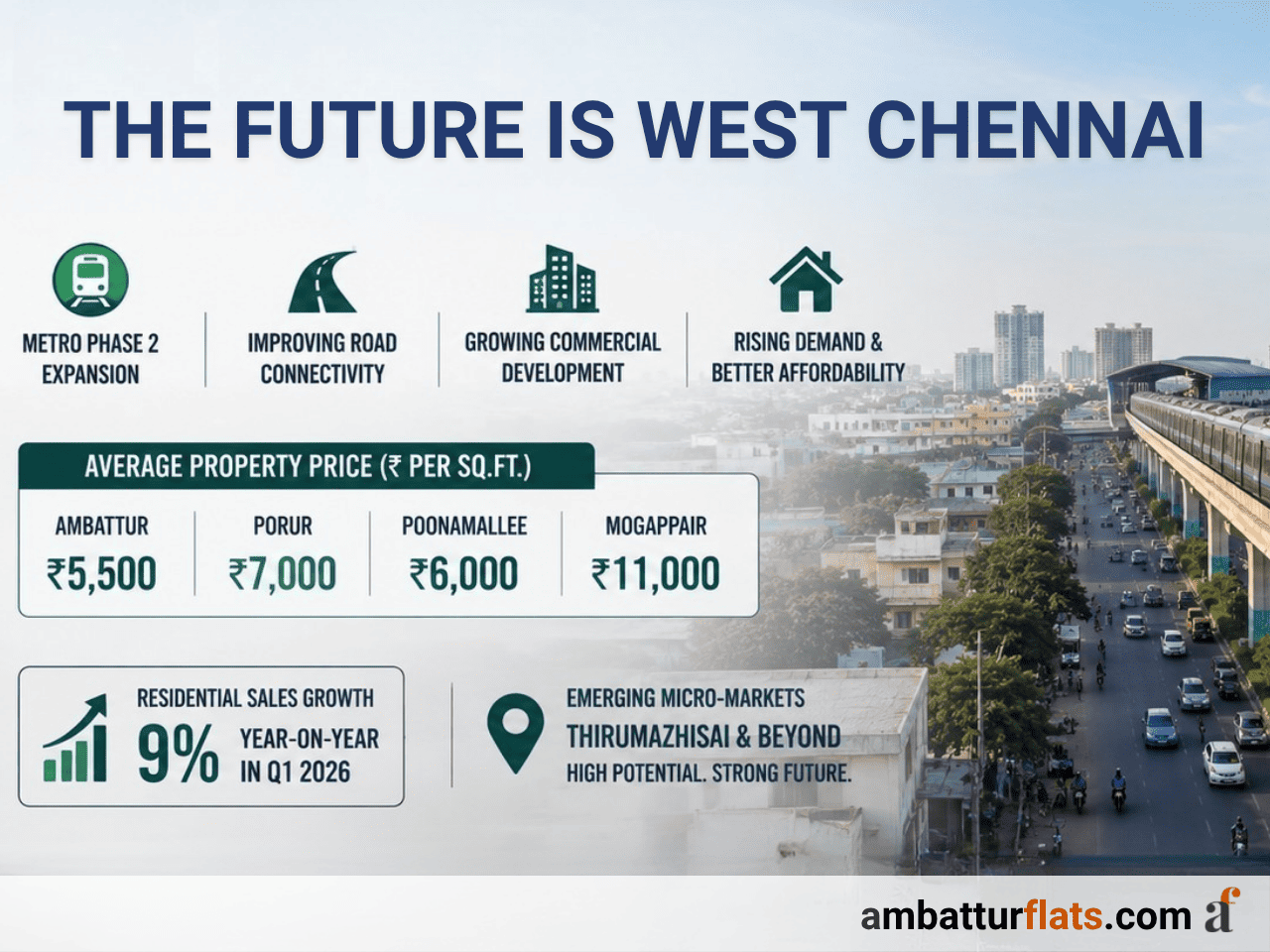
The headline numbers for Chennai's residential market in 2026 are encouraging. The city recorded a 9% year-on-year increase in residential sales in Q1 2026, even as the broader national housing market showed signs of moderation. West Chennai is absorbing a meaningful share of that demand, backed by infrastructure momentum and relative affordability compared to the southern and central corridors.
Across the city, residential prices have been growing at 5-7% annually. Properties within 1 km of a confirmed metro station are seeing stronger appreciation, with some areas recording price increases of 20-30% over a two-year period. As noted in Chennai's real estate trend analysis for 2026, this growth is end-user led - which makes it more sustainable than investor-driven price cycles.
In practical terms, West Chennai currently offers the combination that most buyers find hardest to locate: a price point that is meaningfully lower than south Chennai's IT corridor, improving connectivity that reduces the commute disadvantage, and enough social infrastructure to support daily life comfortably.
The long-term case for West Chennai rests on a straightforward logic. Infrastructure investment tends to precede price appreciation. Metro stations, highway upgrades, and new commercial zones are either already in place or actively under development across the western corridor. Buyers who enter now are getting in ahead of the full impact of that infrastructure becoming operational.
Thirumazhisai is the most striking example of this dynamic. Land values in the area have surged nearly 200% over the past decade, with apartment prices growing 30% and primary market prices spiking 47% over the last three years alone. These are not numbers associated with a fringe market - they reflect sustained investor confidence in an area that still has room to grow.
Thirumazhisai is increasingly described as the most future-focused market in West Chennai. Planned infrastructure projects, proposed highway connectivity, and lower current entry prices are drawing speculative investment interest. The area's proximity to the Sriperumbudur manufacturing belt gives it employment-driven residential demand that is structurally similar to how Ambattur developed over the past two decades.
Poonamallee sits a step ahead of Thirumazhisai in terms of current infrastructure.It already has metro connectivity on the way and highway access in place. Investor attention here has been building steadily, and the area is transitioning from an entry-level market to one with broader appeal across buyer segments.
Less talked about but increasingly active, Iyyappanthangal and Kattupakkam are benefiting from their position close to Porur and several major healthcare hubs. Rental demand in these micro-markets is rising, driven by hospital staff, students, and working professionals who want proximity to Sri Ramachandra and other medical institutions without paying Porur's higher prices.
At the premium end, Valasaravakkam continues to hold its ground as a quiet, well-established residential neighbourhood with limited new supply and a history of steady long-term value appreciation. It remains one of the few western localities that appeals consistently to buyers who prioritise liveability over investment metrics.
West Chennai's story in 2026 is not about hype. It is about fundamentals finally catching up with potential. Metro Phase 2 is reducing the commute disadvantage. New commercial development is generating employment demand. And property prices still sit below what buyers would pay for comparable options in south or central Chennai.
If you are considering a property in Ambattur or the wider western corridor, explore whether Ambattur is the right fit for your needs. The window for getting in ahead of full metro operationalisation is still open, but it will not stay that way for long.