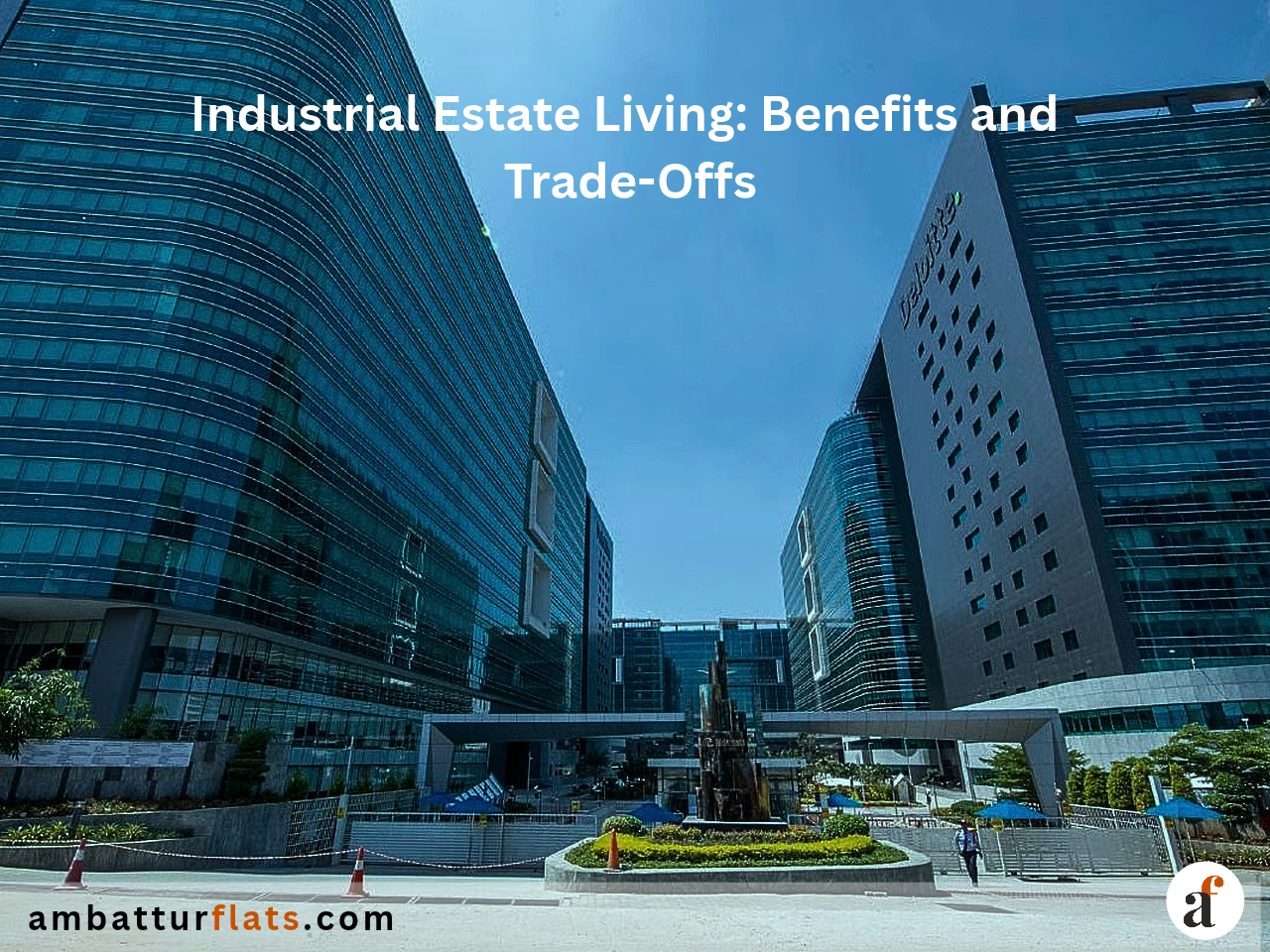

A flat near your workplace can save valuable time every day. But what if the same neighbourhood has heavy vehicles, industrial noise or roads that become difficult to navigate during peak hours? A shorter commute looks attractive on paper, yet the experience of coming home matters just as much.
An industrial estate is a designated area where manufacturing units, workshops, warehouses and other businesses operate, often using shared infrastructure such as roads, electricity and drainage systems. In Chennai, established industrial areas such as Ambattur and Guindy exist alongside residential neighbourhoods.
Two flats near the same industrial estate may offer very different living experiences. One may provide convenient access to work, while another may face frequent commercial traffic, dust or noise.
A homebuyer might wonder, “Living close to work sounds convenient, but will my family be comfortable here?”
The answer depends on the surrounding street, neighbouring activities and everyday living conditions, not simply the distance to the workplace.
For people working in manufacturing, engineering, logistics or nearby offices, residential proximity can reduce commuting time and transport expenses.
Small-business owners may also benefit from being close to their operations, especially when their work requires frequent visits.
Industrial estates are not always isolated from established neighbourhoods. In Chennai, areas around Ambattur and Guindy have residential developments, public transport connections and access to everyday services.
· Workplace accessibility: Less travelling for employees and business owners.
· Potential rental demand: Nearby employment may attract households looking for shorter commutes.
· Existing infrastructure: Established roads, utilities and transport connections may support residential accessibility.
· Housing choice: Buyers can compare different apartment types, sizes and budgets in the surrounding neighbourhoods.
However, proximity is only valuable when the actual journey is convenient.
An apartment two kilometres from a workplace may still require crossing a congested junction, while a slightly more distant property could have better access.
For buyers considering homes near industrial employment areas, practical access to workplaces, schools and public transport deserves more attention than the locality's reputation alone. The article on why homebuyers are choosing West Chennai provides broader context for employment-driven residential decisions.
The environmental impact of living near an industrial estate depends on the activities operating nearby, commercial vehicle movement and local conditions.
Not every factory produces the same emissions, and not every nearby apartment experiences the same exposure.
Road dust, vehicle exhaust and certain industrial activities can affect air quality.
IIT Madras's Project Kaatru, reported in 2019, used mobile air-quality monitoring equipment, including a pilot in parts of Chennai. Its approach highlighted how pollution levels can vary between locations and why street-level measurements may provide useful information beyond fixed monitoring stations. These historical findings cannot establish current air quality near a particular apartment.
India's national ambient air-quality standard for PM2.5 is 60 µg/m³ over 24 hours. PM2.5 refers to fine airborne particles that can enter deep into the lungs. A brief pollution spike cannot, by itself, establish that the 24-hour average standard has been exceeded.
Air quality can change with traffic, weather and surrounding activities. Rather than judging a neighbourhood from a single property visit, buyers can refer to the Chennai Air Quality Dashboard to understand recent Air Quality Index (AQI) readings and available pollutant information.
AQI converts pollution measurements into an index that helps people understand general outdoor air-quality conditions. However, a city-level reading cannot establish the air quality of a specific apartment or street.
For a more reliable assessment, compare available readings from nearby monitoring stations, check when they were recorded and consult official pollution-control data before making a property decision.
If my flat is not directly next to a factory, does that mean air pollution won't affect us? Not necessarily. Commercial traffic, wind, surrounding activities and building orientation can influence exposure even when the factory itself is farther away.
Practical measures: Examine nearby industrial activities, consult available pollution-monitoring information and assess road conditions during normal working hours. Suitable filtration, window sealing and reduced exposure to busy roads may help, but serious environmental concerns require professional assessment.
India's Noise Pollution (Regulation and Control) Rules, 2000 establish different ambient noise limits according to official zone classification.
| Zone | Daytime limit | Night-time limit |
| Residential | 55 dB(A) | 45 dB(A) |
| Commercial | 65 dB(A) | 55 dB(A) |
| Industrial | 75 dB(A) | 70 dB(A) |
| Silence zone | 50 dB(A) | 40 dB(A) |
Daytime is 6 AM to 10 PM, while night-time is 10 PM to 6 AM. The values are equivalent continuous sound levels measured over an applicable period, not limits for isolated instantaneous sounds.
The applicable noise standard depends on the area's official noise-zone classification, not simply its proximity to a factory. Industrial zones have a daytime limit of 75 dB(A), compared with 55 dB(A) for residential zones. Where industrial and residential activities coexist, buyers should verify the officially notified classification rather than assume either limit applies. Land-use approval and compliance with noise regulations must be checked separately.
Noise exposure can be reduced through suitable glazing, better window sealing and bedroom orientation. These measures improve indoor comfort but cannot eliminate serious disturbance outside the building.
Heavy vehicles, employee commuting, delivery operations and school traffic may share nearby roads.
For buyers, the most useful check is the actual approach to the apartment. A location may be well connected to major roads yet have difficult pedestrian access or frequent vehicle obstructions.
Test the journey during regular commuting hours, including the route to schools, railway stations or bus stops.
Road maintenance and drainage deserve particular attention in industrial-residential neighbourhoods, especially during Chennai's northeast monsoon.
Infrastructure is not a static condition. Public authorities may undertake maintenance or propose improvements, but buyers need to distinguish approved work from completed facilities.
In February 2026, Greater Chennai Corporation signed an agreement with TANSIDCO to maintain civic infrastructure in the Ambattur and Guindy industrial estates.
A report dated 5 July 2026 described proposed improvements covering approximately 90 km across Ambattur, Guindy and Vyasarpadi, including about 50 km in Ambattur. At the time, the authorities were preparing for detailed surveys and project planning. These improvements should not be considered completed until their implementation is confirmed.
Improvements to roads and drainage may eventually benefit nearby residents. However, their usefulness depends on the actual location, implementation and connection to surrounding residential infrastructure.
Buyers should investigate whether the apartment's access road has flooded previously, whether drainage is functional and whether water enters parking or electrical areas during heavy rainfall. Water supply and wastewater management also affect monthly expenses.
Some apartments rely on municipal supplies, while others may require groundwater or purchased water. Sewage may be managed through public connections or approved on-site systems.
The guide to water and sewer connections in Chennai apartments explains why buyers should verify actual connections rather than assume they are available.
Risk reduction: Check service records, water bills, drainage arrangements and past flooding. Treat proposed infrastructure upgrades as possibilities until their completion can be verified.
A property should not be judged solely because it is described as being near an industrial estate.
Consider two possible apartment settings.
One faces a road used frequently by commercial vehicles. The other is situated on an interior residential street.
| Factor | Industrial access road | Interior residential street |
| Workplace access | May offer a more direct route | May require additional local travel |
| Commercial vehicle exposure | Potentially higher | Depends on nearby road usage |
| Noise | Greater potential for direct traffic disturbance | Depends on neighbouring activities |
| Road dust | May be affected by passing vehicles | Requires separate assessment |
| Pedestrian convenience | Heavy vehicle movements may create difficulties | Road width and lighting still matter |
| Rental appeal | May suit tenants prioritising commuting | May suit households prioritising residential comfort |
This is an illustrative comparison, not measured evidence about two actual properties.
The difference can be even more subtle within a single apartment building.
Bedrooms facing a quieter side may offer a different experience from rooms directly overlooking a busy road. Nearby vacant land may also have permitted uses that differ from the current surroundings.
Workplace proximity may make a neighbourhood convenient, but daily comfort is determined much closer to home, by the street, neighbouring activities and the design of the apartment itself.
A buyer should examine the entrance, approach road, bedroom orientation and neighbouring land uses rather than relying only on the apartment's address.
Different households place different values on the same neighbourhood.
An industrial employee may consider a shorter commute the biggest advantage. A family with young children may care more about road safety, noise and access to schools.
| Resident | Potential benefit | Important consideration |
| Industrial employee | Reduced travel time | Shift-hour traffic and actual road access |
| MSME owner | Easier access to business operations | Work-life separation and family comfort |
| Family with children | Employment access and neighbourhood services | School routes, air quality and safe crossings |
| Senior citizen | Established services in surrounding areas | Noise, walking conditions and healthcare access |
| Shift worker | Potentially shorter late-hour travel | Street lighting, security and transport availability |
| Work-from-home professional | Location convenience for the household | Daytime noise and reliable broadband |
| Tenant | Convenient access to employment | Water supply, maintenance and recurring disturbances |
A shorter commute may justify the location today, but the property should remain practical even if your workplace changes. Consider its connectivity to other parts of Chennai, access to essential services and overall residential comfort before making a long-term decision.
Employment concentration can provide a potential market for rental housing. Workers, technical professionals, business owners and nearby office employees may look for accommodation that reduces commuting.
However, employment does not guarantee tenancy. Renters also evaluate affordability, building condition, maintenance, parking, water availability and residential comfort.
Consider a hypothetical apartment investment.
| Item | Illustrative figure |
| Apartment size | 900 sq ft |
| Assumed purchase rate |
₹5,500 per sq ft |
| Purchase price |
₹49.5 lakh |
| Assumed monthly rent |
₹15,000 |
| Annual rental income |
₹1.8 lakh |
| Gross rental yield |
3.64% |
These figures explain the calculation and are not verified current market prices or rents.
Gross rental yield is annual rent divided by property price, multiplied by 100. It does not include registration charges, repairs, taxes, maintenance or vacancy costs.
If many people work nearby, won't my flat always have tenants? No. Some employees commute from other areas, while others prefer different housing budgets or neighbourhoods.
A useful investment check is whether the apartment would appeal to people who do not work in the industrial estate. Wider tenant appeal may reduce reliance on one employment group, although it does not guarantee occupancy.
Industrial proximity does not create a universal property-price premium or discount. Future buyers may value the commute, while others may be concerned about noise, roads or neighbouring activities.
A property's legal documentation, maintenance and land ownership also matter. Buyers should understand Undivided Share of Land in Chennai apartments, particularly when comparing small apartment buildings with larger developments.
Future infrastructure may improve residential accessibility, but proposed improvements do not guarantee property appreciation.
Buying a residential flat near an industrial estate is not automatically prohibited. The property must comply with applicable land-use regulations, building permissions and ownership requirements.
Within the Chennai Metropolitan Area, buyers should verify the permitted land use and planning approvals issued by the Chennai Metropolitan Development Authority (CMDA) or the authorised local planning authority. Outside CMDA's jurisdiction, the relevant DTCP or other competent planning authority should be checked.
Buyers should also verify Tamil Nadu Real Estate Regulatory Authority (TNRERA) registration wherever required. A project's RERA registration does not replace verification of its sanctioned building plan, land title, access rights or other statutory approvals.
Neighbouring land uses deserve attention because vacant or industrial plots may accommodate different activities permitted under the applicable planning regulations.
If a bank approves my home loan, doesn't that mean all the legal checks are complete? A lender's approval should not replace independent due diligence. The buyer's lawyer should review the relevant title documents, encumbrances, approved plans and ownership records before purchase.
For additional checks, the homebuyer property verification checklist covers documentation, accessibility and other essential purchase considerations.
Some concerns can be addressed through building design, better maintenance or changes to daily routines.
Others depend on external activities, public infrastructure or legal circumstances and cannot be resolved by the apartment owner alone.
| Potential concern | Practical mitigation | When to reconsider |
| Industrial or traffic noise | Acoustic windows, bedroom orientation and suitable sealing | Persistent disturbance affecting ordinary living |
| Road dust |
Filtration, regular cleaning and reduced direct roadside exposure |
Serious environmental concerns without satisfactory evidence or mitigation |
| Commercial traffic |
Alternative routes and public transport |
Unsafe or repeatedly obstructed access |
| Water supply problems |
Verified connections and suitable backup storage |
No reliable long-term water arrangement |
| Drainage problems |
Documented drainage improvements and building-level protections |
Repeated serious flooding without an effective solution |
| Rental vacancies |
Appropriate rent and good building maintenance |
Weak demand and unaffordable holding expenses |
| Neighbouring industrial activity |
Verify operating conditions and permitted land use |
Significant unresolved safety or environmental concerns |
| Legal discrepancies |
Independent document verification | Unresolved title or approval defects |
A lower purchase price should never be used to justify ignoring a major safety, environmental or legal problem.
Before making a decision, visit the flat at different times.
| Visit | Suggested time | What to observe |
| Morning | Weekday, 8:00 to 9:30 AM | Commercial traffic, school movement and commuting |
| Afternoon | Working day, around 1:00 PM | Industrial activity, dust, indoor comfort and noise |
| Evening |
Later in the day or at night |
Road lighting, transport access and disturbance |
The suggested timings are inspection windows, not verified peak pollution periods.
Where possible, also check the property after rainfall when safe.
Speak to existing residents about recurring noise, waterlogging, water supply and maintenance. Cross-check significant concerns through records and qualified assessments rather than relying on one person's experience.
Living near an industrial estate is neither automatically an advantage nor a disadvantage. A shorter commute can make everyday life easier, but that benefit loses value if noise, heavy traffic, poor drainage or uncomfortable surroundings become part of daily living.
Before buying, visit the property at different times, speak to existing residents and verify its legal documents and infrastructure. A lower price or convenient location should never outweigh serious concerns that cannot be resolved.
The real question is not just how quickly you can reach your workplace, but how comfortably you can live when you return home.
Living near an industrial estate is not automatically unsafe. Actual conditions depend on neighbouring industries, pollution exposure, traffic, building location and infrastructure. Buyers should investigate any significant concerns using reliable evidence.
Not necessarily. Prices vary with locality, building age, facilities, access and demand. A lower-priced apartment should be evaluated for both potential savings and disadvantages.
They may attract employees seeking shorter commutes, but returns depend on purchase cost, achievable rent, vacancy and maintenance expenses. Nearby employment does not guarantee a tenant.
Not automatically. Exposure depends on building orientation, surrounding structures, wind conditions and activity sources. Buyers should inspect the actual floor and rooms.
Verify the legal status of the property and investigate its actual surroundings. Multiple visits help identify issues, while professional assessments may be necessary for legal, structural or environmental concerns.