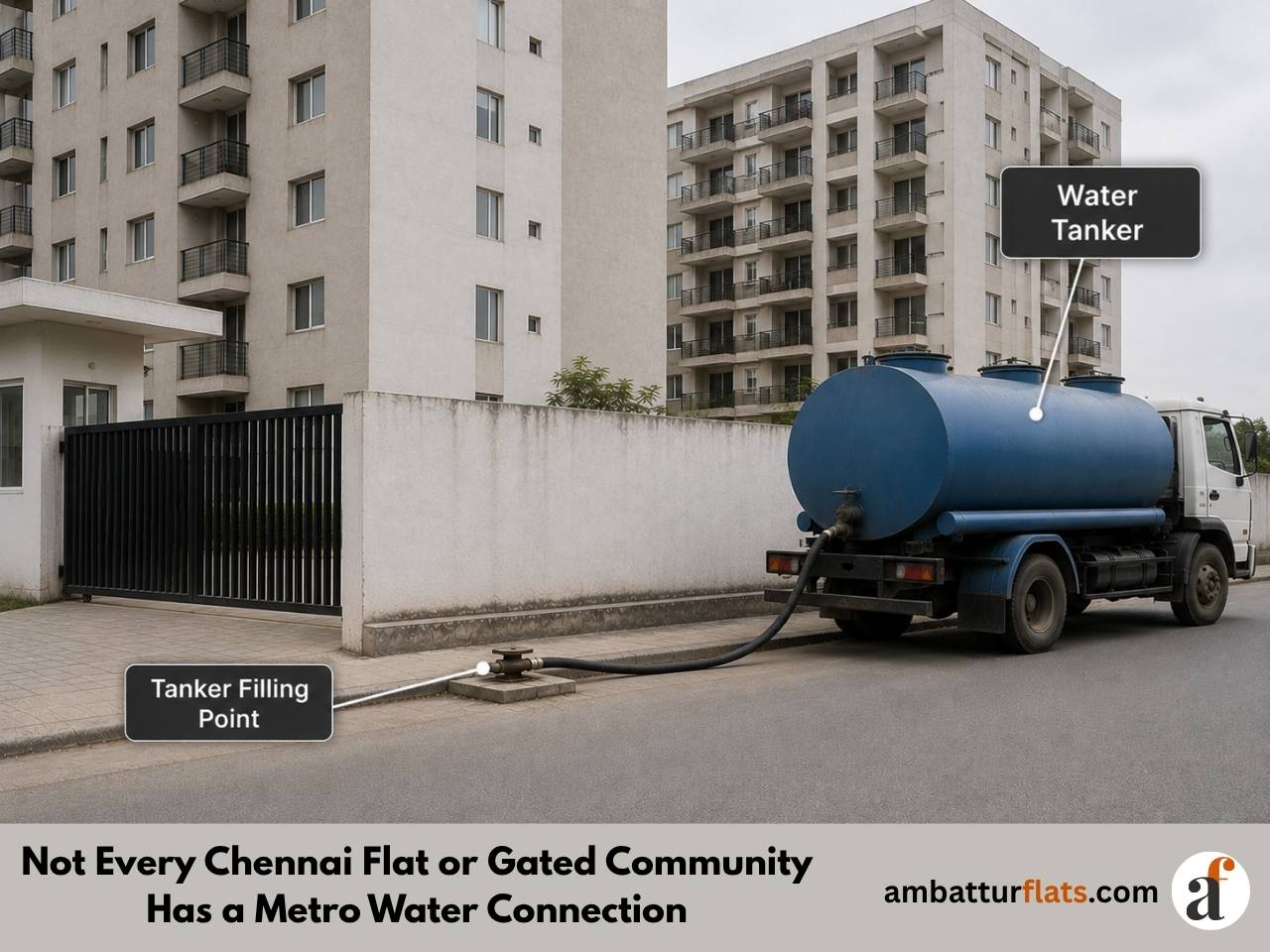

Ask almost any buyer what they checked before booking a flat in Chennai, and you’ll hear the exact same list: parent document, encumbrance certificate, CMDA or DTCP approval, RERA registration, and carpet area measured against the brochure. Virtually nobody asks which pipe under the road the building actually connects to.
That gap matters more than it sounds. A Metro Water connection is not something a builder can arrange with paperwork and a deposit alone. Board rules require a water or sewer main already running in front of the property before a connection can be sanctioned. Every other item on the application sits within the builder's control. That one does not. The board also runs its own distribution network inside Chennai Corporation limits, and which side of that line you are on settles who you are even applying to. So when a sales desk says the connection is applied for, the phrase can describe two completely different buildings: one waiting thirty days for a live main to be tapped, and one waiting for a public network that has not reached the street yet.
This catches gated communities hardest. The big layouts and high rises going up along OMR, parts of ECR and the outer suburbs are the projects most likely to sit past the Corporation boundary, on a road the board's network has not reached. The price band does not protect you and neither does the developer's name.
Metro Water is the common name for the Chennai Metropolitan Water Supply and Sewerage Board (CMWSSB). An official connection means two things at once: the building draws treated water from the city network into its sump through a sanctioned line, and it discharges wastewater into the public underground sewer instead of holding it on site.
Both halves require separate applications and separate approvals. A building can easily have one without the other. Core city neighbourhoods usually hold both. Newer pockets on the periphery often hold neither, relying instead on borewells, private tankers, and an on site treatment plant or septic tank.
The practical difference shows up directly on your monthly maintenance bill. A building connected to the municipal network pays a fixed half yearly tax based on property value, plus a metered charge where fitted. A building reliant on tankers pays whatever the market dictates that month, and that number climbs sharply with the season.
Before you ask whether a connection exists, ask who would issue it. CMWSSB puts the city area inside Corporation limits at 426 sq km, and it maintains the water and sewerage system inside them. The metropolitan area around it was expanded to 5,904 sq km in 2022 and the board's distribution area did not follow. Beyond Corporation limits it supplies water in bulk to adjacent local bodies, naming Avadi, Anakaputhur, Cantonment, Cowl Bazaar, Munavoor, Pallavaram and Pozhichalur among them. Internal distribution in those areas is done by the local body, not by the board.
OMR shows how sharp that line is. Sholinganallur was annexed into Chennai Corporation in 2011. Keep driving south and Navalur sits in Thiruporur taluk of Chengalpattu district, while Siruseri is a village under the Thiruporur panchayat union. Same road, same tech parks, same brochures quoting the same corridor prices. Different authority.
So for a gated community past that boundary, do not assume CMWSSB is the body that would sanction and bill a house connection. The question becomes which local authority runs the network there, whether it buys bulk water from the board, and what it charges. The property tax bill is the quickest tell, because it names the body that levies it. That takes more digging than any other check here, and nothing else on the list means much until you have it.
This is where most buyers lose the thread. CMDA or DTCP approval means the plan cleared zoning rules, floor space limits and structural norms. It says nothing about utilities. CMWSSB runs its own application, its own inspection and its own sanction order.
The board's terms for a new connection set out what has to be produced at inspection: sanctioned plans from CMDA, the Greater Chennai Corporation or the local authority, the planning permission letter, a completion certificate where applicable, proof that infrastructure and development charges were paid, water tax receipts, an indemnity bond and an acknowledgement letter to the Corporation asking for property assessment.
Three conditions in that list catch projects out. The building has to have working rainwater harvesting. Multi storey buildings have to separate and reuse wastewater for flushing. And there has to be a main available in front of the property. The first two are engineering decisions the builder makes. The third is not.
Buyers tend to treat this as a yes or no question. It is closer to five states. The first is not a waiting period at all, and the rest are separated by years, not weeks.
| Situation | What exists on the ground | Who can move it forward | What to ask |
| Outside Corporation limits | The property sits under a panchayat or municipality rather than the Corporation | The local body, which may buy bulk water from CMWSSB | Which authority issues and bills a connection at this address |
| No main on the street | The public network has not reached the road | CMWSSB, through a sanctioned scheme | Is a scheme sanctioned for this division, and at what stage |
| Main laid but not charged | Pipe is in the ground, water is not flowing yet | CMWSSB, pending pumping stations and testing | When is the line expected to be commissioned |
| Main live, building not connected | Network is ready, the building's application is pending | The builder, through documents, dues and plumbing | Which specific document or payment is holding it |
| Connected and billed | Consumer number issued, tax receipts on record | No one, it is done | Show me the last two half yearly receipts |
The fourth state is a short wait. The board's own service timelines put the sanction order at seven days from registration and the connection at thirty days. If a builder has been sitting on a pending application for two years, the problem lies further up the table, not in the paperwork.
Ask the builder to name which of the five situations applies. A specific answer usually means the connection exists, and the documents below will confirm it. A vague one about the process being on usually means the main is not there, and that evasion should carry into how you verify the builder on everything else.
Water and sewerage are not laid together, and assuming otherwise leads people to badly misjudge established areas.
Okkiyam Thoraipakkam makes the point. This is not a distant suburb. It sits on the OMR corridor, next to tech parks, with premium apartments that have been occupied for years. Yet the underground sewerage scheme for divisions 193, 194 and 195 only cleared coastal zone approval on 9 March 2026, covering 83.5 km of sewer network, six pumping stations and 14,310 house service connections at a project cost of Rs 266.44 crore. The clearance document states plainly that households in the area currently depend on individual septic tanks.
Read that again in the context of a purchase. Buyers were paying corridor prices in an area that had no organised sewage collection. Nothing about the address, the developer or the price band signalled it.
The reverse case exists too. Pipes in the ground are not the same as a working connection. In the Avadi belt, residents have pointed to sewer pipelines laid in Pattabiram that were never linked to homes, leaving households on septic tanks and tanker water while the work moves in phases. As of early 2026, piped water and sewer service covered 23 of Avadi's 65 sq km. Avadi sits outside Corporation limits, which is why the scheme there runs on a different body's timetable. Seeing a trench dug on the approach road tells you a scheme exists. It does not tell you when your flat gets attached to it.
Connection costs are published and fixed by building type, so any figure a builder quotes can be checked against the official CMWSSB tariff.
| Property type | Water connection charge | Sewer connection charge |
| Independent house up to 46.47 sq m | Rs 100 | Rs 100 |
| Independent house 46.47 to 100 sq m | Rs 5,000 | Rs 5,000 |
| Independent house above 100 sq m | Rs 7,500 | Rs 7,500 |
| Flats up to ground plus two floors | Rs 7,500 | Rs 7,500 |
| Commercial and institutional | Rs 7,500 | Rs 7,500 |
Charges as published by CMWSSB, checked August 2026. Where a building has no water or sewerage tax assessment yet, an advance tax of Rs 3,000 per equivalent dwelling unit applies and gets adjusted later against the actual demand. Meter testing charges run from Rs 100 to Rs 500 depending on the number of dwelling units.
The published schedule covers flats up to ground plus two floors. Charges for taller and multi storey buildings are not listed in it, so confirm those with the CMWSSB area office.
Rs 7,500 is small enough that no builder will argue over it, which is what makes it a poor thing to negotiate. Offering to bear the connection charges costs a seller almost nothing, so the buyer hears goodwill where there was never any resistance. What decides whether water reaches the flat is a main on the road. No builder can buy one.
The recurring cost is the part buyers forget. Water and sewerage tax is set at 7 percent of the annual rental value fixed by the Chennai Corporation, billed in two halves that fall due on 31 August and 28 February. Metered domestic bills are payable within fifteen days of billing. None of this is negotiable and none of it disappears when the flat changes hands, which is why unpaid arrears from a previous owner become your problem on registration.
Do not accept a verbal answer on this. Seven checks settle it, and they belong on any Chennai real estate checklist alongside the title documents.
1. Confirm which authority the address falls under. If the property sits outside Chennai Corporation limits, do not assume CMWSSB sanctions and bills the connection there. Find out which local panchayat or municipality does, and put the checks below to that body instead.
2. Ask for the CMWSSB sanction order for both the water and sewer connections, issued by the area office. This is the document that proves a connection was granted rather than applied for.
3. Ask for the last two half yearly water and sewerage tax receipts, and cross check the consumer number through the CMWSSB online payment portal, where a valid connection will pull up a live billing record. A building that is connected has been paying tax. A building that has never been billed has almost certainly not been connected.
4. Match the consumer number on those receipts against the physical address of the property. Numbers issued to an adjacent plot or an older structure on the same land are a known source of confusion.
5. Ask the CMWSSB area office for a no dues certificate covering water and sewerage charges. Arrears transfer with the property. A clean no dues certificate is not automatically good news, because a building that was never connected has never been billed either. Nothing is owed because nothing was ever charged, and on that one certificate a blank record and a connected record look the same.
6. Walk to the road and look for the incoming municipal line and meter entering the sump, separate from the borewell feed and the tanker filling point. If the only inlet is a tanker coupling, you have your answer regardless of what the file says.
7. Speak to two or three residents in the block, or the resident welfare association if one is formed. Ask what they paid for water last summer, not last month.
For a new launch rather than a resale, most of these will not exist yet. There are no receipts, no consumer number and no residents to ask. The question shifts to whether a live main runs on the road in front of the site, which you can check by asking neighbouring buildings on the same street whether they hold CMWSSB connections and who issued them.
You will see cost projections for tanker dependence quoted with impressive precision. Treat them carefully. Private tanker rates in Chennai are not published, not regulated by CMWSSB and not uniform. They move with the season, the source borewell, the delivery distance and the tanker's capacity. A rate that holds in December is not the rate in May. CMWSSB does sell water by lorry at published rates, but private operators are not bound by them.
So the only figure worth anything is the one a specific building has actually spent. Ask for twelve months of maintenance accounts with the water procurement line separated out, covering at least one summer. That single document tells you more than any general estimate, because it shows where the building sourced its water, how much it used and what it paid in the months when supply tightened.
For a project with no occupancy history, ask what the builder has budgeted per flat per month for water. Then ask whether that figure sits inside the quoted maintenance charge or outside it and what happens to it once the association takes over. A builder who cannot answer has not costed it, which usually means the early residents will find it out the hard way.
Three arrangements are common, and they carry different long term costs.
An underground sewerage connection links the building's outflow to the public sewer. It needs no periodic emptying and no equipment upkeep, which makes it the cheapest to live with. An on site sewage treatment plant is standard in larger developments and lets treated water be reused for flushing and gardens, but it consumes power and needs steady maintenance, both of which land in the monthly charge. A septic tank holds waste on site and has to be emptied by suction truck at the community's cost, and the frequency rises as occupancy rises.
Ask which one the building runs, and if it is a treatment plant, ask what the annual maintenance contract costs and who holds it.
Send these to the builder or seller by email so the answers exist on record.
• Which authority sanctions and bills water and sewer connections at this address, CMWSSB or the local panchayat or municipality
• Is the building connected to live CMWSSB water and sewer mains today, or are the applications pending
• If pending, does a main already exist on the road in front of the property
• Are there outstanding infrastructure or development charges due against this property
• What is the current source mix across the year, and how does it change between January and June
• What is the monthly per flat cost of water procurement and treatment, shown separately from other maintenance heads
• Does the building have a sewage treatment plant, and what does its annual upkeep cost
A seller who answers all seven specifically is worth trusting on the rest of the file. Someone who deflects on the first two is telling you something the brochure will not.
Buying a flat in Chennai involves plenty of things you can change later. Water infrastructure is not one of them. Flooring, fittings and kitchens are all fixable after possession. A street with no municipal main is fixed only when a scheme is sanctioned, funded and built, and the Thoraipakkam sewer project shows that an area which looks fully developed from the road can still be waiting on its first sewerage scheme.
Check the pipe before you check the paint.
Not automatically. Many large gated layouts on OMR, parts of ECR and the outer suburbs sit past Chennai Corporation limits, where CMWSSB may not be the body that sanctions house connections. Others sit inside the limits but on a road the network has not reached. Ask which authority covers the address, then ask whether a live main runs in front of the property.
Not for distribution. CMWSSB puts the city area inside Corporation limits at 426 sq km and maintains the network inside those limits, while the metropolitan area around it was expanded to 5,904 sq km in 2022. Beyond Corporation limits it supplies water in bulk to adjacent local bodies, and those bodies handle internal distribution themselves.
No. CMWSSB conditions require a water or sewer main to be available in front of the property before a connection is given. Until the network reaches that road, the building has to run on borewells, tankers or both, regardless of how complete its paperwork is.
No. CMDA or DTCP approval covers zoning, floor space and structural compliance. The water and sewer connection is a separate CMWSSB application with its own inspection, documents and sanction order. A building can hold valid planning approval and still have no municipal connection.
The board's stated timeline is a sanction order within seven days of registration and the connection within thirty days. That applies once a live main exists on the road. Where the network has not reached the street, the wait depends on when a scheme is sanctioned and built, which is measured in years.
Water and sewerage tax is 7 percent of the annual rental value fixed by the Chennai Corporation, billed half yearly with due dates of 31 August and 28 February. Metered domestic consumption is billed separately and payable within fifteen days.
For flats up to ground plus two floors, the published charge is Rs 7,500 each for the water and sewer connections. The schedule does not list a charge for taller buildings, so confirm that with the CMWSSB area office. Where the building has no tax assessment yet, an advance tax of Rs 3,000 per equivalent dwelling unit applies and is adjusted against the later demand.
Yes. Water and sewerage tax attaches to the property, so arrears left by a previous owner become the buyer's liability after registration. Ask for a no dues certificate from the CMWSSB area office before you complete the transaction.