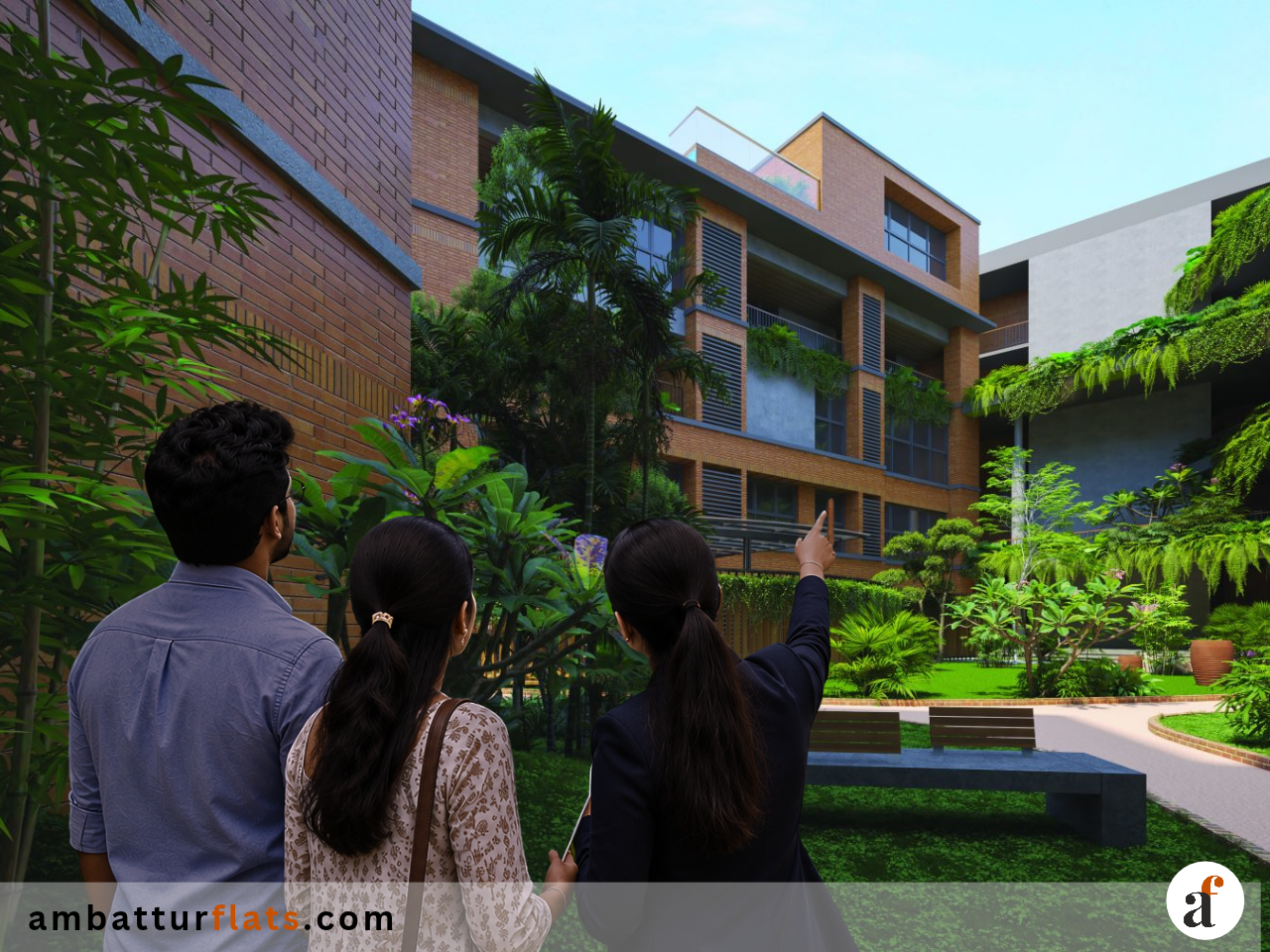

A flat may look impressive during a site visit, with greenery around the building, solar panels on the rooftop and promises of lower utility bills. But once a family moves in, what really matters is how these features support everyday living.
An eco-friendly flat is a home designed to use water and energy responsibly while providing a comfortable living environment. For families considering eco-friendly flats in Chennai in 2027, understanding how a building responds to summer heat, seasonal rains and everyday resource needs is just as important as its appearance.
If a builder says the flat is eco-friendly, how do I know these features will actually benefit my family? Consider a rooftop solar installation. It may help power common-area lighting without directly reducing individual electricity bills. Similarly, a rainwater harvesting system may be installed, but its long-term usefulness depends on how well it is maintained.
For a homebuyer, this raises an important distinction: having an eco-friendly feature and experiencing its benefits are not necessarily the same thing. Before making a purchase decision, buyers should understand what is installed, how it works and who will maintain it over time.
A feature that looks impressive during a site visit may become an expense rather than a benefit if no one knows who maintains it, who pays for it or how well it works. For a family buying a home, the real measure of sustainability is what continues to work after the builder hands over the keys.
An eco-friendly apartment uses building design, materials and supporting systems to manage resources efficiently and improve living conditions.
This can include natural ventilation, measures to reduce heat entering the building, efficient lighting, responsible water management and waste-handling facilities. However, no single feature establishes that a building is environmentally responsible.
A landscaped garden may improve the surroundings, but it does not establish whether the building uses water efficiently. Similarly, rooftop solar panels do not necessarily mean individual apartments receive solar electricity.
For buyers comparing apartments in Chennai, three questions are more useful than simply counting advertised amenities:
This distinction becomes particularly important when comparing an under-construction property with an occupied apartment.
The Indian Green Building Council (IGBC) operates a voluntary rating system for residential buildings called IGBC Green Homes. The system evaluates environmental features across several categories, including site planning, water conservation, energy efficiency, building materials and indoor environmental quality.
Under the IGBC Green Homes rating system, multi-dwelling residential projects can receive one of four certification levels.
| Certification level | Credit points required |
| Certified | 50 to 59 |
| Silver | 60 to 69 |
| Gold | 70 to 79 |
| Platinum | 80 to 100 |
Projects must also meet applicable mandatory requirements. A higher rating reflects more credits earned under the assessment system, but it does not automatically establish how much an individual household will save on utility bills.
If a builder says the apartment is green-certified, can I simply trust that claim? An IGBC rating assesses specific environmental criteria, but it does not guarantee that every feature inside an apartment performs equally well. Buyers should ask for the official certification details and confirm whether the rating covers the building they are considering.
Buyers should understand another important distinction: green-building certification is not the same as legal approval for construction. A property still requires the relevant statutory approvals and compliance checks, regardless of whether it has an environmental rating.
The words registered, pre-certified and certified may appear similar in marketing material, but they represent different stages.
Registration means the project has entered the IGBC assessment process. It does not mean that the building has already received a green-building rating.
Registration confirms participation in the assessment process, not an awarded certification. A project should not be presented as IGBC-certified merely because it is registered. Buyers should request proof of the actual rating before accepting such a claim.
Pre-certification assesses proposed environmental measures during the design stage. For example, an under-construction project may submit plans for energy-efficient lighting, water conservation or thermal performance.
The rating is based on the proposed design and supporting documentation. It does not establish that every promised system has already been installed.
Final certification involves assessment of implemented measures, including physical verification under the applicable rating procedure. The final rating may differ from the pre-certification rating.
The IGBC certification procedures state that pre-certified projects must provide progress updates every six months until final certification. The pre-certification rating is valid for three years.
For someone booking an apartment with possession expected in 2027, this distinction is important. A design-stage award should not be presented as proof that the completed building has already achieved the same rating.
A certification claim should be connected to the exact project under consideration. Start by requesting the official certificate or award letter rather than relying on a promotional statement. Check the project name, applicable rating system, certification level, issue date and whether the award covers the building or phase containing the selected apartment.
For projects with multiple towers or construction phases, the scope deserves particular attention. A certification associated with one part of a development should not automatically be assumed to cover every building. Where the documentation is unclear, buyers can contact IGBC to seek confirmation of the award and its scope.
For completed buildings, ask whether the certification remains valid or has been renewed where required. These checks should complement the ordinary process of verifying a builder before buying a flat in Chennai. A valid environmental certification does not establish property ownership, approved construction boundaries or regulatory registration status.
For buyers considering eco-friendly flats in Chennai, DRA Beena Clover in Selaiyur, East Tambaram is one residential project that highlights eco-conscious design and green-building features. Buyers can review its project details while also verifying the current certification status, available facilities and supporting documents before making a purchase decision.
Environmental features deserve the same attention as floor plans, construction quality and common-area facilities.
An infographic highlighting five essential checks for eco-friendly flat buyers in Chennai.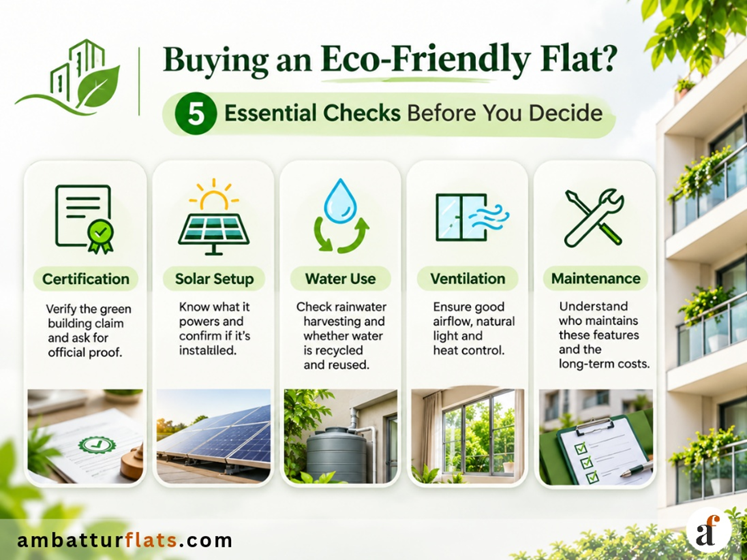
The inspection should focus on what each system does, how it operates and whether its performance can be assessed.
A solar installation might supply electricity to common-area lighting, water pumps or other shared equipment. It may not directly reduce the electricity bills of individual flats.
There is a meaningful difference between solar panels that power corridor lighting and a system that offsets electricity used by shared water pumps. Both may serve useful purposes, but their financial benefits are not necessarily the same. Buyers should ask how the generated electricity is used and who receives the savings.
Buyers should ask:
The presence of solar panels is not enough to establish the financial benefit.
Rainwater harvesting typically involves collecting rainfall and directing it to suitable storage or groundwater recharge arrangements, depending on the design. During an inspection, buyers can ask where water enters the collection system, how it is filtered and where it is ultimately directed.
A recharge pit that has not been maintained may not perform as intended. Rainwater harvesting is also different from a sanctioned municipal water connection. Buyers should examine the two issues separately, particularly when reviewing water supply arrangements in Chennai apartments.
Some residential developments may include sewage treatment plants or wastewater-reuse systems. Where such facilities are advertised, buyers should ask whether the equipment is installed, operational and maintained.
It is also important to understand where treated water is intended to be reused and whether applicable operating approvals and quality checks are in place. A recycling system should not be assumed to make treated water suitable for drinking or every household purpose.
Ventilation deserves attention in Chennai's climate, particularly when a flat receives prolonged direct sunlight. During a property visit, examine the direction of windows, the positioning of neighbouring buildings and whether air can move through the living spaces.
Shading, roof treatment and glazing specifications can also influence indoor heat. These details should be considered at the individual flat level rather than inferred from a building-wide green claim.
Before accepting an environmental claim, buyers can compare the advertised feature against available evidence.
| Advertised feature | What buyers should verify |
| IGBC certification | Official award, rating level, project identity and validity |
| Solar installation | Installed capacity, operating status and electricity usage arrangement |
| Rainwater harvesting | Collection design, storage or recharge arrangement and maintenance |
| Wastewater recycling | Treatment equipment, operating records and intended reuse |
| Energy-efficient design | Relevant material, lighting, glazing or insulation specifications |
| Natural ventilation | Window placement, shading, neighbouring structures and actual airflow |
The purpose is not to make buyers responsible for conducting complex engineering assessments. It is to help them recognise when an advertised claim requires documentary evidence or independent technical verification.
A feature should be assessed through its documentation, physical installation and actual operation wherever those records are available.
The operating cost of an environmental system can matter as much as its original installation. Solar equipment may require cleaning, servicing and eventual component replacement.
Wastewater treatment systems may involve pumps, electricity, testing and specialist maintenance. These expenses can become part of the residential community's shared financial responsibilities.
For occupied apartment buildings, buyers can ask the residents' association for relevant maintenance statements, service records and information about major equipment repairs.For under-construction projects, request the proposed operating arrangements and maintenance budget.
This is closely related to apartment handover responsibilities in Chennai, particularly where shared equipment is transferred from the developer to the owners' association. An environmental installation may offer a useful benefit, but buyers should know who is responsible for keeping it functional over the long term.
Not every environmentally responsible apartment needs to be newly constructed. Existing residential communities may improve resource efficiency through better water management, lighting upgrades, waste-handling systems and maintenance practices.
IGBC has a separate Green Residential Societies rating system designed for existing multi-dwelling residential buildings. Its assessment includes facility management, water practices, energy conservation and waste management.
The distinction matters when evaluating resale apartments. A new building may offer documentation describing what it intends to install. An occupied apartment may offer actual operating records showing how shared systems have performed. For buyers considering older properties, maintenance records can sometimes provide more practical information than a list of proposed facilities.
A higher purchase price is not automatically justified by an environmental label. The value depends on what the buyer receives, whether the systems work and how much they cost to operate.
For example, solar electricity may reduce some power purchases, but the financial outcome depends on installed capacity, energy consumption, maintenance expenses and how the savings are allocated. Similarly, wastewater recycling may reduce demand for certain freshwater uses while introducing equipment and operating costs.
When comparing properties, buyers should separate three elements:
Without comparable information, claims of guaranteed savings, faster resale or higher property appreciation cannot be established.
As with premium flats that may not deliver better everyday living conditions, the value of an environmental feature should be judged by what it contributes to the household.
There is no need to treat 2027 as the start of a new universal green-building certification requirement.
Instead, buyers planning a purchase or move-in during 2027 can use the time before booking to check whether the property's environmental claims are supported by evidence.
Before booking an apartment in 2027, buyers can follow four practical steps:
Environmental claims should be verified alongside the property's legal, financial and practical suitability.
A landscaped entrance may create a good first impression, but a home's real value becomes clearer through everyday living. How comfortable will it feel during Chennai's summer? How will the building manage water during the monsoon? Who will maintain its shared systems five years from now?
For buyers preparing for 2027, these questions matter more than an impressive list of environmental features.
Before committing to a property, match every important green claim with a document, a working installation or a clear explanation. A home should meet your family's needs long after the first site visit.
No. IGBC Green Homes is a voluntary certification programme. Its assessment is separate from statutory construction approvals and other legal requirements applicable to residential projects.
Yes. Eligible residential projects can receive pre-certification based on proposed design measures and supporting documents. The final rating may differ after construction and implementation are assessed.
No. A Gold rating indicates that a project achieved the required credits under the applicable assessment system. Individual electricity bills depend on household consumption and the building's actual energy arrangements.
Yes. An apartment may incorporate energy-saving, water-management or climate-responsive design features without participating in a voluntary certification programme. Buyers should assess the available evidence for those features.
A premium should be evaluated against the property's location, specifications, certification evidence, operating costs and actual benefits. Certification alone does not guarantee financial savings or higher resale value.