
A property ad turns up on your phone somewhere between a cricket highlights clip and a food delivery notification: “3 BHK near the IT corridor, prices starting at just...” Most buyers scroll past dozens of these a week without checking any of it, and until now, there was little reason to. From July 1, 2026, TNRERA can fine developers up to five lakh rupees for misleading real estate advertisements, graded by how serious the violation is. For Chennai homebuyers, this changes what an ad is supposed to prove, and it gives you a fast way to check any ad before you respond to it.
TNRERA issued the circular on 24 June 2026, and it took effect on 1 July 2026. The Authority split advertisement violations into two categories, major and minor, and tied the fine amount to both the type of violation and the size of the project involved.
Major violations include advertising a project that isn't registered with TNRERA, leaving out the registration number or Form-C QR code, using a QR code that doesn't scan or points to the wrong page, and comparing a project's price against a rival's without justification. For projects worth Rs 100 crore or more, a major violation now attracts a fine of Rs 5 lakh. For projects below that threshold, the fine is
Rs 2 lakh.
Minor violations cover smaller omissions: missing the TNRERA website reference, leaving out the promoter's office address, or printing a QR code too small or blurry to scan. These attract penalties of up to Rs 1 lakh. The disclosure requirements themselves have applied since July 2025. What changed on 1 July 2026 is that ignoring them now carries a defined fine.
Every advertisement, whether it's a newspaper insert, a hoarding on GST Road, or an Instagram reel, must display the project's TNRERA registration number along with a scannable Form-C QR code. Both are supposed to sit in a fixed spot on the ad, the top right corner, in a font no smaller than size 12, so a buyer isn't left hunting for them in fine print at the bottom.
Beyond the QR code, the ad must name the promoter, list a working office address, and state the project's location as it appears in the approved layout, not a nearby landmark used to make the address sound better. Vague catch-alls like “terms and conditions apply” no longer cover for missing specifics, and claims about travel time to a landmark are barred outright, since traffic makes that kind of promise meaningless anyway. If you're also trying to make sense of how RERA registration works for a lease versus a sale, the same registration number is what ties an ad back to a real,
verifiable filing.
The registration number and QR code get most of the attention, but TNRERA's broader advertising guidance covers softer tactics too. Exaggerated amenities claims, a clubhouse or pool shown in a render that isn't actually part of the approved plan, project names styled to sound like a government housing scheme when they aren't, and pre-launch bookings advertised before a project even has its approvals all fall under the same scrutiny. None of this shows up in a QR code scan, which is one reason the checklist below works best as a first filter rather than a
final answer.
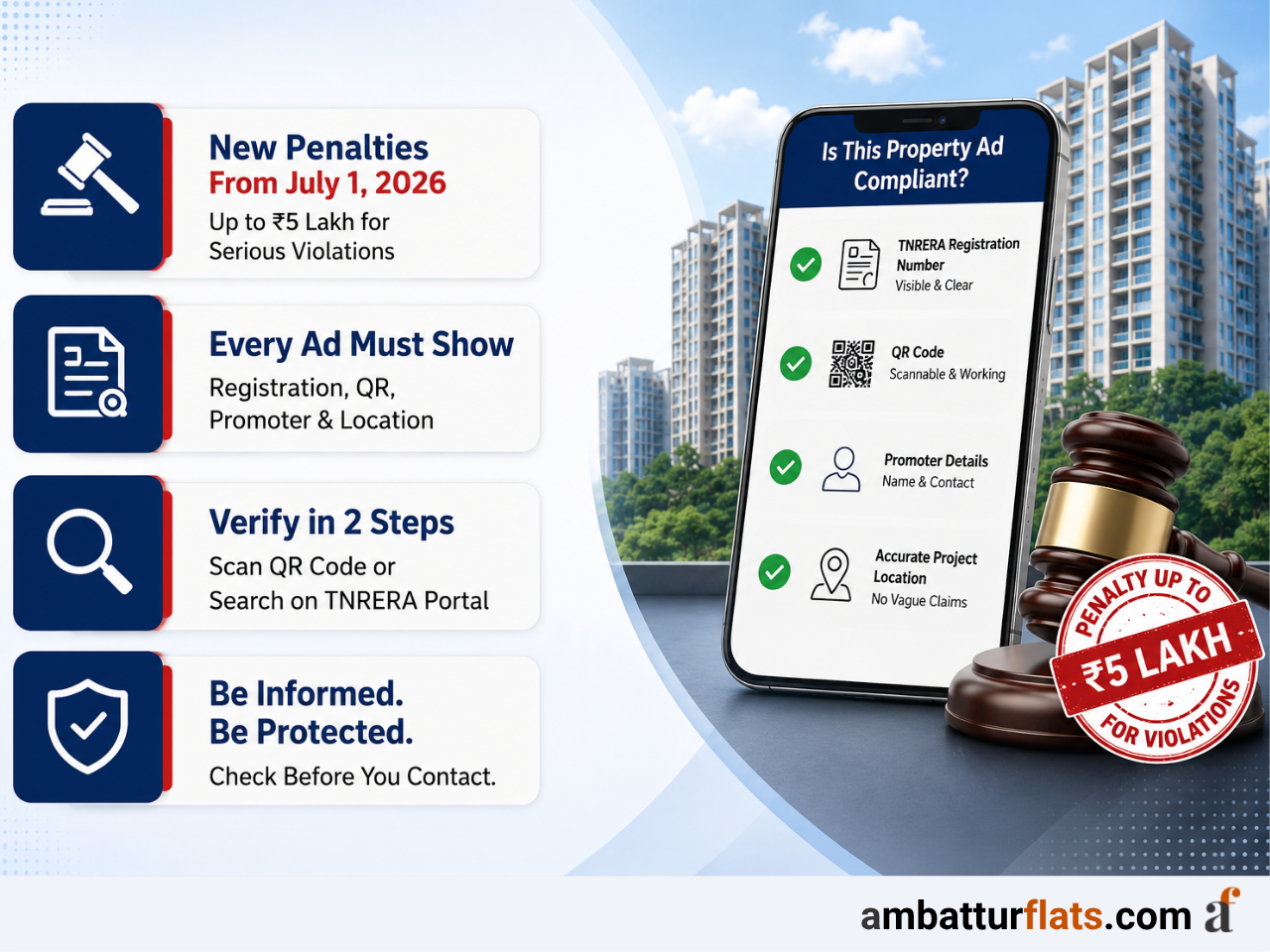
Open your phone's camera and point it at the QR code to see where it actually takes you. A compliant code opens a project page on TNRERA's own portal, showing the registration number, promoter name, and current project status. If the code opens a WhatsApp chat, a builder's own website, or nothing at all, that's your first red flag.
You don't need the QR code to check a project at all. TNRERA's official portal lets you search registered projects directly, by project name, promoter name, or registration number, and shows whether a project is registered, pending, rejected, or revoked. It takes about as long as reading the ad itself, and it tells you something the ad alone can't: whether the claims in front of you match what's on public record.
A fine of Rs 5 lakh looks small against a Rs 100 crore project, and by itself, it probably won't move a developer's marketing budget. What it does is attach a real cost to a rule that used to depend on buyers noticing something was off and complaining after the purchase. Other states show what that cost can look like once a case actually goes to a hearing. In Haryana, RERA fined a Gurugram promoter Rs 50 lakh over an advertisement that left out key project details, a much steeper number than anything TNRERA's current framework prescribes.
Chennai has been through several rounds of tighter property rules recently, from CMDA's own approval process for high-rises to changes in how projects get registered. The advertising penalty framework fits the same pattern: requirements that already existed on paper are now backed by an enforcement mechanism that costs money to ignore.
Buyers also have a legal lever that exists independently of TNRERA's own fine. Section 12 of the RERA Act makes a promoter liable to compensate a buyer, or return the amount paid with interest, if that buyer paid money based on a false or misleading statement in an advertisement. TNRERA's penalty runs alongside this provision rather than replacing it: the circular fines the developer for the ad itself, while Section 12 protects the specific buyer who acted on it.
Not entirely. A compliant ad confirms that the project is registered and that the promoter disclosed the basics TNRERA requires. It doesn't confirm the promoter's delivery record, whether the land title is clean, or whether the amenities shown in the brochure are actually being built.
The ad checklist is step one, not the whole process. Before you go further with any project, verifying the builder's track record covers the parts a compliant ad doesn't touch: past delivery timelines, litigation history, and the quality of previous handovers.
If an ad is missing the registration number, shows a QR code that doesn't work, or leans on a disclaimer instead of specifics, don't take it at face value. Search the project directly on TNRERA's portal before you respond to the ad or share your number with a sales team.
You can also file a complaint with TNRERA if you believe an ad is genuinely misleading rather than just poorly formatted. The Authority handles advertisement complaints through the same formal filing process it uses for project delays or construction defects, not a phone call to customer care.
That process runs through Form M, filed online for a modest fee, the same form used for other complaints against a promoter. It takes longer than messaging a sales team, but it puts your complaint on record with the regulator instead of leaving it as a private grievance between you and the developer.
TNRERA's penalty framework makes it costlier for a developer to cut corners in an ad. Checking the registration number and QR code confirms the paperwork; it doesn't replace due diligence on the builder or the project itself. Run the QR code, check the portal, and go through your full homebuyer checklist before committing to anything. If you're comparing verified options, our current list of TNRERA-registered apartments in Chennai is a reasonable place to start.