

The Tamil Nadu Assembly Elections 2026 arrive at a time when Chennai’s real estate market is moving through a phase of gradual recovery and consolidation. After regulatory changes, pandemic-related disruptions, and shifting buyer preferences, the market has become more stable and largely driven by end-users rather than speculation.
In this context, elections tend to create a sense of uncertainty among buyers and investors. Many assume that political change will directly push property prices up or down. In reality, the relationship is more indirect. Elections influence sentiment in the short term, but it is the policies and infrastructure decisions that follow which shape long-term price movement.
Understanding this distinction is essential before drawing any conclusions about where the market is heading in 2026.
Elections do not cause immediate price fluctuations in Chennai’s real estate market. What they affect is buyer behavior.
In the upcoming elections, uncertainty becomes the dominant factor. Buyers delay purchase decisions because they expect either policy changes or better opportunities after the results. This leads to a temporary slowdown in transactions. Developers, in response, attempt to sustain sales by offering flexible payment plans, limited-time discounts, or additional incentives.
However, this slowdown does not translate into a price correction. Chennai’s market is not driven by speculative investors who exit quickly under uncertainty. It is largely an end-user market, which keeps prices relatively stable even during periods of reduced activity.
Once election results are announced, the market does not react immediately. Instead, both buyers and developers wait for clarity on policy direction. Real price movement begins only when policies start translating into actual infrastructure development, approvals, or economic activity.
Looking at previous Tamil Nadu elections, including 2016 and 2021, a consistent pattern emerges.
In the pre-election phase, which typically spans three to six months before voting, demand softens slightly. This is not due to a lack of need, but due to hesitation. Buyers who were already planning to purchase often postpone their decisions. As a result, transaction volumes decline, and developers shift their focus toward clearing existing inventory rather than launching new projects.
After the elections, the market enters a transition phase. During this period, there is no immediate surge in prices. Instead, activity resumes gradually as policy direction becomes clearer. Over the next six to eighteen months, the impact of government decisions begins to reflect in the market. Infrastructure projects gain momentum, approvals move forward, and confidence returns.
This delayed response highlights an important point: real estate in Chennai reacts to execution, not political events themselves.
The influence of political parties on real estate is not about ideology but about governance priorities. Each party tends to emphasize certain areas of development, which in turn affects how and where demand grows.
The DMK has generally focused on strengthening urban infrastructure and expanding Chennai’s position as an economic hub. This includes investments in metro rail expansion, improvements in city connectivity, and support for IT and service sectors.
Such an approach tends to increase demand within Chennai and its suburban regions. Areas that benefit from improved connectivity or proximity to employment hubs gradually see higher absorption rates. Over time, this translates into steady price appreciation rather than sudden spikes.
The AIADMK has historically taken a more balanced approach by distributing development across urban and semi-urban regions. Along with infrastructure, there has been a focus on industrial expansion in different parts of Tamil Nadu.
This approach tends to spread real estate growth beyond Chennai. While the city continues to grow, the pace is more moderate compared to periods of aggressive urban infrastructure push. At the same time, peripheral areas and Tier-2 cities benefit from increased activity.
Parties like the BJP play a different kind of role, especially when it comes to coordination with the central government. Alignment between state and central policies can influence funding for large infrastructure projects, industrial corridors, and national-level schemes.
When such alignment is strong, it can accelerate execution timelines. This does not create immediate price changes, but it strengthens long-term growth potential in areas linked to these projects.
Political outcomes matter only because they determine policy direction. Certain policy areas have a direct and measurable impact on property prices.
Changes in stamp duty directly affect affordability. Even a small reduction can significantly reduce the upfront cost of buying a property. In the past, temporary reductions have led to a noticeable increase in transactions, as buyers moved quickly to take advantage of lower costs.
Infrastructure remains the most powerful driver of real estate growth in Chennai. Projects such as metro rail expansions, ring roads, and IT corridor developments do more than improve connectivity. They change the economic potential of entire regions.
The impact usually follows a sequence:
This is why locations connected to infrastructure projects often outperform others over time.
The efficiency of approval systems such as CMDA and DTCP plays a critical role in determining supply. When approvals are delayed, new project launches slow down, leading to limited supply in the market. This can push prices upward even if demand remains constant.
On the other hand, faster approvals increase supply and can stabilize prices by maintaining balance between demand and availability.
Policies that support affordable housing directly influence the largest segment of buyers in Chennai. Most demand comes from the mid-income category, typically within the ₹30 lakh to ₹70 lakh range.
When the government introduces subsidies, incentives, or financing support, demand in this segment increases. This has a stabilizing effect on the overall market, as it drives consistent absorption of inventory.
Real estate demand in Chennai is closely tied to employment. Expansion of IT parks, manufacturing units, and industrial corridors creates job opportunities, which in turn generate housing demand.
Without job growth, property prices cannot sustain long-term appreciation. This is why economic policy is often more important than housing policy in determining market direction.
Instead of making predictions, it is more useful to examine how different outcomes could influence the market.
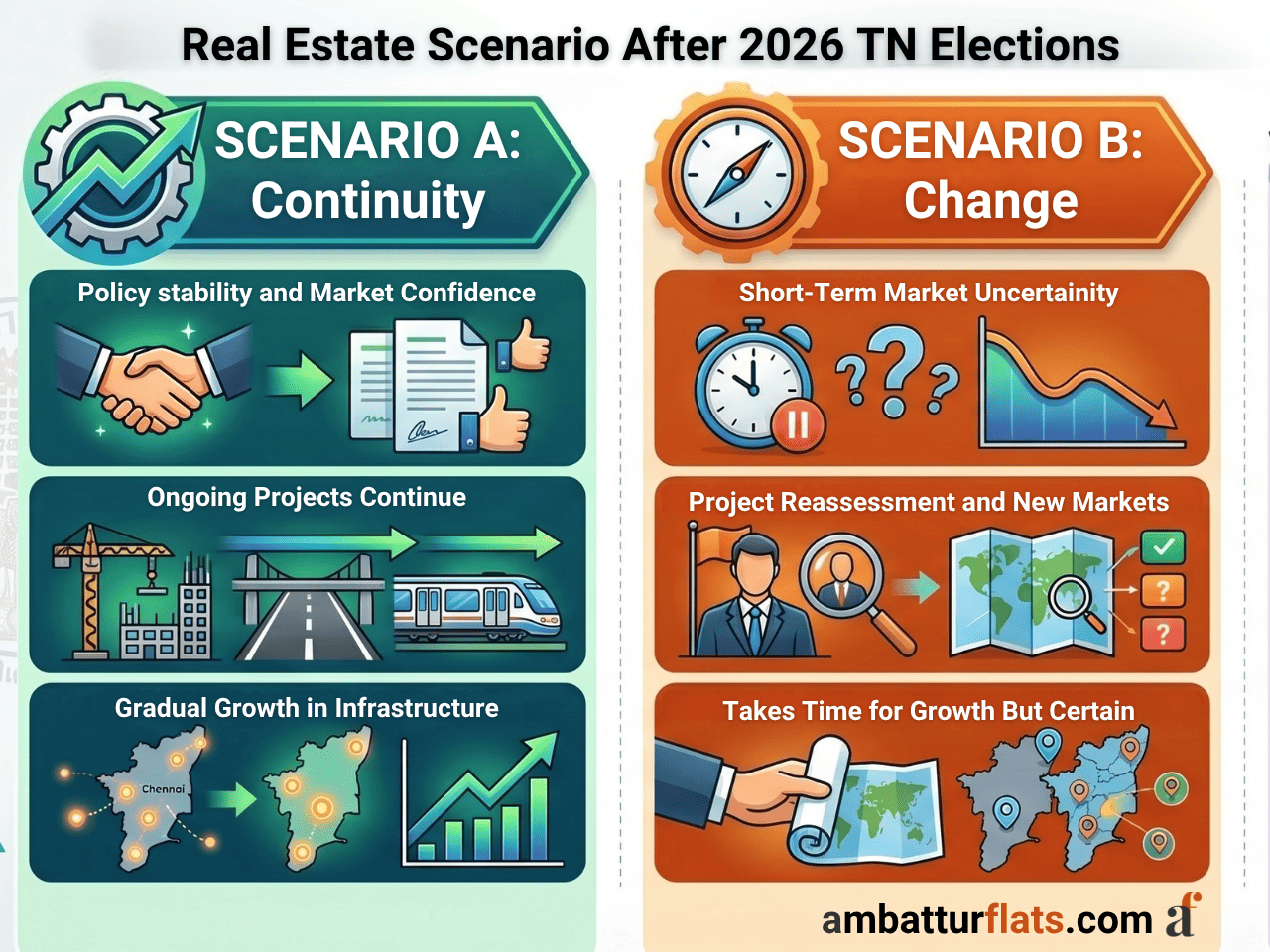
If there is continuity in governance, ongoing infrastructure projects are likely to proceed without disruption. Policy consistency tends to build confidence among both buyers and developers. In such a scenario, price growth is usually gradual and concentrated in areas linked to infrastructure and employment hubs.
If there is a change in government, the market may experience a short-term slowdown. New leadership often reassesses existing projects and priorities, which can delay decision-making. However, this phase is temporary. Once new policies are implemented, growth resumes, often shifting toward different micro-markets.
If there is stronger alignment between state and central governments, large infrastructure projects may move faster due to improved coordination and funding. This can enhance long-term growth prospects, although it does not eliminate short-term uncertainty.
It is important to move beyond the assumption that elections control the market. In reality, property prices in Chennai are shaped by a combination of fundamental factors.
These include employment growth, infrastructure execution, interest rates, and the balance between supply and demand. Elections influence these factors indirectly, but they are not the primary drivers.
A market with strong job creation and infrastructure development will continue to grow regardless of political transitions. Conversely, without these fundamentals, price growth will remain limited even under stable governance.
Based on historical trends and current market structure, it is unlikely that property prices in Chennai will either rise sharply or fall significantly due to the 2026 elections alone.
In the period leading up to the elections, the market is expected to remain stable, with slightly slower transaction activity and better negotiation opportunities for buyers. Immediately after the elections, there may be a pause as the market waits for clarity.
The real direction of price movement will become evident only in the months that follow. Areas supported by infrastructure development and employment growth are likely to see gradual appreciation, while others may remain stable.
Tamil Nadu Elections 2026 will not directly determine whether property prices in Chennai rise or fall. Their impact is indirect and unfolds over time through policy decisions, infrastructure execution, and economic growth.
For buyers and investors, the key is not to focus on election outcomes alone, but to understand how those outcomes translate into real-world developments. Real estate decisions should be based on fundamentals such as location, connectivity, and long-term demand drivers rather than short-term political events.
In a market like Chennai, stability is the norm. Price movements are gradual, and opportunities are created not by elections themselves, but by what follows after them.