
Developing a housing layout in Chennai is not just about dividing land into plots and selling them. It is a regulated legal process governed by statutory authorities, zoning laws, and development control rules. Any mistake in land classification, approval procedure, or infrastructure provision can delay the project or make the entire layout unsellable. Developers must understand the role of planning authorities, conversion requirements, open space obligations, and compliance under state laws. This guide explains the complete process, from raw land verification to layout approval and post-approval execution, with a clear focus on CMDA and DTCP procedures.
Chennai Metropolitan Development Authority (CMDA) is the primary planning authority for the Chennai Metropolitan Area, which includes Chennai district and parts of Kanchipuram and Thiruvallur districts. Any layout falling within this jurisdiction must obtain approval from CMDA.
Directorate of Town and Country Planning (DTCP) governs areas outside CMDA limits. Many suburban and peri-urban developments fall under DTCP authority.
Greater Chennai Corporation (GCC) handles building plan approvals within corporation limits, typically after layout approval is secured.
All developments are regulated under the Tamil Nadu Town and Country Planning Act, 1971 and the Tamil Nadu Combined Development and Building Rules, 2019 (TNCDBR 2019). These laws define zoning, road widths, OSR requirements, FSI limits, and infrastructure standards. If your layout violates these rules, approval will not be granted.
So, when you are developing plots in Chennai’s real estate hotspots or in any locality, you must know have knowledge on these governing authorities to avoid defaulting.
Before preparing a layout plan, verify whether the land is legally safe for development. Developers often underestimate this step and pay for it later.
Start with ownership verification. Collect:
The Encumbrance Certificate confirms whether the property has mortgages, court attachments, or prior claims. The FMB sketch verifies exact boundaries and survey details.
A legal opinion from a property lawyer is not optional. It protects you from hidden disputes, missing inheritance links, or defective title chains. If title clarity is weak, layout approval becomes secondary because banks will refuse loans to buyers.
Also verify physical access. A land parcel without a legally recorded access road will face rejection during layout scrutiny.
After confirming ownership, check zoning classification under the Master Plan. This determines whether residential development is permissible.
Within CMDA limits, land use can be verified through the official GIS zoning map using the survey number. If the land falls under Primary Residential (R1) or Mixed Residential zones, development is allowed subject to rules.
If classified as Agricultural or Industrial, residential plotting is not permitted unless conversion is obtained. Wetlands, water bodies, poramboke lands, and canal-adjacent areas are highly restricted and often rejected.
Zoning mismatch is one of the most common reasons for layout rejection. Never proceed with layout design before confirming zoning compliance.
If the land is classified as agricultural, you must obtain Change of Land Use (CLU) approval before layout submission.
Under the Tamil Nadu Change of Land Use Rules, agricultural land cannot be used for non-agricultural purposes without official permission.
The process includes:
CLU charges are generally 3% of the market value determined under stamp valuation rules, along with scrutiny fees.
Skipping CLU and directly applying for layout approval will result in immediate rejection. Revenue records must reflect non-agricultural status before planning authorities consider your application.
Once land classification is clear, appoint a licensed civil engineer or architect to prepare the layout drawing.
The layout plan must include:
Under TNCDBR 2019, typically 10% of the total layout area must be reserved as OSR. This land must be handed over to the local body free of cost. Developers cannot sell OSR portions.
For projects exceeding 4,000 square meters, affordable housing obligations or shelter charges may apply.
Authorities scrutinize road widths strictly. If access road width is insufficient, you may be required to provide road widening or surrender land.
A technically weak layout drawing leads to multiple queries and delays. Invest in competent planning support.
Applications are now processed through the Tamil Nadu Single Window Portal. Form A is used for layout approval submission.
Documents required include:
After submission, the authority circulates the proposal to various departments for No Objection Certificates. These may include the Highways Department (if near a state or national highway), local body authorities, fire services (in certain cases), and revenue officials.
Site inspection follows. Officials verify boundary alignment, physical access, encroachments, and compliance with planning rules.
If discrepancies are found, you receive queries. Prompt response reduces delay. Ignoring or delaying corrections extends approval timelines significantly.
Once satisfied, the authority issues a layout approval order with an LP/DDTP number. Approvals are typically valid for three years and may require renewal if development is not completed.
Approval is not the final step. You must execute infrastructure exactly as sanctioned.
This includes:
Authorities may inspect before issuing completion acknowledgement. Non-compliance can result in refusal to regularize plot sales.
Developers who sell plots without infrastructure risk buyer disputes and reputational damage.
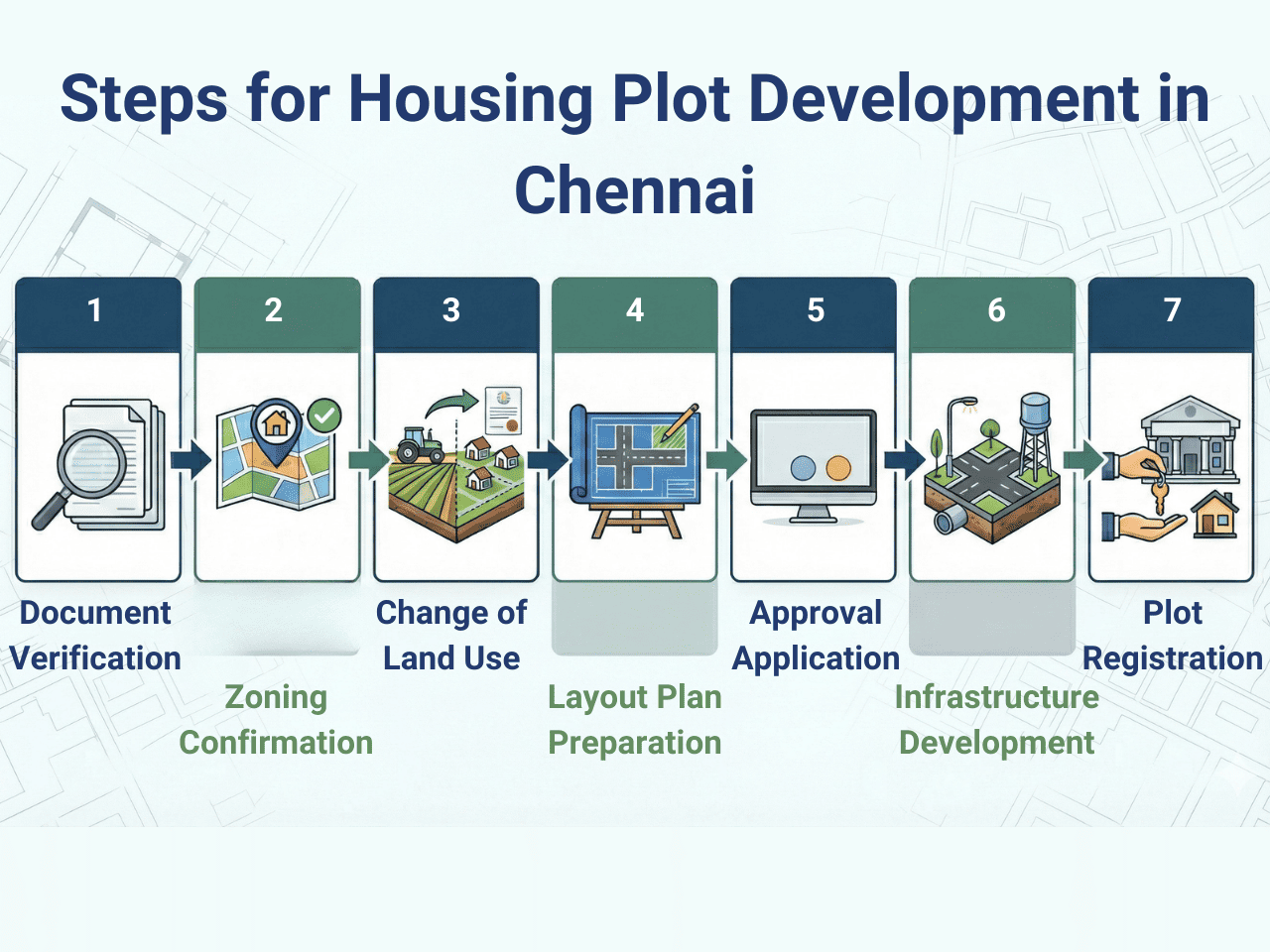
After infrastructure is developed and conditions are satisfied, plots can be individually registered at the Sub-Registrar’s Office.
Each sale deed must reference the approved layout number. Banks typically verify CMDA/DTCP approval before sanctioning home loans to buyers.
Selling unapproved layouts may generate short-term cash flow but creates long-term legal exposure. Approved layouts command higher market value and faster absorption.
Layout development in Chennai is rule-driven and documentation-heavy. The approval process is structured but unforgiving of errors. Developers who approach projects casually face delays, rejection, or litigation.
Key risks to avoid:
A compliant layout not only reduces legal exposure but also improves buyer confidence, bank funding eligibility, and long-term credibility.
Developing housing layouts in Chennai is profitable when executed with regulatory clarity, disciplined documentation, and technical precision. Treat compliance as a core investment, not an obstacle.