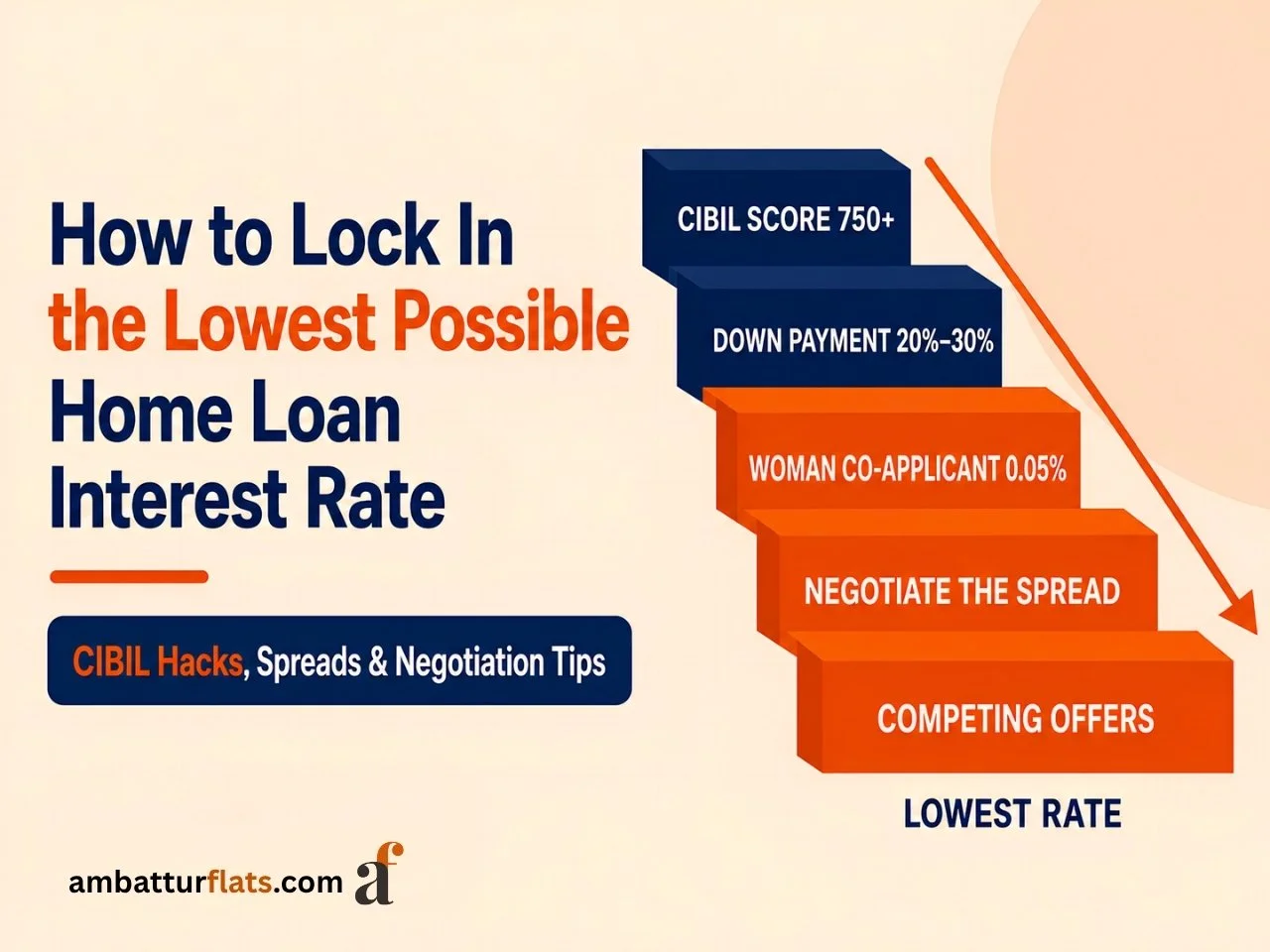
How to Lock In the Lowest Possible Home Loan Interest Rate

[DISCLAIMER]: Interest rate concessions, processing fee waivers, and spread discounts are subject to independent credit evaluations and discretionary approval by lending institutions. Maintain a strong financial profile to qualify for tier-1 rate brackets.
Securing the lowest possible home loan interest rate isn't a matter of luck—it is the direct outcome of strategic financial preparation and deliberate negotiation. Many homebuyers mistakenly assume that the published interest rate on a bank's brochure is fixed and non-negotiable. In reality, Indian home loan pricing relies on risk-based models where the final rate offered depends entirely on your creditworthiness, capital contribution, and bargaining power.
Driving down your mortgage rate by even 0.25% (25 basis points) translates into massive savings over a typical 20 to 30-year loan tenure. For instance, on a ₹50 lakh home loan over 20 years, a 25 bps drop in interest rate saves you nearly ₹1.8 lakh to ₹2 lakh in cumulative interest payouts. By implementing structured preparation tactics, you can systematically compress the lender's credit risk premium and unlock the absolute bottom-tier interest rate brackets. For a holistic understanding of how property purchasing fits into your overall financial plan, explore our comprehensive guide to home loans in Chennai.
Maintain a CIBIL Score Above 750 (Ideally 800+): Unlocks prime credit risk tiers and automatically minimizes discretionary lender spreads.
Increase Down Payment to 20%–30%+: Reduces Loan-to-Value (LTV) ratios, lowering perceived risk for financial institutions.
Register a Woman Primary Co-Applicant: Earns an instant gender-based interest rate concession of 0.05% (5 bps) across most major public and private banks.
Negotiate the Lender's Spread & Risk Markup: Target the markup added to the Repo-Linked External Benchmark Lending Rate (EBLR) rather than just asking for a generic discount.
Leverage Banking Relationships & Alternative Offers: Use active salary accounts or written sanction letters from competitor banks to compel your preferred lender to match or beat lower rates.
Under risk-based pricing frameworks, your credit score directly governs the interest rate band you qualify for. Indian lenders classify applicants into Credit Risk Grades (CRGs) based on their CIBIL score. Borrowers with pristine credit scores of 800 and above are awarded Tier-1 pricing, receiving the lowest published rates. Conversely, scores hovering between 700 and 749 often incur additional credit risk premiums ranging from 15 to 50 basis points.
Before submitting your mortgage application, spend 3 to 6 months optimizing your credit profile:
Pay off high-interest revolving debt like credit card balances and personal loans to drop your credit utilization ratio below 30%.
Verify your credit report for administrative errors, incorrect late payment entries, or fraudulent inquiries, raising disputes immediately through CIBIL.
Avoid applying for new credit cards or personal loans within 90 days of applying for a home loan, as multiple hard inquiries signal financial distress.
By repairing your profile before applying, you remove the lender's justification to append a risk surcharge to your baseline rate. To dive deeper into how underwriting algorithms evaluate your financial profile, read about understanding key factors that determine home loan interest rates.
The Loan-to-Value (LTV) ratio measures the loan amount against the official assessed value of the property. The Reserve Bank of India permits banks to fund up to 90% for loans up to ₹30 lakh, 80% for loans between ₹30 lakh and ₹75 lakh, and 75% for loans exceeding ₹75 lakh. However, borrowing at the absolute regulatory ceiling maximizes the lender's loss exposure in case of default.
When you contribute a larger personal equity portion—paying 25% to 30% upfront instead of the minimum required 10% to 15%—you dramatically alter the risk dynamics:
Lower Capital Requirement: Smaller loan requests present lower absolute capital risk to the bank's balance sheet.
Lower LTV Category: Dropping your LTV below 70% shifts your profile into a lower-risk category, allowing loan sanction officers to offer lower interest rates.
Savings Over Time: You pay interest on a significantly lower principal amount, multiplying your overall interest savings over the tenure.
Most major Indian public sector and private banks offer a mandatory or discretionary interest rate concession of 0.05% (5 basis points) for women borrowers. To claim this benefit, a female family member (such as a wife, mother, or daughter) must be registered as a primary applicant or co-applicant, as well as a co-owner of the property.
Beyond interest rate discounts, adding a female co-applicant provides strategic financial advantages:
Lower Stamp Duty Costs: Many state governments offer 1% to 2% stamp duty exemptions or concessions when registering property in a woman's name.
Enhanced Eligibility: Combining incomes increases overall repayment capacity, lowering your Debt-to-Income or Fixed Obligation-to-Income Ratio (FOIR).
Additional Tax Deductions: Both co-borrowers can independently claim tax deductions on interest repayment under Section 24(b) (up to ₹2 lakh each) and principal repayment under Section 80C (up to ₹1.5 lakh each).
Learn more about managing joint structures by reviewing the guidelines on applying for a joint home loan with a co-applicant.
To negotiate effectively, you must understand how your interest rate is calculated under the External Benchmark Lending Rate (EBLR) framework:
Final Home Loan Rate = RBI Repo Rate + Base Benchmark Spread + Credit Risk Premium
While the base RBI Repo Rate is uniform across all banks, the spread markup and credit risk premium vary between institutions. Borrowers often make the mistake of accepting the initial offer provided by sales agents.
When negotiating with credit managers, focus on the following components:
Discretionary Spread Discount: Ask the credit manager to waive or reduce the discretionary spread component by presenting a stable corporate employer profile, long employment tenure, or high disposable income.
Zero Risk Premium Exemption: If your CIBIL score is above 780, demand a complete exemption from any risk premium markups.
Processing Fee Waivers: Use rate negotiations to simultaneously secure zero-processing-fee concessions or waivers on legal and technical appraisal fees.
Lenders fight aggressively to acquire low-risk, high-income borrowers. You can turn this market competition to your advantage during negotiations:
Leverage Existing Banking Relationships: Banks frequently maintain pre-approved home loan offers with discounted interest rates and zero processing fees for customers holding active salary accounts or substantial fixed deposits.
Present Competing Written Offers: Apply to 2 or 3 competing lenders simultaneously. Once you secure a formal, written loan sanction letter offering a lower interest rate from one bank, present it to your preferred bank. Credit committees often match or beat competitive quotes to secure prime accounts.
Consider a Balance Transfer: If you have an existing loan at a higher rate, explore transferring your balance to another bank offering lower EBLR spreads. Threatening an external balance transfer often prompts your existing lender to offer a concession or re-pricing fee discount to retain your account.
To evaluate options across the market, check our guide on comparing home loan interest rates across major public and private banks.