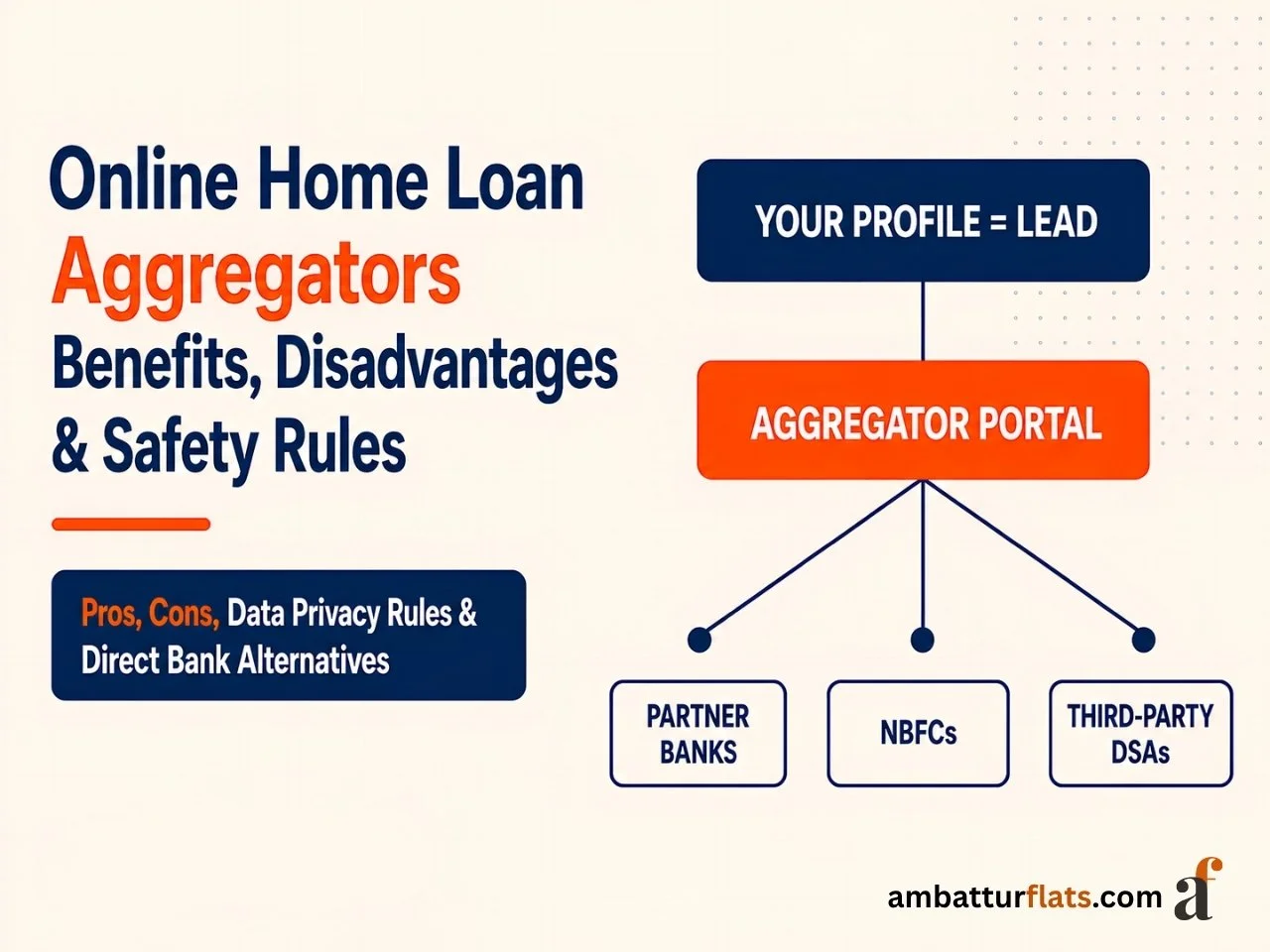
Online Home Loan Aggregators: Benefits, Disadvantages & Safety Rules

[DISCLAIMER]: Financial aggregators operate as digital distribution and lead generation partners for banks and Housing Finance Companies (HFCs). Interest rates, eligibility estimates, and pre-approval offers shown on third-party aggregators remain subject to final verification and legal underwriting by the primary lending bank.
The digital revolution has transformed how homebuyers secure property financing. Gone are the days of physically visiting half a dozen bank branches to negotiate rates. Today, digital home loan aggregators like Paisabazaar, BankBazaar, NoBroker, and Magicbricks allow buyers to compare rates, processing fees, and eligibility criteria from dozens of lenders in seconds. Navigating these portals is often the first step when utilizing any complete guide to home financing in Chennai, as they provide a bird's-eye view of the current financial market.
However, borrowers must understand both the immense convenience and the potential drawbacks of these platforms. Submitting your personal financial details online triggers a complex chain of data sharing. Before entering your contact information and income details into a third-party portal, it is crucial to weigh the benefits of instant comparison against the risks of telemarketing spam, data privacy concerns, and the difference between soft and hard credit checks.
To make an informed decision, homebuyers should understand the core differences between using a digital comparison portal and applying directly with a primary lending branch:
Platform Comparison Speed: Aggregators provide an instantaneous side-by-side view of offers from 25+ lenders, whereas direct bank applications require researching each bank individually.
Multi-Lender Access vs Direct Relationship: Aggregators give you broad market access. Direct applications leverage your existing banking relationships, which can sometimes yield negotiated processing fee waivers.
Lead Sharing Mechanisms: When you apply through an aggregator, your profile acts as a "lead" that is often distributed to multiple partner banks or Direct Selling Agents (DSAs). Direct applications keep your data siloed within one institution.
Credit Check Variations: Portals typically perform a soft credit check to estimate eligibility. A direct application almost always initiates a hard inquiry on your credit report.
Digital Convenience: Aggregators offer seamless UI, document upload portals, and digital tracking, streamlining the early stages of the borrowing process.
There are substantial reasons why millions of Indian homebuyers begin their mortgage journey on digital portals. The primary advantage is market transparency. When comparing home loan interest rates across top Indian banks, aggregators present real-time data in a centralized, standardized format. You can instantly see who is offering the lowest repo-linked lending rate (RLLR) and who is running festive season zero-fee promotions.
Additionally, these platforms excel at personalized loan offer filtering. By inputting your monthly income, age, and existing liabilities, the aggregator's algorithm filters out banks whose strict eligibility criteria you may not meet, saving you time and preventing rejection.
Most premium aggregator platforms also provide dedicated relationship assistance. Once you select a preferred bank, the portal assigns a representative to help you navigate the initial paperwork and act as a liaison between you and the bank's processing team.
Despite their convenience, aggregator platforms come with notable downsides. The most prominent disadvantage is the immediate influx of telemarketing spam. Because aggregators operate on a lead-generation model, agreeing to their terms and conditions often means giving consent for your phone number and email to be shared with multiple banks, NBFCs, and third-party DSAs.
Another hidden risk is the potential for aggressive sales tactics. Aggregators earn commissions from partner banks when a loan is disbursed. Consequently, their representatives might push you toward a partner bank offering them a higher payout, even if a non-partner bank offers a marginally better rate for your specific profile.
Furthermore, while aggregators help with the financial application, they generally offer incomplete property legal checks. The ultimate responsibility of verifying builder approvals and titles still falls entirely on the primary lending bank. Finally, submitting multiple full applications through an aggregator in a scattered approach can delay the process while you are busy gathering the essential documents needed for home loan processing.
One of the most critical safety aspects to understand is the difference between soft and hard credit inquiries. Top-tier aggregators allow you to fetch your credit report using a soft pull. This is invaluable for checking your credit score without causing multiple hard inquiries, as soft pulls do not negatively impact your CIBIL score.
However, if you instruct the aggregator to officially apply to four different banks simultaneously on your behalf, each of those banks will execute a "hard pull" on your CIBIL report. Multiple hard inquiries within a short window signal credit-hungry behavior to bureaus, temporarily lowering your score and potentially jeopardizing your final interest rate.
Regarding data privacy, India's strict digital lending guidelines require portals to explicitly state how they use your data. However, the fine print in digital financial portals often includes broad data-sharing consent clauses. Once your data is syndicated to local DSA agencies, revoking access becomes practically impossible, leading to long-term promotional outreach.
To leverage the power of home loan aggregators without falling victim to the pitfalls, follow these strict safety rules:
Use Dedicated Contact Channels: Create a separate email address and use a secondary or masked phone number when registering on aggregator portals to protect your primary inboxes from mortgage spam.
Opt Out of Marketing Distribution Consents: Carefully uncheck any pre-ticked boxes that allow the platform to share your data with "affiliates, partners, and third-party marketers."
Request Soft Eligibility Checks Only: Strictly use the platform for preliminary research and soft credit checks. Do not authorize the portal to submit official applications to multiple banks at once.
Deal Directly for Final Sanctioning: Use the aggregator to identify the best two or three banks. Then, take that knowledge and deal directly with the official bank branch managers for your final application, sanctioning, and document handover.
Verify the DSA Credentials: If you proceed with an agent assigned by an aggregator, always ask for their official bank authorization ID before handing over KYC documents or processing fee cheques.