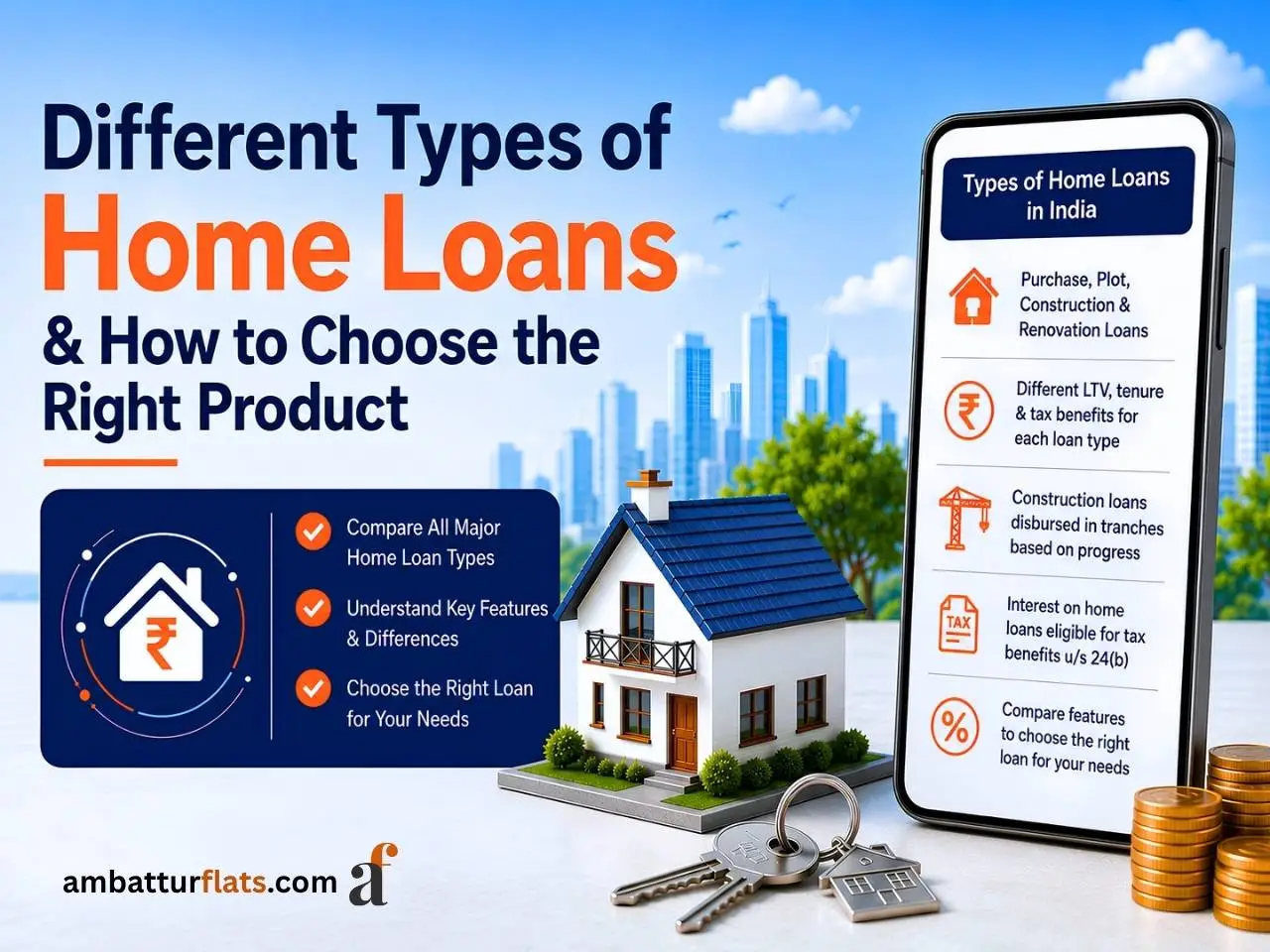
Different Types of Home Loans & How to Choose the Right Product

[DISCLAIMER]: Loan-to-Value (LTV) limits, maximum tenures, interest rate spreads, and property compliance conditions vary significantly depending on the specific home loan category and individual bank policies. Confirm full sanction parameters with your lender.
Bajaj Finserv
Navigating the Indian real estate market requires understanding that housing finance is not a one-size-fits-all product. Indian commercial banks, Housing Finance Companies (HFCs), and major non-banking financial companies like Bajaj Finserv offer specifically structured loan categories tailored to precise property acquisition and development needs. Whether you are purchasing a ready-to-move-in apartment, securing a vacant residential plot, building a house from the ground up, or expanding an existing residence, selecting the appropriate loan product is critical.
Each housing loan category comes with distinct regulatory guidelines set by the Reserve Bank of India (RBI) regarding Loan-to-Value (LTV) caps, disbursement schedules, legal verification checks, and tax treatment. For detailed insights into local property financing strategies, explore our comprehensive Chennai home loan guide. Choosing the right borrowing structure ensures lower overall borrowing costs, smoother disbursement, and full access to eligible tax benefits.
Standard Purchase Loans: Offer up to 75%-90% LTV, long tenures up to 30 years, single or milestone disbursements, and full tax benefits under the Old Tax Regime.
Pure Plot Loans: Cap LTV ratios around 70%-80%, restrict maximum tenures to 15-20 years, and offer no Section 24(b) interest tax deductions unless combined with construction.
Composite Loans: Combine land purchase and house construction into one facility, unlocking full tax deductions once construction finishes within a mandated timeframe.
Self-Construction Loans: Disburse funds in tranches aligned with site engineer inspection stages rather than upfront lump sums.
Renovation & Extension Loans: Offer shorter repayment windows (typically 10-15 years) with lower processing overheads and an annual Section 24(b) interest deduction capped at Rs. 30,000 for self-occupied properties.
Standard home purchase loans are the primary mortgage mechanism used in India. They apply to buying ready-to-move-in flats, under-construction apartments from real estate developers, or pre-owned resale homes.
Under current RBI guidelines, the allowable Loan-to-Value (LTV) ratio is tiered based on the sanction amount:
Loans up to Rs. 30 Lakhs: Up to 90% LTV.
Loans between Rs. 30 Lakhs and Rs. 75 Lakhs: Up to 80% LTV.
Loans above Rs. 75 Lakhs: Up to 75% LTV.
These loans feature repayment tenures stretching up to 30 years, subject to the borrower's age at maturity. For ready properties or resale transactions, the lender disburses the sanctioned amount directly to the seller or seller's lender in a single settlement. For under-construction properties, banks release funds based on construction stages verified through engineer certificates. Borrowers can evaluate their maximum loan capacity by assessing rules for calculating maximum home loan eligibility based on salary.
Understanding the operational differences between a Plot Loan and a Composite Loan is crucial when acquiring land:
Pure Plot Loans A standalone Plot Loan (or Land Loan) is intended solely for purchasing a vacant residential plot of land. Financial institutions view vacant land as higher-risk collateral. Consequently, lenders enforce stricter criteria: LTV caps are typically limited to 70%-80%, tenures are capped at 15 to 20 years, and interest rates may carry a slight premium over standard home loans. Crucially, a pure plot loan offers zero tax benefits under Section 24(b) or Section 80C because no residential structure exists on the land.
Composite Loans A Composite Loan bundles plot acquisition and home construction into a unified financial package. The lender sanctions a single loan divided into two phases: land purchase and subsequent building construction. To retain composite status and access tax advantages, lenders mandate that physical construction must commence within a specified window (typically 1 to 3 years from land registration). Once the house is constructed and a completion certificate is issued, the borrower becomes eligible for tax deductions under Section 24(b) for interest and Section 80C for principal repayment.
Self-construction loans serve individuals who already own a plot of land—either unencumbered or under an active plot loan—and wish to build a custom independent house. Home extension loans follow a similar framework but are designated for adding new rooms, floors, or structural square footage to an existing property.
Unlike standard purchase loans where capital is transferred in large upfront sums, construction loans use a staggered, tranche-based disbursement model. The lender releases funds incrementally according to predefined construction stages:
Plinth level completion
Brickwork and structural slab casting
Plastering, wiring, and finishing works
Before sanctioning a self-construction loan, banks require complete verification of title deeds, approved municipal layout plans, local authority building permits, and an itemized cost estimate prepared by a certified civil engineer or architect. Lenders dispatch technical inspectors to verify actual physical progress at the site prior to releasing each subsequent disbursement tranche. Maintaining a clear paper trail is vital; review the essential documentation required for home loan approval to prevent funding delays.
Home Improvement Loans cater to internal upgrades and non-structural enhancements of an existing residential unit. These loans finance projects such as interior repainting, flooring replacements, kitchen remodels, bathroom overhauls, external waterproofing, or electrical rewiring.
Key structural features of renovation loans include:
Tenure & Amount: Shorter repayment tenures (usually 5 to 15 years) and lower overall quantum compared to primary purchase loans.
Documentation: Simplified processing requiring contractor estimates, material quotations, and proof of property ownership rather than full civil layout approvals.
Tax Implications: Under Section 24(b) of the Income Tax Act (under the Old Tax Regime), interest paid on home improvement loans for a self-occupied property is tax-deductible up to a maximum cap of Rs. 30,000 per financial year. This is subsumed within the overall Rs. 2 Lakh ceiling allowed for home acquisition/construction. Borrowers should analyze their options carefully by understanding tax deduction rules under Section 80C and Section 24b.
To optimize interest expenses, taxation, and cash flow, align your specific property objective with the appropriate loan product:
Identify the Exact Real Estate Intent: Choose a standard purchase loan for developer flats or resale houses; choose a composite or construction loan if building a custom home.
Factor in Tax Eligibility: If tax deduction is a priority, avoid standalone plot loans unless you intend to construct a house promptly under a composite loan structure.
Evaluate Disbursement Mechanisms: Ensure your cash flow aligns with tranche-based disbursements if opting for construction or extension products, as interest accrues on disbursed amounts during the build phase.
Compare LTV Ratios & Down Payment Needs: Standard purchase loans require smaller down payments (10%-25% margin) compared to plot or land acquisition loans (20%-30%+ margin).