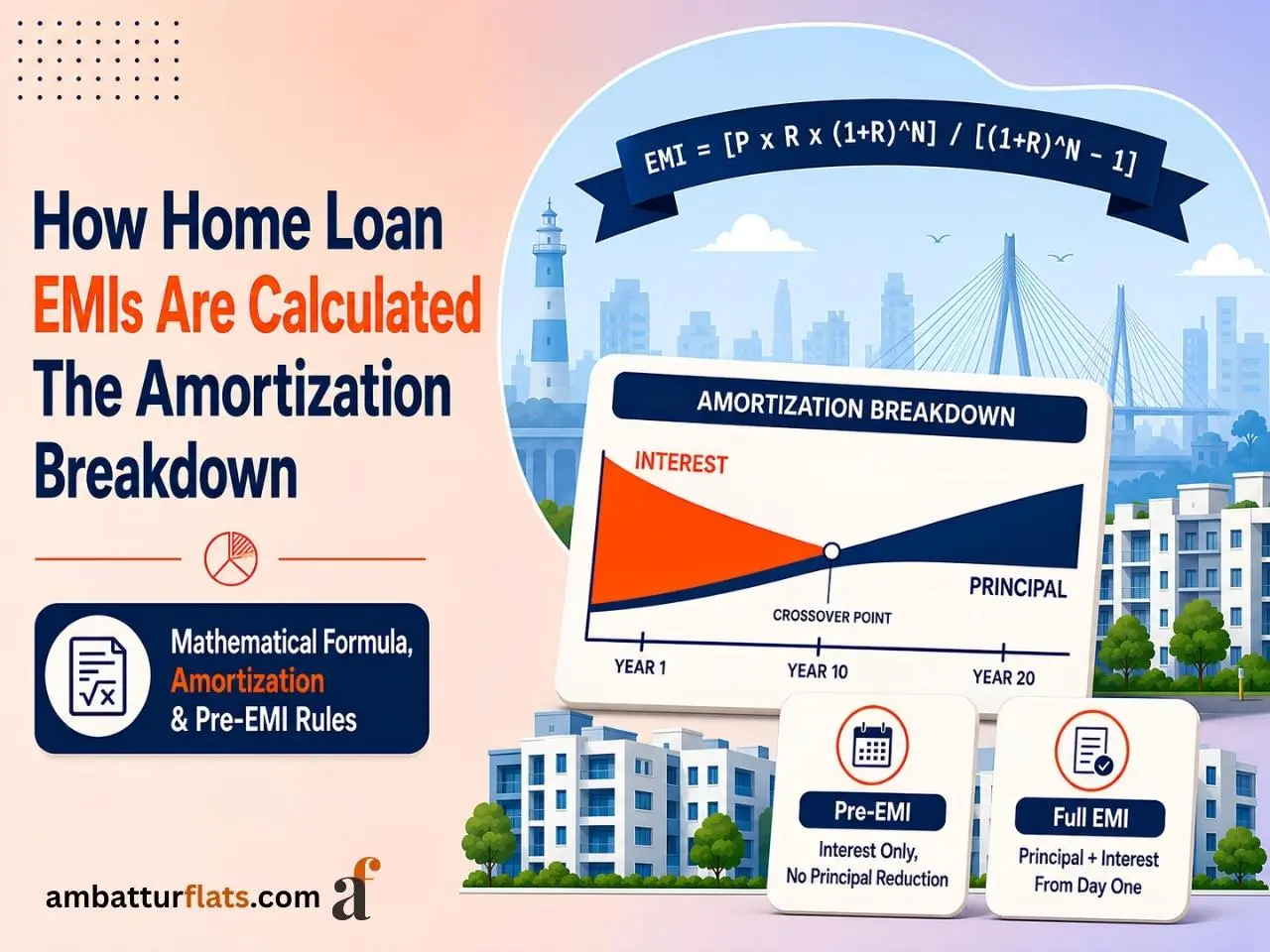
How Home Loan EMIs Are Calculated: The Amortization Breakdown

[DISCLAIMER]: EMI estimates, amortization tables, and interest breakdown figures are provided for financial planning purposes. Actual monthly repayment schedules are calculated by individual lending institutions using precise daily reducing balance methods.
Navigating a real estate purchase requires a grounded understanding of how long-term debt functions. At the heart of home financing is the Equated Monthly Installment (EMI)—a fixed financial commitment paid to a lender on a specific date each month throughout the agreed loan tenure.
While your monthly payout remains constant, the interior anatomy of an EMI changes continuously. Every installment you pay is split into two distinct elements: principal repayment and interest charges. Understanding how banks recalculate this split month after month is essential for managing long-term borrowing costs, choosing optimal loan tenures, and executing effective debt reduction strategies. For a holistic overview of property acquisition financing, explore our complete Chennai home financing guide.
Reducing Balance Method: Indian home loan lenders evaluate interest on the outstanding principal at the end of each billing cycle rather than on the original borrowed sum.
Front-Loaded Interest: Due to the mathematical nature of amortization schedules, early EMI installments are heavily weighted toward interest servicing.
Tenure Relationship: Extending repayment tenure reduces the monthly EMI burden but increases total interest paid over the life of the loan.
Pre-EMI vs. Full EMI: Pre-EMI covers interest charges on partial loan disbursements during property construction, whereas Full EMI begins after full disbursement and includes principal reduction.
Market Benchmark Sensitivity: Floating interest rates fluctuate based on benchmark shifts, directly altering either your EMI obligation or remaining loan tenure.
Home loan EMIs are computed using a standard mathematical formula based on compounding discounted cash flows. The standard equation is:
EMI = [P x R x (1+R)^N] / [(1+R)^N - 1]
Where each variable represents:
P (Principal): The original loan amount approved and disbursed by the financial institution.
R (Monthly Interest Rate): The annual interest rate divided by 12 months and expressed as a decimal. Formula: (Annual Rate / 12) / 100.
N (Tenure in Months): The total tenure of the loan expressed in months (e.g., 20 years = 240 months).
P = Rs. 5,000,000
R = (8.50 / 12) / 100 = 0.0070833
N = 20 x 12 = 240
Plugging these parameters into the formula:
EMI = [5,000,000 x 0.0070833 x (1 + 0.0070833)^240] / [(1 + 0.0070833)^240 - 1]
EMI = [35,416.5 x 5.4382] / [5.4382 - 1]
EMI = 192,602.01 / 4.4382 = Rs. 43,391 per month (approx.)
Over 240 months, total repayments equal Rs. 1,04,13,840 (Rs. 1.04 Crore). Of this total, Rs. 50 Lakhs pays back the principal, while Rs. 54,13,840 goes toward interest charges. To evaluate how much borrowing capacity your income allows prior to committing to a tenure, consult our guide on determining total loan eligibility based on monthly salary.
An amortization schedule is an itemized table showing the exact breakdown of every EMI payment across the entire loan lifespan. Because home loans follow the monthly reducing balance mechanism, interest is charged only on what remains unpaid.
In the early stage of a 20-year loan, the outstanding principal balance remains high. Consequently, monthly interest charges dominate each installment. In Month 1 of our Rs. 50 Lakh loan example:
Interest portion: Rs. 5,000,000 x 0.0070833 = Rs. 35,417
Principal portion: Rs. 43,391 - Rs. 35,417 = Rs. 7,974
During the initial years, up to 80% of your EMI servicing goes strictly toward interest costs, resulting in a slow decline of the main principal.
As monthly installments chip away at the balance, the interest burden drops. Around the midpoint of a 20-year loan, the repayment schedule reaches an inflection point where the principal portion matches, and then exceeds, the interest component.
In the final stretch, the remaining principal balance is significantly lower. The interest component declines to a small fraction of the monthly installment, and almost the entire EMI goes toward wiping out the final principal balance.
When purchasing an under-construction home, lenders do not release the full loan amount at once; instead, funds are released in tranche disbursements tied to construction milestones. Borrowers typically choose between two payment structures during this phase:
Pre-EMI:
Payment Focus: Interest on disbursed sum only.
Principal Impact: Zero principal reduction.
Monthly Outflow: Lower initial cash burden.
Total Loan Cost: Higher overall cumulative cost.
Full EMI:
Payment Focus: Combined principal and interest.
Principal Impact: Loan principal drops immediately.
Monthly Outflow: Higher monthly outlay from day one.
Total Loan Cost: Lower total interest burden over time.
Pre-EMI provides short-term cash flow flexibility while awaiting handover, but it adds holding costs because none of the payments reduce the principal balance. Full EMI requires higher liquidity during construction, but it begins amortizing the loan immediately, cutting total interest paid over time.
Execute Early-Tenure Prepayments: Because interest is front-loaded in the loan cycle, making extra payments early directly reduces the principal balance. This cuts future interest calculations significantly. For regulatory guidelines, review making principal prepayments to reduce total loan tenure and interest.
Opt for Annual EMI Step-Ups: Increasing your EMI payout by 5% to 10% each year in line with salary growth dramatically accelerates principal reduction and shortens loan tenure.
Select Shorter Repayment Tenures: While shorter tenures require higher monthly payments, they deliver substantial savings on overall cumulative interest charges.
Monitor External Benchmark Lending Rates (EBLR): Ensure your floating loan is benchmarked to the RBI Repo Rate. When policy rates fall, check that your lender passes on interest rate reductions promptly. Learn more about how RBI repo rate changes impact monthly EMI payments.