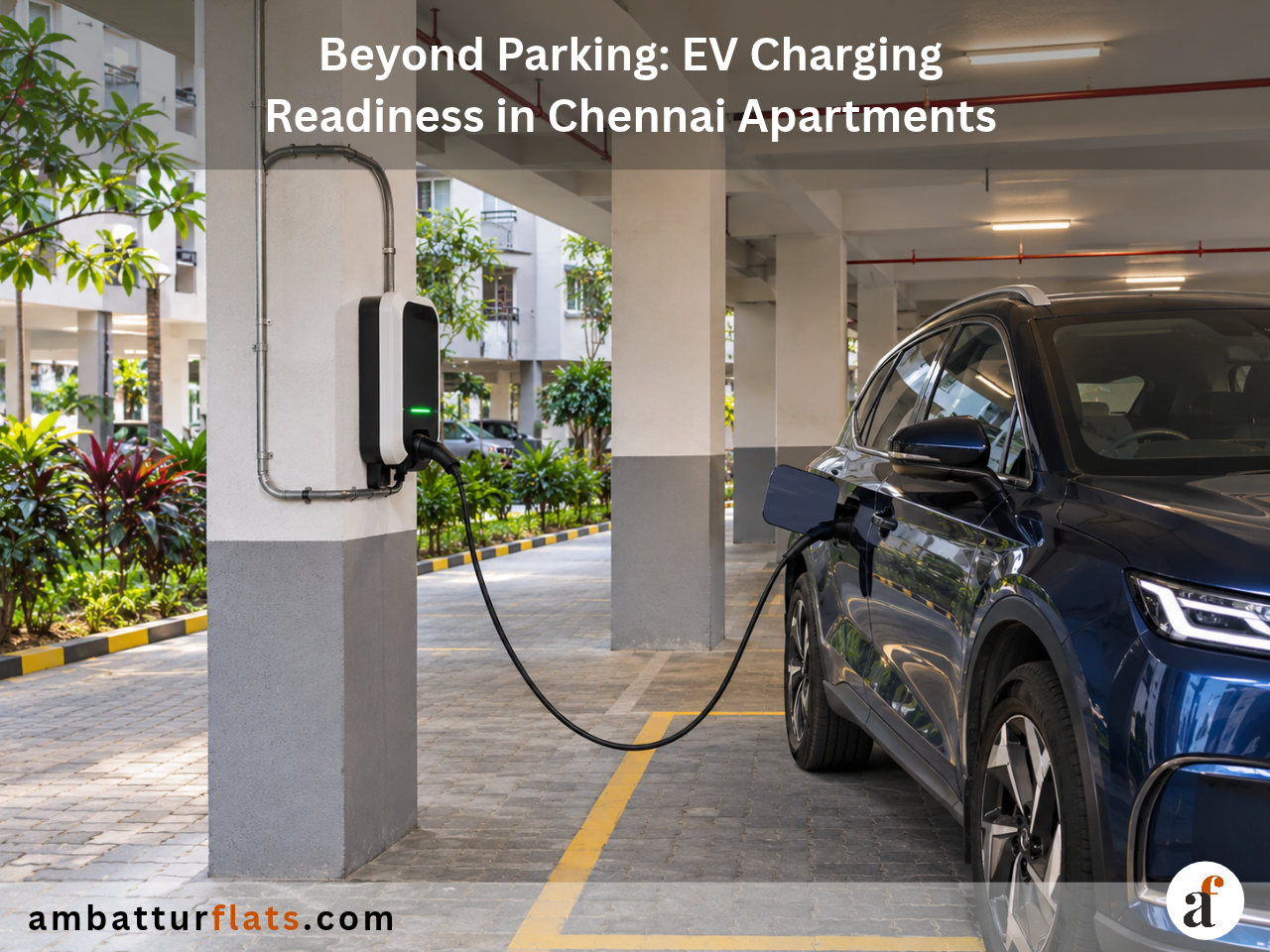

The parking space may already be allotted to you, yet bringing electricity to that spot could require additional wiring, electrical capacity, permissions and expenses.
We ask whether parking is included in the flat's price, but how often do we ask what that parking space can support in the future? Installing a charger after an apartment is occupied could involve the developer, electricity provider and residents' association, even though the vehicle belongs to just one homeowner.
With Tamil Nadu revising its EV charging infrastructure requirements in October 2026, this becomes a relevant consideration for people planning to buy apartments in 2027.
Before booking, understand what EV charging in Chennai apartments actually includes and whether the advertised facility is ready for use or only planned for future installation.
An EV-ready parking space has electrical infrastructure intended to enable the installation of an electric vehicle charging point.
This may include cable conduits, suitable electrical panel capacity and metering arrangements.
An installed EV charger, on the other hand, is actual charging equipment that has been connected and, when properly commissioned, can supply electricity to a compatible vehicle.
"The builder says EV charging is available. Does that mean I can use it immediately?"
Not necessarily. A developer may have provided wiring provisions without installing the charging equipment. Ask whether a charger is operational, whether your allotted parking space can access it and what additional installation or payment is required.
There is a meaningful difference between a parking facility prepared for charging and one where residents can already plug in their vehicles.
The important buyer question is not simply "Does this apartment have EV charging?" It is "What exactly will I receive when I take possession?"
Tamil Nadu amended its Combined Development and Building Rules through G.O. Ms. No. 194, dated 26 October 2026.
The amendment revised the EV charging provision originally introduced on 30 October 2025.
Under the revised rule, qualifying residential buildings must provide adequate electrical infrastructure, including cabling conduits, panel capacity and metering, to enable EV charging-point installation at the required car and two-wheeler parking spaces.
The revised provision also addresses infrastructure capable of enabling fast charging in visitor parking for residential buildings with more than 50 dwelling units.
The change can be verified through the Tamil Nadu Government's October 2026 building-rule amendment.
The Tamil Nadu building-rule amendment dated 26 October 2026 excludes certain smaller residential buildings from the EV charging infrastructure requirement. The exemption wording refers to buildings up to 14 metres in height, eight dwelling units or 750 square metres of built-up area.
"I'm buying a flat in a six-unit apartment. Will EV charging infrastructure be compulsory?"
A six-unit building may fall within the exemption. However, buyers should verify how the provision applies to the project's approved height, built-up area and building category.
Even where the requirement does not apply, buyers can ask whether the developer has voluntarily provided conduits and electrical capacity for future EV charging.
The October 2026 amendment also provides for infrastructure enabling fast charging at a minimum of 50% of visitor car and two-wheeler parking spaces in residential buildings exceeding 50 dwelling units.
This refers to charging infrastructure readiness. It should not be interpreted as a promise that half the visitor spaces will automatically contain operational fast chargers.
"Does this mean the builder must give every resident a free EV charger?"
No. Providing electrical infrastructure that enables future charger installation is different from supplying a charger to every homeowner without additional cost.
Before booking, ask which facilities are included in the approved project specifications and whether any additional payment is required.
An electric vehicle requires a suitable electrical connection, appropriate protection and sufficient capacity for its charging arrangement.
Electrical load capacity refers to the power an installation is designed and permitted to supply under specified conditions.
Apartment complexes also require electricity for lifts, water pumps, common-area lighting and other essential facilities. Charging multiple electric vehicles adds another demand that must be considered during electrical planning.
"There is already a plug point near my parking slot. Can't I just charge my car there?"
Do not assume an ordinary parking socket is suitable for regular EV charging. The required wiring, protective devices, socket or charger rating and available capacity depend on the vehicle and the installation.
Ask whether the building has dedicated charging circuits and what arrangements are available for individual parking spaces.
A qualified electrical professional should assess a proposed charging connection. Improvised extension cables and unsuitable wiring can create electrical and fire hazards.
A socket is visible during a site visit, but the capacity and safety of the electrical system behind it are not. That is why a technical explanation is more useful than merely being shown a power point.
EV charging installation is not always included in the apartment's purchase price.
The total expense can involve the charging equipment, dedicated cable runs, protective devices, installation work and any necessary electrical upgrades.
"Will installing a charger cost the same if my parking space is near the electrical room or at the other end of the basement?"
Not necessarily. A longer wiring route may require more cable, additional installation work and a review of voltage drop and protective arrangements. Existing electrical capacity and the chosen charger also influence the cost.
For example, a basic lower-powered charging arrangement and a dedicated 7.4 kW charger should not be treated as having identical installation requirements or prices.
Rather than relying on one advertised installation package, request an itemised estimate covering the equipment, wiring distance, electrical protection, labour and any applicable connection changes.
Before comparing installation quotations, find out which parts of the electrical infrastructure are already included in the apartment's specifications. If cable conduits and sufficient panel capacity are provided, the buyer may need to arrange less additional work than in a building without these provisions.
Ask the developer to distinguish between infrastructure included in the project, equipment that must be purchased separately and electrical work that the homeowner will need to fund.
Two flats may come with similarly sized parking spaces, but the work needed to make those spaces EV-ready could be very different. That cost may remain invisible until a homeowner actually tries to install a charger.
Before booking, clarify whether the building already provides the necessary infrastructure or whether you will be paying to create it later.
The way charging electricity is measured can affect the amount a homeowner pays.
EV charging metering means measuring electricity consumed during vehicle charging so that costs can be allocated or billed appropriately.
Charging arrangements may involve an individual domestic connection, an approved separate connection or an apartment-managed charging system.
Tamil Nadu's published electricity tariff schedules include a separate LT-VII category for public EV charging stations. However, private apartment charging may use different authorised arrangements.
Buyers should confirm whether charging electricity will be billed through their domestic connection, a separately approved connection or an apartment-managed charging system. The applicable tariff and connection requirements should be verified with the electricity distribution utility.
"If I charge my electric car using my flat's electricity connection, will my household bill increase?"
Yes, the additional electricity consumed will contribute to that connection's metered usage. Depending on the applicable domestic tariff structure, this can also affect the billing slab.
Where an eligible, separately approved EV charging connection is used, the relevant tariff and billing conditions may differ.
Ask whether charging electricity will be billed through your domestic meter, a separate approved connection or a shared charging service.
For the latest approved tariff, refer to the applicable Tamil Nadu Electricity Regulatory Commission orders rather than relying on an older per-unit rate.
"If I charge my vehicle in the apartment basement, will everyone have to share the electricity cost?"
Not necessarily. Costs may be allocated to individual users through suitable metering or managed charging arrangements. Maintenance expenses for common charging equipment may be handled separately.
Ask how electricity consumption will be recorded, who issues the bill and whether charging involves additional service or maintenance fees.
Our guide to parking problems in Chennai apartments explains why ownership and usage arrangements in shared parking areas deserve careful attention.
A reserved parking slot does not automatically establish permission to connect private electrical equipment to common-area electricity.
Not everyone buying an apartment in Chennai currently owns an electric vehicle.
But a home is usually a longer-term purchase than a car or scooter. Vehicle preferences may change while the homeowner continues living in the same property.
"I drive a petrol car and have no plan to buy an EV. Why should I worry about charging facilities now?"
Because electrical infrastructure may be easier to accommodate during building construction than after residents have moved in.
Adding new cable routes or upgrading shared electrical equipment later could involve technical work, additional costs and approvals.
That does not mean an apartment with EV charging readiness will necessarily have better resale appreciation. Such a claim would require reliable market evidence.
The more useful consideration is whether the building provides flexibility for future needs.
This fits into a broader assessment of how infrastructure influences property value and usability in Chennai.
An apartment's value to its residents depends partly on how easily it can accommodate changes in everyday living, not only on the amenities advertised at launch.
EV charging equipment may require servicing, repairs, software support or replacement over time.
Responsibility depends on who owns and operates the charging equipment.
A personal charger connected to an individual arrangement may be maintained differently from a shared charger operated by the apartment association or a third-party provider.
"If the charging point stops working after the developer hands over the building, who should repair it?"
Ask whether the charger is individually owned, developer-provided or part of the common facilities.
Review the available warranty terms, service arrangements and maintenance responsibilities.
For shared systems, also clarify how servicing expenses will be handled and who residents should contact when the equipment fails.
The process of transferring common facilities is discussed in our guide to apartment handover in Chennai.
Installing a charging facility may be a one-time expense, but maintaining it is an ongoing responsibility. Buyers should understand both before treating EV charging as a valuable amenity.
Two apartments may advertise EV charging readiness, but the electrical infrastructure provided at possession can differ significantly.
For example, one project may offer only cable conduits, another may provide conduits with panel capacity and metering arrangements, while a third may include installed and commissioned charging equipment.
These differences influence how much additional work a homeowner may need to arrange.
| Infrastructure provided | What the buyer still needs to verify |
| Cable conduits only | Wiring, available electrical capacity, metering and charger installation |
| Conduits, panel capacity and metering provisions | Charger compatibility, installation work, connection approval and additional costs |
| Installed and commissioned charger | Parking access, electricity billing, equipment warranty and maintenance |
These are illustrative arrangements, not specifications of particular apartment projects.
"The salesperson says EV charging will be provided later. What should I ask for?"
Request written confirmation of the equipment or infrastructure promised, the expected installation arrangements, the applicable charges and who will be responsible for completing the work.
Before booking, compare what is already provided against what the homeowner must arrange independently.
For other essential property checks, refer to the homebuyer property verification checklist.
The October 2026 amendment makes EV charging readiness a timely consideration for buyers assessing residential developments.
But the new provision should not lead buyers to assume that every apartment advertised in 2027 will have an installed charger.
A buyer looking at a newly approved large apartment project may face different requirements from someone considering an older, completed or smaller residential building.
In areas such as Ambattur, Mogappair and Anna Nagar, the same basic verification applies: Does the building have suitable infrastructure, what does the buyer receive and what must be arranged separately?
"Can I assume a newly launched apartment in 2027 will automatically have EV charging facilities?"
No. The applicable building rules, approval circumstances and actual project specifications must be examined.
A new launch date alone does not establish that a project satisfies every recently amended requirement or includes an operational charging facility.
Before making a comparison, separate three questions:
That gives buyers a more useful basis for evaluating the property than the phrase "EV charging available" in a brochure.
A reserved parking space tells you where your vehicle can be kept. EV charging readiness tells you whether that space has the electrical provisions needed for a different kind of vehicle ownership.
For people comparing apartments in Chennai, this is one more building-level feature worth evaluating alongside price, location, approvals and maintenance.
What matters is not simply whether EV charging appears in the amenity list, but whether the infrastructure is usable, documented and suitable for the building.
Understanding that difference before booking may prevent unexpected installation work and unclear financial responsibilities after possession.
Is Your Parking Space EV-Ready?
Ask for the project's EV charging and parking specifications before finalising your flat.
It may be possible if suitable electrical capacity, wiring routes and parking arrangements are available. Installation may also require relevant permissions and electrical safety checks. A qualified professional should assess feasibility before work begins.
Yes. Buyers can ask the developer for available electrical plans, EV charging provisions, equipment specifications and relevant approvals. If technical drawings cannot be shared, request a written explanation from the project engineer identifying what infrastructure is included and what additional installation work may be required.
Not in every arrangement. The applicable metering method depends on the approved connection, the charging system and electricity distribution requirements. Buyers should confirm how their usage will be measured and billed.
The October 2026 rules specify exemptions involving building height, dwelling units and built-up area. The requirements applicable to a particular six-unit project should be verified against the full regulation and its approval circumstances.
Feasibility depends on electrical capacity, equipment requirements, available space, safety provisions and permissions. A parking space with ordinary charging readiness should not automatically be assumed capable of supporting fast charging.