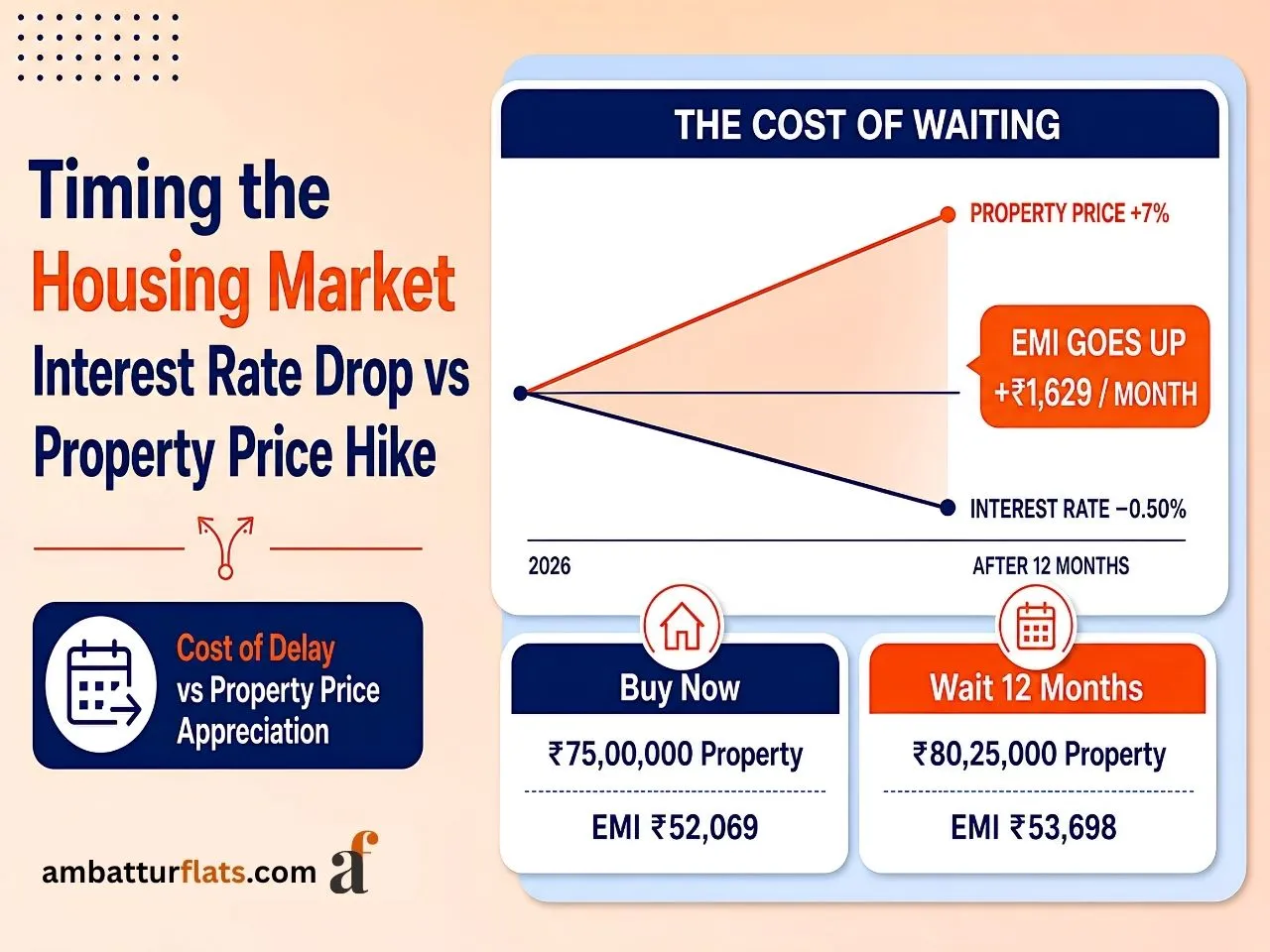
Timing the Housing Market: Interest Rate Drop vs Property Price Hike

[DISCLAIMER]: Macroeconomic forecasts, interest rate projections, and property appreciation estimates are indicative and subject to market volatility. Homebuyers should prioritize long-term financial readiness and personal housing requirements over short-term market timing.
Prospective property buyers in 2026 frequently find themselves standing at a financial crossroads: should you defer your home purchase in anticipation of future central bank interest rate cuts, or lock in a property immediately? While holding out for lower Equated Monthly Installments (EMIs) appears logical on paper, real-world real estate dynamics often reveal a striking paradox. Waiting for home loan rates to drop can significantly increase your total cost of homeownership when local property price inflation outpaces interest rate relief.
When analyzing the current residential ecosystem alongside current monetary policies, calculating the interplay between capital appreciation, rental cash outflows, and floating rate mechanisms is critical. Exploring a comprehensive guide to home financing in Chennai provides foundational clarity on how these broader macro trends translate directly into local real estate purchasing decisions.
RBI Monetary Policy Stance: The Reserve Bank of India’s benchmark repo rate stands at 5.25% in 2026. While rate cuts remain possible over longer monetary cycles, policy remains paused to manage inflation.
Capital Appreciation Realities: Residential property prices in major Indian metro markets appreciate at a steady average pace of 6% to 10% per annum, driven by infrastructure delivery and supply constraints.
Automated Rate Transmission under EBLR: All floating rate home loans sanctioned by commercial banks are anchored to an External Benchmark Lending Rate (EBLR) linked directly to the repo rate.
Non-Recoverable Waiting Costs: Delaying a purchase by 12 to 18 months incurs recurring, non-recoverable rental expenses alongside rising raw material costs (steel, cement, labor).
The Net Math Deficit: A minor 0.25% to 0.50% drop in interest rates reduces loan interest costs marginally, but a 6% to 8% jump in baseline property cost increases both the principal borrowing requirement and down payment size permanently.
To evaluate market timing accurately, buyers must measure potential interest rate savings against property price inflation. Consider a scenario where a buyer is eyeing a property valued at ₹75,000,000 (₹75 Lakhs) in 2026.
Scenario A: Buy Immediately in 2026
Property Cost: ₹75,000,000
Down Payment (20%): ₹15,000,000
Home Loan Amount (80%): ₹60,000,000
Floating Interest Rate: 8.50% per annum
Loan Tenure: 20 Years
Monthly EMI: ₹52,069
Total Interest Payable over 20 Years: ₹64,96,560
Scenario B: Wait 12 Months for a 0.50% Rate Cut
Assuming property prices appreciate by a conservative 7% over the next year, while the RBI lowers interest rates, giving you an 8.00% loan rate:
Revised Property Cost (7% appreciation): ₹80,25,000
New Down Payment (20%): ₹16,05,000 (Requires ₹1,05,000 extra cash upfront)
New Home Loan Amount (80%): ₹64,20,000
Lower Interest Rate: 8.00% per annum
Loan Tenure: 20 Years
Monthly EMI: ₹53,698
Total Interest Payable over 20 Years: ₹64,67,520
The Financial Verdict:
By waiting 12 months, the buyer secured a lower interest rate (8.00% vs. 8.50%). However, because the underlying property cost increased by ₹525,000, the required down payment rose by ₹1,05,000, and the required monthly EMI actually increased by ₹1,629 per month. The tiny lifetime interest saving of ₹29,040 is completely erased by the higher initial cash layout and increased total loan principal. Understanding how RBI repo rate changes impact home loan interest rates highlights why trying to time rate drops rarely neutralizes underlying property appreciation.
One of the biggest misconceptions among property buyers is that locking in a home loan today freezes you out of future interest rate reductions. Under regulations mandated by the RBI, all retail floating rate home loans are tied to external benchmark rates, primarily the RBI Repo Rate.
When you take out an EBLR-linked floating home loan, your bank is legally obligated to pass on policy rate reductions to your loan contract during mandatory reset windows (typically every 3 months).
Continuous Rate Alignment: If you buy today at an 8.50% interest rate and the RBI cuts repo rates by 50 basis points six months from now, your bank automatically lowers your home loan interest rate to 8.00%.
Capitalizing on Base Prices: Buying now locks in the current purchase price of the property while allowing you to capture future rate cuts effortlessly.
For a deep dive into loan structure selection, review our guide on choosing floating interest rates to capture future rate cuts to understand reset frequencies, bank spreads, and conversion terms.
Beyond the mathematical gap between property price growth and rate cuts, waiting introduces secondary financial drains that erode your net worth:
Cumulative Outflow of Unrecoverable Rent: If you pay ₹25,000 in monthly rent while waiting 18 months for interest rates to drop, you spend ₹450,000 in non-recoverable housing costs. This expense directly reduces the capital available for your home down payment.
Input Cost Inflation: Construction materials, labor charges, and municipal approval fees systematically rise over time. Developers pass these cost increases directly onto buyers in subsequent project phases.
Shrinking Inventory & Prime Units: Prime units—such as corner apartments, park-facing layouts, or lower floor preferences—sell first. Waiting often leaves buyers choosing from compromise units at higher price points per square foot.
Instead of attempting to time volatile macroeconomic policy cycles, evaluate your personal readiness using these structural financial benchmarks:
CIBIL Score Above 750: A strong credit score qualifies you for the lowest spread offered by lenders above the RBI repo rate.
Stable Income & Manageable FOIR: Ensure your total monthly debt obligations (Fixed Obligation to Income Ratio, or FOIR) remain under 40% to 50% of your net monthly salary. Assessing your debt limits via evaluating home loan eligibility and monthly EMI affordability ensures your loan remains comfortable throughout rate cycles.
Emergency Fund Intact: You have accumulated a 20% down payment alongside stamp duty and registration fees without exhausting your 6-month contingency fund.
Fair Valuation Secured: You have identified a property priced at or below prevailing micro-market rates with transparent legal documentation.
When these four personal financial criteria are met, buying property immediately under an EBLR floating loan structure yields superior long-term wealth creation compared to waiting for speculative rate cuts.