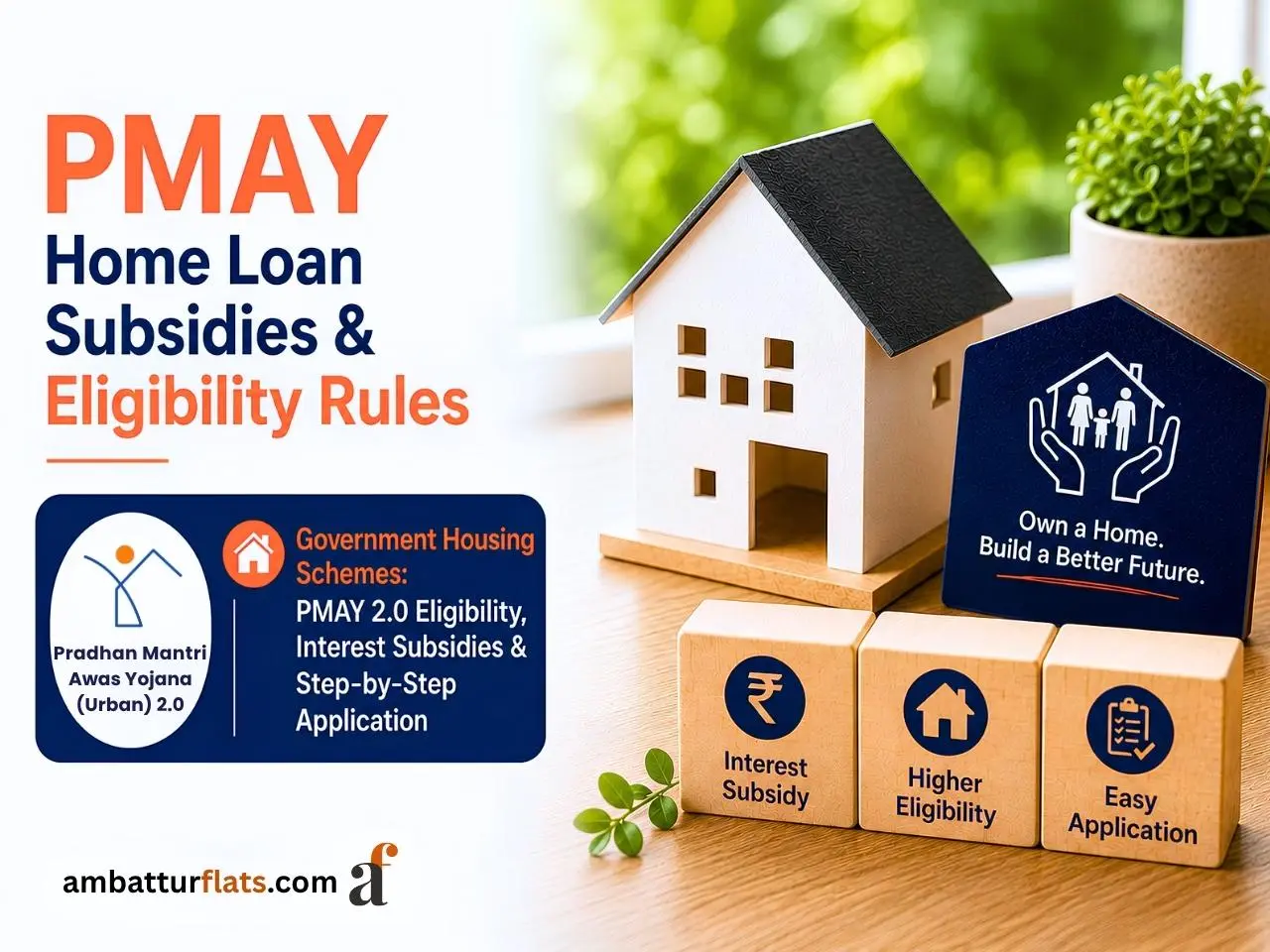
How to Claim PMAY Home Loan Subsidies & Eligibility Rules
[DISCLAIMER]: Scheme guidelines, income eligibility thresholds, interest subvention rates, and subsidy disbursement timelines under Pradhan Mantri Awas Yojana (PMAY) are subject to periodic updates by the Ministry of Housing and Urban Affairs (MoHUA) and state housing boards. Confirm current criteria on official portals prior to application.
Navigating the financial road to homeownership can often feel overwhelming, but government-backed housing welfare initiatives in India significantly reduce the financial barrier for first-time buyers. Central to this effort is the flagship Pradhan Mantri Awas Yojana (PMAY), managed by the Ministry of Housing and Urban Affairs (MoHUA). Designed to address urban and rural housing shortages, PMAY makes property acquisition affordable through direct capital grants and interest rate subventions.
Under the current PMAY Urban 2.0 (PMAY-U 2.0) framework, eligible families can substantially reduce their effective borrowing costs. By lowering the principal balance on long-term housing finance, these government subsidies decrease monthly Equated Monthly Instalments (EMIs) and total interest payouts over the life of the loan. Whether you are buying an apartment in a fast-growing city or constructing a home on ancestral land, consulting a complete home financing guide for Chennai property buyers helps you understand how public subsidy frameworks seamlessly integrate with institutional home loans.
First-Time Homebuyer Mandate: Applicants and their beneficiary family members (spouse and unmarried children) must not own a pucca (permanent) house anywhere in India.
Target Income Categories: Covers Economically Weaker Sections (EWS), Low Income Groups (LIG), and Middle Income Groups (MIG) with annual household incomes up to ₹9 Lakhs under PMAY-U 2.0.
Maximum Interest Subsidy: Eligible borrowers can receive an interest subsidy benefit of up to ₹1.80 Lakhs, calculated at a Net Present Value (NPV) discount rate.
Mandatory Female Ownership: Title deeds for EWS and LIG categories must include an adult female family member as sole or joint owner, subject to limited legal exceptions.
Direct Credit Mechanism: The calculated subsidy amount is credited upfront directly into the borrower's home loan account by primary lending institutions, immediately reducing the outstanding principal.
Property and Loan Limits: PMAY-U 2.0 covers home loans up to ₹25 Lakhs for residential properties valued up to ₹35 Lakhs with carpet areas up to 120 square meters.
To ensure welfare benefits reach the intended demographic, MoHUA classifies eligible households into distinct income categories based on total gross annual household income. A beneficiary family comprises a husband, wife, and unmarried sons or daughters.
Economically Weaker Section (EWS): Families with an aggregate annual income of up to ₹3.00 Lakhs. This tier receives priority allocation under housing grants and interest subventions.
Low Income Group (LIG): Households with an annual income exceeding ₹3.00 Lakhs and up to ₹6.00 Lakhs.
Middle Income Group (MIG): Households with an annual income between ₹6.00 Lakhs and ₹9.00 Lakhs under the PMAY-U 2.0 Interest Subsidy Scheme.
Before starting your home purchase journey, evaluating home loan eligibility based on household income is a vital step to verify whether your aggregate earnings meet the specific slab requirements. The primary non-negotiable eligibility rule across all slabs is that no member of the beneficiary family should own an all-weather pucca residential dwelling in any part of the country. Additionally, applicants must self-certify that they have not claimed central housing subsidies under any state or central scheme during the preceding 20 years.
A cornerstone of the Pradhan Mantri Awas Yojana is social empowerment through property ownership. For properties falling under the EWS and LIG categories, PMAY guidelines mandate that property registration and title deeds MUST include an adult female family member.
Ownership can be structured as:
Sole ownership in the name of an adult female.
Joint ownership featuring an adult female (e.g., husband and wife co-owning the property).
This mandatory rule ensures that women gain legal asset ownership, boosting financial security and social status within urban and rural communities. The only permissible exceptions to the mandatory female ownership rule occur in households where there is no surviving adult female family member—such as cases involving widowers, unmarried male applicants, or male-headed households with no adult female dependents. For construction on existing land or property expansion where land is already registered solely in a male member's name, relaxation norms may apply per state housing board rules.
The Interest Subsidy Scheme (ISS) operates by lowering the net borrowing burden for the homebuyer. Rather than issuing monthly reimbursement cheques, the government calculates the Net Present Value (NPV) of the interest subvention over the loan tenure using a standardized discount rate (currently 8.5%).
Once sanctioned, the Central Nodal Agencies (such as the National Housing Bank - NHB or HUDCO) release the lump-sum subsidy amount to your primary lending institution (bank or Housing Finance Company). The lender immediately credits this entire lump-sum subsidy directly into your housing loan principal account.
For instance, if you take a home loan of ₹20 Lakhs and qualify for an NPV subsidy credit of ₹1.80 Lakhs, your loan balance is immediately reduced to ₹18.20 Lakhs. Your monthly EMI is then recalculated based on this lower remaining balance.
Smart borrowers can amplify these financial gains even further. By combining PMAY interest subsidies with Section 80C and Section 24b tax benefits, you can deduct up to ₹2 Lakhs in home loan interest under Section 24(b) and up to ₹1.5 Lakhs in principal repayments under Section 80C, drastically reducing your tax liabilities alongside your monthly EMI.
Claiming your housing subsidy involves a structured application path coordinated between your bank and the central portal:
Loan Application & Inclusion: Apply for a home loan with a participating Primary Lending Institution (PLI)—including major public/private banks or Housing Finance Companies (HFCs). Inform the lender during loan processing that you intend to claim PMAY subsidy benefits.
Portal Registration & Document Verification: Register your application on the PMAY Unified Web Portal or through authorized Common Service Centres (CSCs). Ensure you have all required paperwork in order. Having the essential documents needed for housing loan approval—such as Aadhaar details for all family members, income proof, property title deeds, and a self-declaration affidavit—prevents processing holds.
Aadhaar Seeding & Verification: The system performs mandatory Aadhaar-based deduplication checks to verify that no family member has previously availed of housing subsidies anywhere in India.
Geo-Tagging & Site Inspection: For home construction or incremental housing, local authorities perform mandatory geo-tagging of the site before issuing subsidy installments.
Central Nodal Agency (CNA) Approval: The PLI submits your verified application to a designated CNA (like NHB or HUDCO). Upon audit and approval, the CNA releases funds to the bank for upfront credit to your loan account.
Application Tracking: You can track your application status online via the official PMAY portal using your Application ID and registered mobile number.
While PMAY offers substantial financial relief, administrative oversights can stall or disqualify an application. Understanding these common pitfalls helps ensure a smooth approval process:
Previous Property Ownership: If municipal or land registry databases indicate that any family member named on the application owns a pucca house in India, the application is automatically flagged and rejected.
Inconsistent Name and Aadhaar Details: Minor spelling discrepancies between your Aadhaar card, PAN card, bank records, and property purchase agreement cause system failures during central deduplication checks.
Non-Compliance with Female Ownership Rules: Submitting EWS or LIG applications without including an adult female as sole or joint property owner results in immediate rejection unless valid legal exemption documentation is attached.
Exceeding Income or Property Caps: Submitting a subsidy request where the overall household income exceeds the threshold, or where the home loan exceeds ₹25 Lakhs or property value exceeds ₹35 Lakhs, renders the file ineligible under ISS guidelines.
Balance Transfers Before Subsidy Disbursement: Switching your loan to another lender before the subsidy is processed by your original bank can forfeit your claim under standard guidelines.