

Global conflicts often feel distant from everyday life in Chennai. However, large geopolitical events can influence the local economy in ways that are not immediately obvious. One such example is the impact of a potential Middle East war on the Indian economy and, eventually, the property market.
The connection may seem indirect at first. But when you follow the chain from oil prices to construction costs and inflation, the relationship becomes clearer. For homebuyers and investors in Chennai, understanding this connection helps explain why property prices sometimes rise even when local demand remains stable.
This article explains how a conflict in the Middle East could affect Chennai’s real estate market and what buyers should watch in the coming months.
The Middle East plays a critical role in global energy supply. A large portion of the world’s oil shipments pass through the Strait of Hormuz, a narrow shipping route between the Persian Gulf and the Arabian Sea.
India depends heavily on oil imports from this region. Nearly 90% of India’s crude oil needs are imported, and more than half of that supply comes from Middle Eastern countries.
This means any disruption in that region can quickly affect energy prices in India.
Recent geopolitical tensions have already demonstrated how sensitive global markets are. During the latest escalation, Brent crude prices briefly crossed $100 per barrel, creating pressure on currencies and stock markets across Asia.
For a country like India, which imports most of its energy, higher oil prices can influence several parts of the economy.
The most immediate effect of geopolitical conflict in oil-producing regions is an increase in global crude prices.
Fuel prices influence multiple sectors in India. Transportation, manufacturing, logistics, and power generation all depend on energy. When oil prices rise, operating costs increase across these industries.
Economists estimate that a sustained increase in crude oil prices can raise India’s inflation rate and widen the country’s current account deficit, putting pressure on the rupee and overall economic growth.
Even a modest oil price increase can push inflation upward. Analysts estimate that a 10% rise in crude prices could increase India’s inflation by around 30 basis points.
Several of these materials are energy intensive to produce or transport.
Industry experts note that rising fuel costs often lead to higher construction and logistics expenses, particularly in sectors like cement, glass, ceramics, and transportation.
In practical terms, this means developers may face higher costs when building new housing projects.
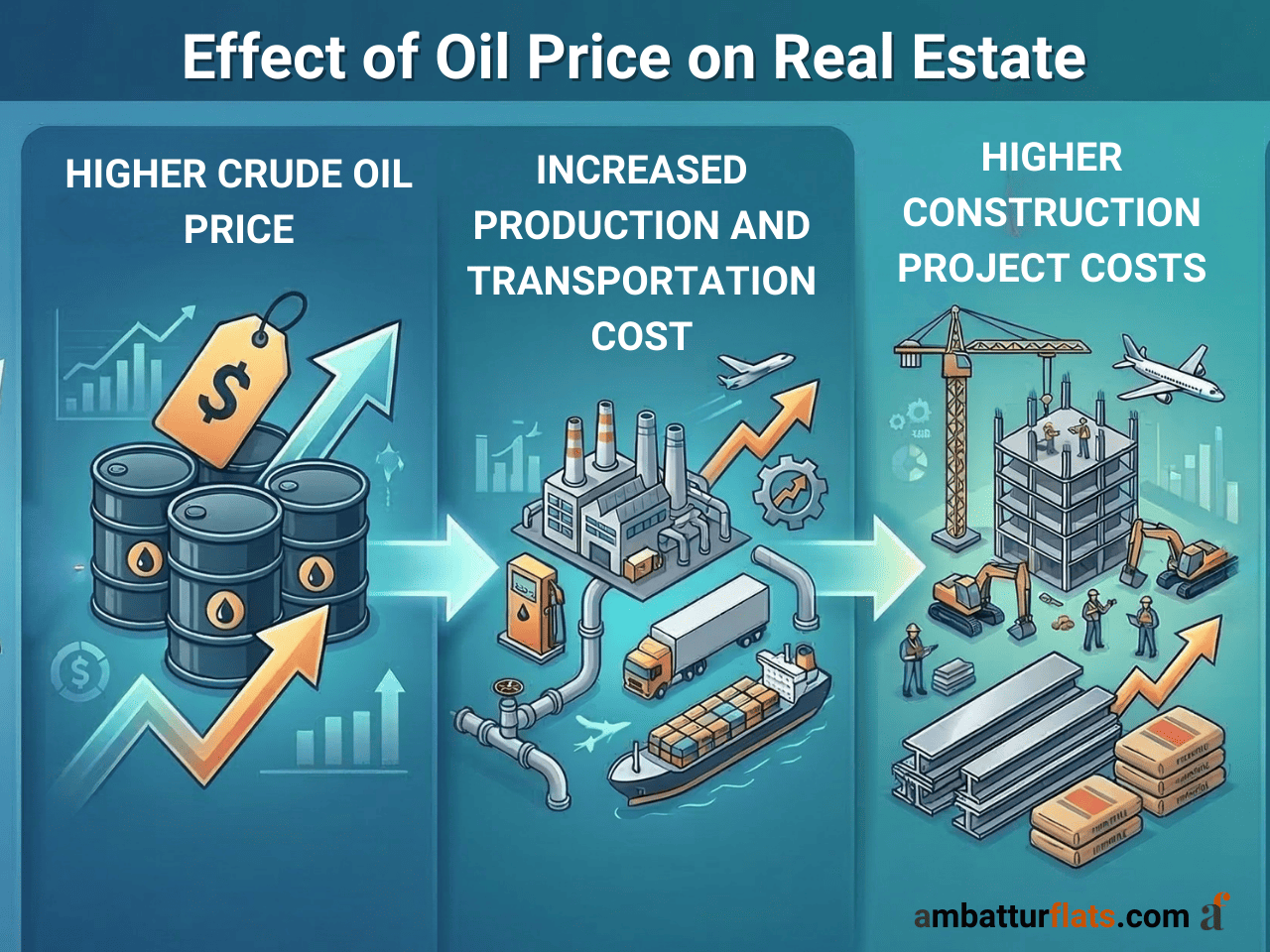
When construction costs rise, developers face two options:
In most cases, developers adjust prices gradually during new project launches rather than increasing prices for ongoing projects. This helps them maintain profitability while keeping existing commitments intact.
Chennai’s housing market, by contrast, is largely driven by buyers who plan to live in the homes they purchase. This creates a more stable demand pattern.
If oil prices remain elevated for a prolonged period, construction material manufacturers may also increase prices. Cement companies, for example, may pass on cost increases to maintain operating margins.
Over time, these cost adjustments are reflected in the pricing of new residential projects.
Inflation is another important factor that connects global conflicts to property markets.
When inflation rises, central banks often respond by adjusting interest rates to control price increases.
The Reserve Bank of India keeps inflation within a target range of 2% to 6%, and any persistent rise in energy costs could influence monetary policy decisions.
Higher interest rates can slow down housing demand because home loan EMIs increase. At the same time, rising construction costs push developers to raise prices.
These two forces sometimes move in opposite directions:
The final outcome depends on which factor dominates the market.
Chennai’s housing market has shown steady growth over the past few years. Recent reports indicate that average residential prices in the city increased about 7% year-on-year, reaching roughly ₹4,854 per square foot.
Demand has also remained strong. In 2025, Chennai recorded a 15% increase in housing sales, reaching more than 22,000 units sold across the city.
Unlike some other metropolitan markets, Chennai’s property sector is largely driven by end users rather than speculative investors. This tends to create a more stable price environment.
Several growth corridors have played an important role in this expansion.
Old Mahabalipuram Road remains one of the most active residential corridors in Chennai. Average property prices in some parts of OMR are around ₹6,600 per square foot, supported by demand from IT professionals.
Areas such as Porur, Pallavaram, and Medavakkam are also seeing strong development due to metro expansion, improved road infrastructure, and proximity to employment hubs.
This steady demand provides developers with the confidence to launch new projects even when external economic conditions fluctuate.
Despite these global risks, several factors support the long-term stability of Chennai’s property market.
Unlike some speculative markets, most buyers in Chennai purchase homes for personal use. This reduces the risk of sharp price fluctuations. Property prices in Chennai have historically increased at a measured pace compared to cities like Mumbai or Bengaluru.
Major projects such as Chennai Metro Phase 2 and improved road connectivity continue to expand residential growth corridors. These structural factors help maintain market stability even when external economic pressures arise.
For buyers planning to purchase property in Chennai, global conflicts are only one part of the larger economic picture.
Instead of focusing solely on geopolitical events, buyers should monitor a few key indicators.
Understanding these indicators helps buyers make more informed decisions about when and where to purchase property.
A Middle East war does not directly determine property prices in Chennai. However, it can trigger economic changes that eventually influence the real estate market.
For Chennai’s property market, the long-term drivers remain strong. Steady employment growth, expanding infrastructure, and consistent end-user demand continue to support residential development across the city.
Global events may influence short-term trends, but the fundamentals of the Chennai housing market still depend largely on local economic activity and urban development.