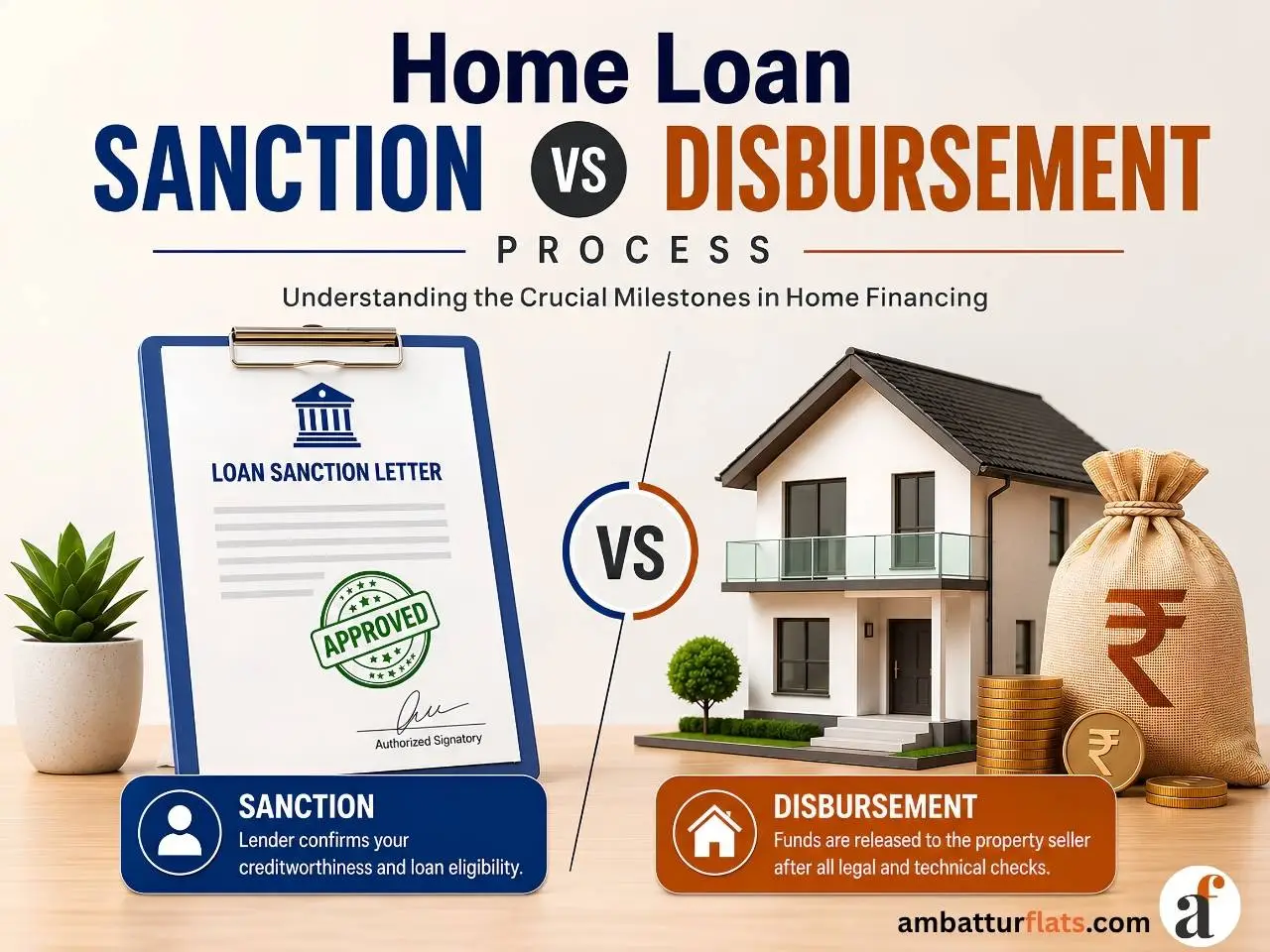
Home Loan Sanction vs Disbursement Process

[DISCLAIMER]: Loan sanction terms, validity periods, legal valuation checks, and disbursement conditions are determined independently by individual banks and Housing Finance Companies (HFCs). A loan sanction does not guarantee final disbursement if property title or technical requirements are not satisfied.
Securing financing for a home involves navigating a series of formal banking milestones. First-time homebuyers frequently confuse receiving an official home loan sanction letter with the actual disbursement of funds. While these two stages represent major approval hurdles, they serve entirely distinct purposes within the lending lifecycle.
A home loan sanction is the lender’s formal confirmation of your personal creditworthiness, indicating how much money the bank is willing to lend you based on your financial credentials. In contrast, loan disbursement is the physical transfer of approved funds to the property seller or real estate developer after rigorous property-level verification. Understanding the functional, legal, and operational boundaries between sanction and disbursement ensures you manage transaction timelines smoothly, avoid financial defaults, and navigate pre-EMI interest obligations with confidence. For a broader overview of structuring your property purchase, explore our comprehensive Chennai home loan resource.
Primary Approval Trigger: Sanction evaluates the borrower's personal income, age, credit history, and existing financial obligations. Disbursement evaluates the property's legal title, structural progress, and valuation.
Financial Commitment: A sanction letter states conditional intent to lend; disbursement represents the binding execution of funds release.
Validity Timeframes: Sanction letters remain valid for 3 to 6 months. Disbursement occurs either in a single lump sum or across multiple construction-linked installments spread over several years.
Legal and Technical Prerequisite: Sanction requires no property verification. Disbursement cannot proceed without clear title search reports, approved building plans, and physical site inspections.
Repayment Commencement: No interest or Equated Monthly Installment (EMI) is charged upon receiving a sanction letter. Interest accruals or pre-EMI payments begin only after the first disbursement check or digital transfer is issued.
A home loan sanction letter is an official document issued by a bank or Housing Finance Company (HFC) confirming in principle that your loan application has been conditionally approved. Lenders issue this letter after performing extensive credit underwriting. During this phase, credit managers assess your CIBIL score, evaluate monthly income stability, calculate existing Debt-to-Income (DTI) ratios, and verify employment credentials. Before applying, it helps to estimate your maximum borrowing capacity by calculating eligibility based on monthly salary.
Key components detailed within a formal sanction letter include:
Sanctioned Loan Limit: The maximum principal amount the bank agrees to lend.
Applicable Interest Rate: The benchmark-linked interest rate structure (such as Repo-Linked Lending Rate spreads) applicable to the loan.
Approved Loan Tenure: The maximum repayment duration offered (typically 15 to 30 years).
Validity Period: The timeframe (usually 90 to 180 days) during which the offer remains valid before requiring credit re-evaluation.
Pre-Disbursement Conditions: Specific stipulations, such as closing open personal loans, providing additional co-applicants, or submitting specific tax records.
A sanction letter gives property buyers the bargaining power to sign purchase agreements or pay booking advances to sellers, knowing their creditworthiness is established with a financial institution. However, it is vital to remember that a sanction letter is not an unconditional guarantee of money; it remains subject to satisfactory property checks.
Home loan disbursement is the final operational phase where the lender transfers funds to the seller, builder, or development authority. The disbursement mechanism varies depending on whether you are buying a ready-to-move property or an under-construction project:
Full Disbursement: Applicable primarily to ready-to-move-in apartments, resale homes, or plot purchases. The lender releases 100% of the sanctioned loan amount in a single payment directly to the seller or vendor upon property registration.
Partial (Tranche-Based) Disbursement: Applied to under-construction properties. Funds are released in installments or "tranches" linked directly to construction milestones verified by civil engineers (e.g., foundation completion, slab casting, brickwork, tiling, and final possession).
Before disbursement occurs, the borrower must execute the formal loan agreement, submit post-dated checks or Electronic Clearing Service (ECS) auto-debit mandates, and pay applicable stamp duty fees. To plan your upfront transaction expenses accurately, review the required payment of stamp duty and registration expenses.
The period between receiving a sanction letter and securing final loan disbursement is known as the verification gap. During this critical window, bank emphasis shifts entirely from the borrower’s income to the physical and legal integrity of the real estate asset being financed.
Lenders deploy empanelled professionals to conduct three mandatory evaluations:
Legal Title Scrutiny: Independent legal counsel verifies 13 to 30 years of parent title deeds, checking for clear ownership chains, unencumbered titles, and valid legal rights. An Encumbrance Certificate (EC) is examined to ensure no existing mortgages, court litigation, or third-party claims taint the property.
Technical Valuation: Empanelled civil engineers or architects physically inspect the project site. They verify that the structure adheres strictly to approved building permits issued by local planning authorities, assess construction quality, evaluate real market value, and estimate completion schedules.
Documentation Audit: The borrower must submit all original title deeds, sale agreements, builder-buyer contracts, mother deeds, tax receipts, and property registration drafts. Ensuring all paperwork is in order requires gathering the mandatory required documentation for legal and technical home loan processing.
If legal defects or plan deviations surface during these audits, the lender will withhold disbursement regardless of how pristine your personal credit score or salary credentials may be.
The timeline between loan sanction and final disbursement is often stressful for homebuyers. A seller or developer may enforce strict payment deadlines, threatening late payment penalties or contract cancellation, while the lending institution refuses to release funds due to pending compliance checks.
Common bottlenecks causing disbursement delays include:
Minor discrepancies in property ownership documents or unrecorded historical land transfers.
Builder delays in securing mandatory statutory clearances, such as No Objection Certificates (NOCs) from fire, water, or environmental boards.
Unapproved construction plan modifications executed by developers without updated municipal sanctions.
Delays in receiving structural progress certificates signed by certified project engineers.
Mismatches between property purchase agreement values and technical valuation limits assessed by the bank.
Homebuyers can minimize these frictions by choosing projects pre-approved (APF) by major financial institutions or ensuring that all legal search reports and parent deeds are scrutinized before executing purchase agreements.
Once partial disbursement begins for an under-construction home, the borrower enters a specific repayment structure. Understanding the distinction between Pre-EMI and Full EMI is critical for managing household budgets during construction delays:
Pre-EMI Mechanics: Pre-EMI is the simple interest charged exclusively on the specific amount disbursed by the bank up to that point. For example, if your total sanctioned loan is ₹50 Lakhs but the bank has disbursed only ₹10 Lakhs for the initial foundation slab, you pay monthly interest calculated strictly on ₹10 Lakhs. Crucially, Pre-EMI payments do not reduce the principal loan amount; they cover borrowing costs during construction.
Full EMI Mechanics: Full EMI payments comprise both principal repayment and interest components, structured to fully amortize the loan over the selected tenure. Full EMI automatically begins after the final disbursement tranche is released upon property completion and possession.
Tranche-Based Full EMI Option: Some lenders permit buyers to start paying full EMIs right from the first disbursement tranche. Under this arrangement, any payment exceeding the simple interest portion goes directly toward principal reduction, shortening total loan tenure and reducing cumulative interest burdens over time.
Evaluating your financial capacity to handle Pre-EMI or Full EMI payments alongside rent obligations during construction ensures smooth financial management through to final property possession.