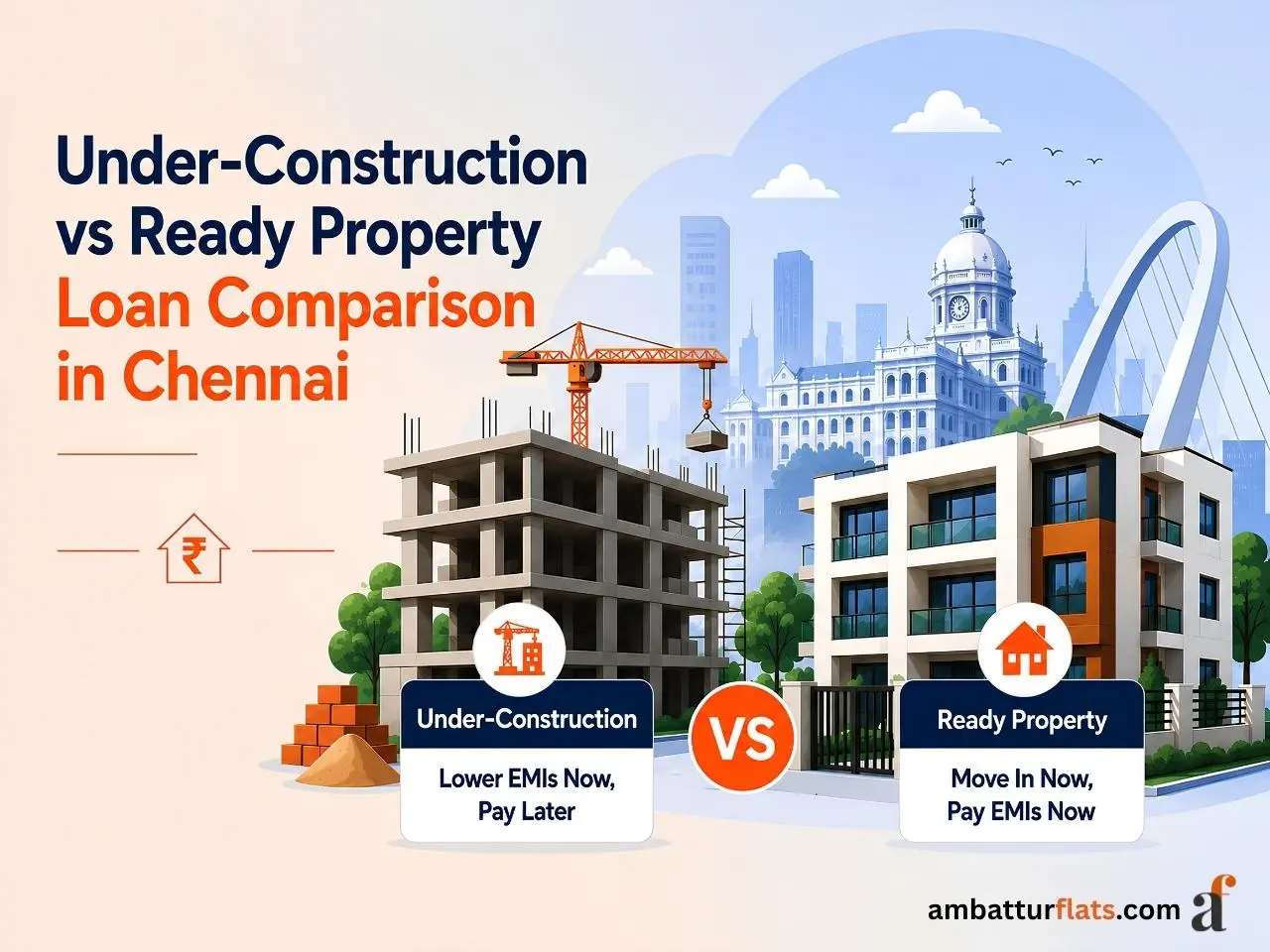
Loan Comparison: Under-Construction vs Ready Flats

Buying a home in Chennai is one of the most significant financial commitments an individual makes. When evaluating the primary residential market, buyers inevitably encounter a crucial crossroads: purchasing an under-construction apartment or opting for a ready-to-move-in property. While initial listing prices often push budget-conscious buyers toward under-construction projects, the financial architecture behind the purchase extends far beyond the base cost per square foot.
The structure of your home loan, payout schedules, interest calculations, tax deductions, and statutory levies like Goods and Services Tax (GST) function completely differently depending on the construction status of the flat. Navigating these differences requires an analytical breakdown of how financial institutions disburse funds, how tax authorities treat interest payments, and how risk factors influence loan approval timelines in Chennai's real estate ecosystem.
Disbursement Model: Under-construction properties follow a Construction-Linked Plan (CLP) with staggered tranche payments, whereas ready flats receive a single lump-sum disbursement.
Monthly Outflow: Under-construction flats allow for Pre-EMI payments (paying interest only on disbursed amounts), while ready-to-move properties require immediate Full EMI payments comprising both principal and interest.
Statutory GST Impact: Under-construction properties attract 5% GST (or 1% for affordable housing under ₹45 lakhs) without Input Tax Credit (ITC). Ready-to-move properties with an Occupancy Certificate (OC) attract 0% GST.
Immediate Tax Benefits: Under Section 24b, interest deductions on self-occupied properties up to ₹2 lakh per financial year are available immediately upon possession. Interest paid during the pre-construction phase must be accumulated and claimed in five equal annual installments starting from the year construction finishes.
Documentation Burden: Ready properties demand stringent legal checks on title deeds and Occupancy Certificates, while under-construction properties heavily rely on builder tie-ups, TNRERA registration, and sanction approvals.
The mechanics of how a bank releases funds directly impact your overall financial exposure.
For a ready-to-move-in apartment, the disbursement process is straightforward. Once title searches, property valuation, and legal vetting are complete, the lending institution disburses the sanctioned loan amount directly to the seller or developer in a single lump-sum payment. Understanding the step-by-step loan disbursement workflow helps buyers manage documentation, stamp duty, and legal registration payments smoothly.
In contrast, an under-construction unit uses a Construction-Linked Plan (CLP). The bank does not release the total loan amount upfront. Instead, disbursement occurs in progressive stages or tranches tied directly to verified civil engineering milestones—such as foundation completion, casting of specific floor slabs, brickwork, plastering, and final handover. The lender inspects the site or requests an engineer's progress certificate before releasing each installment to the builder. This structured payout safeguards the buyer and the bank by ensuring capital is not deployed faster than physical progress.
During the construction phase of an apartment, buyers are given a choice between Pre-EMI and Full EMI payments.
Pre-EMI refers to the payment of simple interest on the loan amount that the bank has disbursed up to that date. For instance, if your sanctioned loan is ₹60 lakh but the bank has only released ₹20 lakh to the builder for early structural work, you pay interest strictly on ₹20 lakh. The primary draw of Pre-EMI is lower initial monthly cash outflows. However, Pre-EMI payments do not reduce your principal loan balance; every rupee paid goes toward interest servicing.
Full EMI involves paying both principal and interest components from the very first disbursement, calculated as if the entire loan were disbursed or based on structured tranches. While this results in a significantly higher monthly outlay during construction, it begins reducing your loan principal immediately, cutting down the cumulative long-term interest burden.
For buyers currently living in rented accommodation, Pre-EMI is often chosen out of necessity to avoid managing full EMIs alongside monthly rent. However, if construction stretches over several years, the total Pre-EMI interest paid adds substantial unproductive overhead to the property's acquisition cost.
Taxes represent a major point of divergence between under-construction and ready-to-move flats in Chennai.
Under Section 24b of the Income Tax Act (applicable under the old tax regime), a buyer can claim up to ₹2 lakh annually on interest paid for a self-occupied home loan. However, tax law dictates that interest deductions cannot be claimed for a property that is under construction. All interest paid during the building phase—known as pre-construction interest—is aggregated. Once the project obtains a Completion Certificate or Occupancy Certificate, this accumulated pre-construction interest can be claimed in five equal annual installments, subject to the overall ₹2 lakh annual limit alongside current-year interest.
From a statutory tax perspective, GST adds a distinct cost layer. Under-construction residential properties carry a 5% GST rate (or 1% for affordable housing units valued up to ₹45 lakh with carpet area within prescribed limits) without Input Tax Credit. This 5% GST applies to the agreement value and directly increases your total cash outflow. Conversely, ready-to-move-in flats holding an Occupancy Certificate issued by local planning authorities are completely exempt from GST (0%).
Financial institutions evaluate risk profiles differently across these two property stages.
When processing loans for under-construction units, Chennai banks focus heavily on regulatory compliance and developer credibility. Lenders require mandatory registration with the Tamil Nadu Real Estate Regulatory Authority (TNRERA) along with planning permissions from the Chennai Metropolitan Development Authority (CMDA) or the Directorate of Town and Country Planning (DTCP). Evaluating property location and bank valuation impact reveals how local master plan compliance and infrastructure approval status directly dictate loan-to-value (LTV) ratios.
For ready-to-move apartments, banks assume zero construction delay risk. However, legal scrutiny shifts toward property clear titles, mother deeds, Encumbrance Certificates (EC) for a minimum of 13 to 30 years, and critically, the Occupancy Certificate (OC) or Completion Certificate (CC). Without a valid OC issued by the CMDA or local body, leading public and private banks in Chennai will refuse to disburse home loans for ready properties due to legal and structural compliance liabilities.
Beyond mathematical calculations, the choice between under-construction and ready properties carries significant risk management implications.
The primary risk of booking an under-construction apartment is project delay. Despite TNRERA oversight, unexpected construction bottlenecks, material price inflation, or developer liquidity crises can push handover dates back by months or years. This creates a severe "double burden" for buyers who must continue paying monthly house rent while simultaneously servicing escalating Pre-EMI payments on an delayed property.
A ready-to-move flat eliminates construction risk entirely. The buyer gains immediate possession, can move in right away to eliminate rental expenditure, or lease out the unit to generate rental income that offsets the Full EMI outgo. Reviewing options by comparing top home loan lenders in Chennai helps buyers secure competitive interest rates and lower processing fees to balance the higher upfront purchase cost of ready properties.
You are seeking a lower purchase price and flexible payment terms spread across 2 to 3 years.
You have stable temporary housing or manageable current rent expenses.
You prefer brand-new construction with modern layout options and amenity customization.
The project is fully TNRERA-approved with an established, financially stable developer.
You need immediate possession to end ongoing rental payments.
You want complete tax relief under Section 24b starting in the current financial year.
You want to avoid paying 5% GST on the property agreement value.
You have a low tolerance for construction delays, developer disputes, or regulatory uncertainties.
For a deeper analysis of loan eligibility criteria, interest rates, and structural documentation requirements across Tamil Nadu, consult our master home financing resource for Chennai properties.
Complete Home Loan Guide for Chennai Homebuyers
Best Banks for Home Loan in Chennai
How Location Affects Your Home Loan Approval in Chennai
Step-by-Step Home Loan Process in India