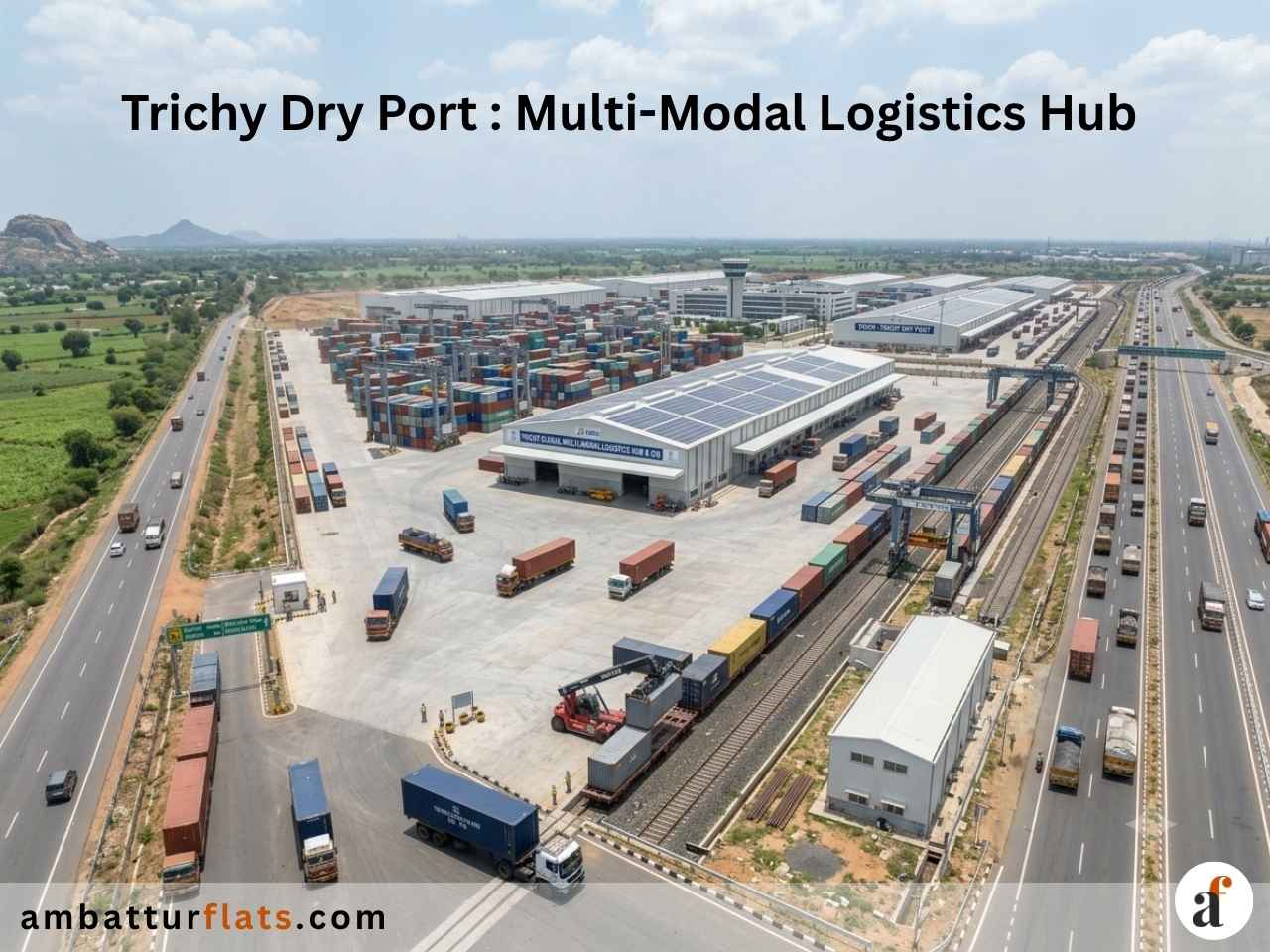

Disclaimer: This project is currently at the proposal and feasibility-study stage. Land sites, acreage, and timelines mentioned below are based on official statements and news reports available at the time of writing and may change as the project moves forward. Please verify current status before making any property or business decisions based on this announcement.
Project: Multi-Modal Logistics Hub (MMLH) and Inland Container Depot (ICD) /
Dry Port
Nodal agency: Tamil Nadu Industrial Development Corporation (TIDCO)
Status: In-principle approval granted by Centre and State; TIDCO executing detailed feasibility study
Likely location: Near Manapparai–Dindigul Highway, directly adjacent to or within existing SIPCOT industrial land
Land requirement: Initial 20 to 21 acres under evaluation (expandable up to 100 acres for future phases)
Acquisition method: Direct allocation of available SIPCOT land, supplemented by a land-pooling model for surrounding private parcels
Expected jobs: Over 12,500 direct jobs, with indirect employment reaching
many more
Key connectivity: Southern Railway network, national highways (NH 45 / NH 83), Trichy International Airport, and port links to
Tuticorin and Karaikal
Central push: State government has secured in-principle backing and approached the Union Finance Ministry for formal Inland Container Depot
(ICD) status
Tiruchirappalli sits almost at the geographic centre of Tamil Nadu, and that single fact explains most of the logic behind this proposal. The state's manufacturing and agricultural export base is spread across central and western districts—including Coimbatore, Karur, Erode, Ariyalur, Perambalur, Pudukkottai, and Thanjavur—while its major ports lie further south and east in Tuticorin, Chennai,
and Karaikal.
A logistics hub placed in Trichy sits midway between these industrial hubs and port nodes, significantly cutting the distance goods travel before reaching a port or a customs clearance point.
This isn't a new idea nationally. Similar dry ports and logistics parks have already come up in other states as part of the central government's push to reduce overall logistics costs and ease pressure on overloaded coastal ports. Tamil Nadu already has a much larger version of this concept underway near Chennai, which offers a useful comparison covered further below.
TIDCO is currently studying a few possible sites, with a location along the Manapparai–Dindigul Highway corridor seen as the strongest contender due to existing SIPCOT industrial infrastructure. A site here naturally aligns with the multi-modal design, sitting close to key rail lines and multi-lane highways for cargo movement.
To secure the required acreage without administrative delays, the state is evaluating a dual path: utilizing existing unallocated SIPCOT land while exploring a land pooling model for adjacent private parcels. Through land pooling, property owners contribute land to the infrastructure project and retain stakeholder equity in the developed zone, reducing the friction and delays common to traditional land acquisition.
The technical detail that matters most for regional enterprise is the proposed Inland Container Depot (ICD). Currently, a manufacturer in Karur, an engineering unit in Thuvakudi, or an agricultural exporter in Thanjavur must truck containers all the way to Chennai or Kochi for customs clearance. That routing adds substantial freight expense, transit time, and administrative friction.
An operational ICD at Trichy allows regional businesses to clear customs locally. State officials estimate this operational shift could reduce logistics expenses by up to 20 percent—a critical cost reduction for small and mid-sized exporters operating on narrow margins. Obtaining final clearance for full ICD status from the Union Finance Ministry remains one of the critical benchmarks ahead.
If established, the broader impact extends beyond warehousing. Global manufacturing companies prioritize robust customs and freight infrastructure when making site-selection decisions. A fully functioning dry port and ICD makes central Tamil Nadu significantly more competitive for foreign direct investment in electronics assembly, general engineering, cold-chain logistics, and food processing.
Tamil Nadu already has a Multi-Modal Logistics Park under development near Mappedu in Tiruvallur district. Comparing the two projects highlights their distinct scope and implementation models:
Mappedu (Chennai): Spans approximately 184 acres and operates as a central initiative under the Ministry of Road Transport and Highways (MoRTH) within a national grid of 35 planned logistics parks. Developed via a Special Purpose Vehicle (SPV) involving Reliance Industries and public agencies, it represents a thousand-crore-plus investment with a 45-year concession period, and initial ground construction is already underway.
Trichy Hub: Currently in the feasibility and site-selection stage led by TIDCO. It covers a smaller initial footprint of 20 to 21 acres. Rather than serving as a massive national freight consolidation center, Trichy's hub focuses on targeted regional execution—giving central Tamil Nadu's industrial units (textiles, engineering components, fabrication, and agriculture) direct local customs access.
Mappedu is a large-scale, centrally backed national transit park already under construction. Trichy is an targeted, state-led proposal designed for regional exporter accessibility. Understanding this difference in scale and development stage provides a realistic perspective on execution timelines.
A dedicated transport and freight hub changes surrounding traffic patterns in two distinct ways:
Positive Relief: A centralized hub consolidates freight operations off inner-city passenger routes. Instead of individual trucks making fragmented trips through urban roads, cargo is systematically organized at the node. Increased rail freight utilization further diverts long-haul container transport off key highways, easing regional congestion.
Localized Pressure: The immediate road arterial surrounding the site—particularly along the Manapparai highway junction—will experience higher localized truck volume and faster road wear from heavy axle loads. Secondary delivery routes feeding local industrial parks and e-commerce distribution centers will also see increased traffic.
Historically, transport and logistics infrastructure announcements trigger land value shifts well before physical construction begins. Speculative interest generally moves early around key nodes, followed by gradual price adjustments during planning stages, and more direct market shifts once site work commences. Areas along the Manapparai highway, alongside established industrial belts like Thuvakudi and Mathur, represent the primary zones likely to reflect this trend due to their
geographic proximity.
This price movement typically follows a clear sequence:
Commercial & Industrial Land: Logistics operators, warehousing developers, and light industrial buyers transact first to secure space adjacent to the planned hub.
Residential Land: Housing demand moves in subsequent phases as commercial operations scale up, generate regional employment,
and create local
housing requirements.
As direct and indirect employment expands around the hub, demand for housing along nearby commuting corridors is expected to adjust. The suburban stretches along the Trichy–Dindigul and Trichy–Madurai highways are positioned to lead this transition, moving from standalone land plots toward organized residential subdivisions designed for an incoming workforce.
Development activity in the initial phases will likely focus on affordable-to-mid-range apartments and plotted residential layouts, prioritizing commute efficiency and
utility over high-end
luxury developments.
Evaluating real estate near proposed infrastructure projects naturally involves balancing market opportunity against project risk.
The Incentive to Move Early: Driven by the objective to acquire land before price appreciation occurs as project milestones are met.
The Reason for Caution: Infrastructure projects routinely navigate complex timelines. ICD status approval, environmental clearances, final site boundary layout, and land pooling agreements require systematic progression before ground breaking occurs.
A practical approach involves monitoring key project milestones - such as site finalization, ICD regulatory approval, and land allocation updates - to accurately assess actual development velocity before taking action.
Trichy's hospitality market has traditionally been anchored by pilgrimage and cultural tourism. An operational dry port introduces a distinct commercial travel segment: logistics operators, supply chain managers, corporate auditors, customs officers, and industrial vendors.
This corporate activity typically drives demand for mid-scale and business-tier accommodations featuring meeting infrastructure, while encouraging the development of executive service spaces along highway access points near the airport and transport nodes.
If you are evaluating land or property options in the Tiruchirappalli region, keep these factors in mind while the proposal moves through official channels:
Verify Official Progress: Evaluate current land pricing against actual project milestones rather than speculative headlines.
Target Specific
Sub-Markets: Infrastructure impacts remain localized. Focus analysis on property directly linked to primary transit corridors like the Manapparai–Dindigul stretch rather than assuming uniform city-wide impacts.
Monitor Regulatory Clearances: Track the central government's formal ICD status designation, as this approval dictates the volume of international trade and industrial activity the
hub can support.
The proposed Trichy Multi-Modal Logistics Hub represents a major structural addition to central Tamil Nadu's industrial, export, and regional real estate framework. However, it remains a project in the active planning and feasibility stage. Tracking measurable progress over the coming months—rather than reacting solely to initial project announcements—provides the clearest foundation for sound property and business decisions.